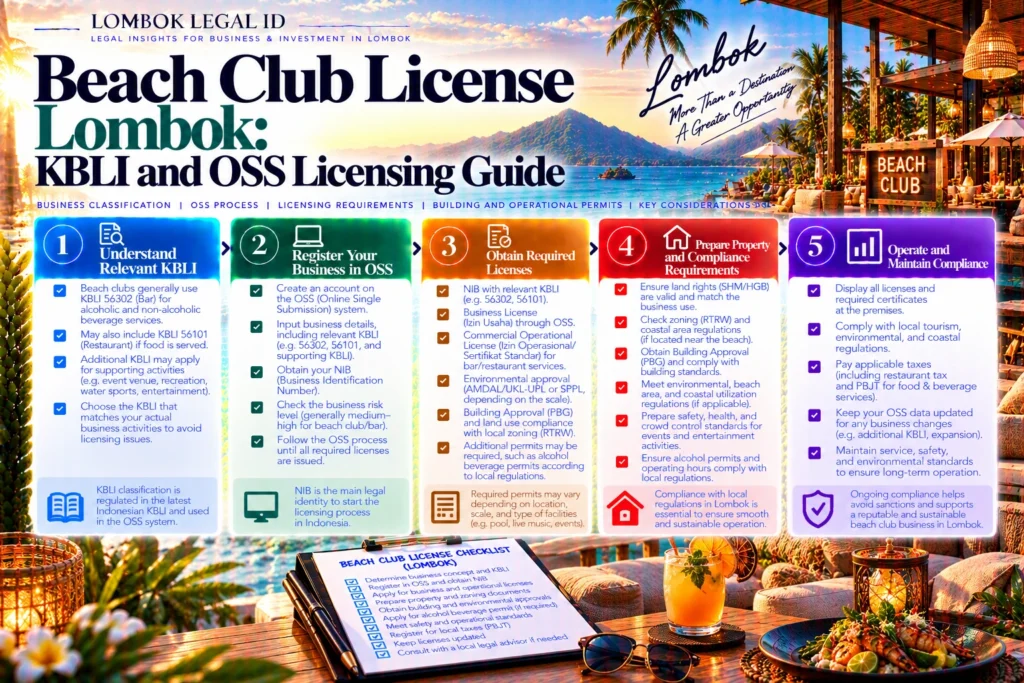
A beach club in Lombok should not be licensed by searching for one generic ‘beach club permit.’ The safer approach is to map what the business actually does: restaurant service, bar or cafe service, entertainment, water recreation, alcohol sales and any use of coastal or marine space.
Beach Club License Lombok: The Short Answer
The current OSS beverage-service classification places KBLI 56301 Aktivitas Bar, KBLI 56302 Aktivitas Kelab Malam atau Diskotek yang Utamanya Menyediakan Minuman and KBLI 56303 Aktivitas Rumah Minum/Kafe within subgroup 5630.
That structure is important because two businesses marketed as beach clubs may have different principal activities. One may primarily sell drinks and operate as a bar, another may be restaurant-led, while another may combine nightlife, water sports and food-and-beverage service.
Indonesia’s current risk-based licensing framework is Government Regulation No. 28 of 2025, which the official BPK database lists as in force.
The current framework places basic requirements, Business Licensing, PB UMKU and OSS services within risk-based business licensing under PP No. 28 of 2025.
The practical consequence is simple: classify the activities first, then review the licences generated for the actual project.
Step 1 — Identify the Beach Club’s Main Business Activity
Start with the revenue and guest experience rather than the brand name.
List the material activities separately: prepared food, alcoholic and nonalcoholic drinks, DJ or live-music entertainment, paid day access, pool or recreation facilities, events, water sports and accommodation if any. Then identify which company or business actor operates each activity.
Drink-led beach clubs should test the bar classification
Where the concept is principally built around serving drinks, KBLI 56301 is the first bar classification to test against the actual operation. If the model instead operates as a nightclub or diskotheque where drinks remain the principal service, KBLI 56302 may become relevant; a cafe-led concept should be compared with KBLI 56303.
OSS states that beverage-service activity can include entertainment such as live music, while diskotheques, dance floors and music venues where beverage service is not the main activity fall outside this subgroup under the current KBLI 2025 description.
That distinction prevents a beach club from assuming that one bar activity automatically covers every entertainment format it may introduce.
A substantial restaurant operation needs its own food-service review
Food service sits in a different branch.
The current OSS restaurant subgroup separates KBLI 56101 Aktivitas Penyediaan Makanan di Bangunan Tetap from KBLI 56102 Aktivitas Penyediaan Makanan di Bangunan Tidak Tetap.
A beach club with a permanent commercial kitchen and meaningful restaurant service should therefore review KBLI 56101 separately from its beverage activity rather than assuming the bar classification absorbs the restaurant.
For a deeper food-service classification review, Lombok Legal ID’s Restaurant KBLI guide addresses that activity separately.
Step 2 — Map Entertainment and Water Recreation Separately
Beach clubs often sell more than food and drinks. Paid events, DJ sessions, dance areas, surf activities, snorkeling, jet skis or boat-based recreation can change the activity map.
For entertainment or recreation that does not fit a more specific classification, OSS shows that KBLI 93299 continues one-to-one into KBLI 2025.
Do not add that code automatically. First establish whether the entertainment is merely ancillary to the restaurant or bar or whether the operator is running a separate material entertainment business.
Where a beach club itself operates water-based recreation, the current OSS Wisata Tirta classification uses KBLI 93297 for activities including surfing, parasailing, jet skiing, boating, snorkeling, diving and related water tourism.
If those activities are provided by an independent third-party operator, the contractual and licensing structure should reflect who actually supplies the service rather than automatically adding the activity to the beach club company.
Step 3 — Apply the Current OSS Licensing Framework
Once the activity map is clear, review the live OSS project under PP No. 28 of 2025.
Check the legal business actor, each registered KBLI, project location, current Business Licensing status and the PB UMKU attached to the material activities. Do not treat a copy of the NIB alone as proof that every food, drink, entertainment or recreation activity is covered.
The current tourism-sector standard is Minister of Tourism Regulation No. 6 of 2025, which the Ministry of Tourism JDIH lists as applicable and as repealing Ministerial Regulations No. 4 of 2021 and No. 8 of 2021.
An existing beach club built around older tourism licensing documents should therefore be checked against the current activity and standards framework before an acquisition, expansion or major change of concept.
Step 4 — Check the Beachfront Location and Basic Requirements
A beachfront commercial concept has an additional location question: does the business remain entirely on terrestrial property, or does any structure or activity use marine space?
The current OSS basic-requirements page separately identifies land spatial conformity, Kesesuaian Kegiatan Pemanfaatan Ruang Laut (KKPRL), environmental approval and building requirements.
For projects that actually occupy marine space, the Ministry of Marine Affairs and Fisheries states that KKPRL is a basic permit for persons or businesses conducting settled activities in marine space.
A beach view alone does not establish that KKPRL applies. Review the actual coordinates, structures and activities. A restaurant located on private land near the shoreline presents a different spatial question from a project with fixed structures or permanent commercial use extending into marine space.
The same caution applies to environmental and building compliance. The business activity and the physical site should be reviewed together rather than assuming that the OSS food-and-beverage activity resolves the land, environmental or building file.
Step 5 — Review Alcohol and Other PB UMKU
Alcohol sales can create supporting-permission requirements separate from the core restaurant or bar activity.
The OSS KBLI 56101 record confirms that code 56101 continues one-to-one into KBLI 2025 and lists hygiene-sanitation and alcoholic-beverage direct-sale permissions among its PB UMKU items.
The operator should therefore review the PB UMKU generated for the exact activities and product range rather than assuming every beach club requires the same alcohol permission.
The same principle applies to health, recreation and other supporting permissions: use the live OSS project and actual operation as the reference point.
Lombok Legal ID’s Restaurant PB UMKU guide can be used separately where the main issue is food-safety or trade-related supporting permissions.
Nine Checks Before Opening or Buying a Beach Club
Use this sequence before launch, acquisition or expansion:
- Define the commercial concept. Identify whether food, drinks, entertainment or recreation is the principal activity.
- Map restaurant activity. Review KBLI 56101 where fixed-building food service is material.
- Map beverage activity. Compare bar, nightclub and cafe classifications with the real service model.
- Map entertainment separately. Determine whether live music or events are ancillary or a separate material activity.
- Map water recreation. Check KBLI 93297 where the operator itself provides relevant water-tourism activities.
- Confirm the legal operator. Identify which person or company receives revenue and contracts with guests for each service.
- Review the live OSS project. Check Business Licensing and PB UMKU rather than relying only on an NIB or old licence file.
- Audit the beachfront location. Review spatial, environmental, building and any applicable marine-space requirements against the actual coordinates and structures.
- Recheck when the concept changes. Adding a bar, nightclub program, water sports or a larger restaurant can change the licensing architecture.
If the beach club forms part of a hostel operation, keep the accommodation layer separate. Lombok Legal ID’s Hostel License Lombok guide addresses the KBLI 55202 accommodation activity rather than the beach-club food, beverage and recreation activities.
Conclusion
A beach club license Lombok review is best approached as an activity map, not a search for one universal beach-club permit. A drink-led concept may need to test KBLI 56301, a substantial restaurant may require KBLI 56101, water recreation can introduce KBLI 93297, and separate entertainment activities may need additional classification.
Those activities then need to be connected to the current OSS project under PP No. 28 of 2025, current tourism standards and the physical beachfront location.
For owners and investors, the practical sequence is business concept → legal operator → KBLI activity map → OSS Business Licensing → PB UMKU → tourism standards → spatial, environmental, building and marine-space review.
Review the Beach Club Activity Map Before Opening
If you are establishing, acquiring or expanding a beach club in Lombok, Lombok Legal ID can assist with Business Setup and business-licensing review based on the actual food, beverage, entertainment, recreation and beachfront-use model.
A pre-opening or pre-acquisition review can help identify whether multiple KBLI activities, supporting permissions or coastal-location requirements need to be addressed before commercial operation.
For help coordinating the documents and next steps discussed above, review our business setup in Lombok.
Read More: Company Setup Guide in Lombok: Entity Choice, OSS and Launch Planning
FAQ Beach Club License Lombok
Is there one universal beach club licence in Indonesia?
A beach-club concept should be mapped from its actual activities rather than treated as one universal licence package. Restaurant, bar, cafe, entertainment, water recreation and alcohol sales can involve different OSS classifications and supporting permissions.
Which KBLI should a drink-led beach club check?
A business whose principal activity is bar-style beverage service should test KBLI 56301 Aktivitas Bar against its real operating model. Nightclub and cafe models have separate classifications within subgroup 5630.
Does a beach club restaurant need KBLI 56101?
Where fixed-building food service is a material activity, KBLI 56101 should be reviewed separately rather than assuming a beverage classification covers the restaurant.
What if the beach club offers jet skis, surfing or snorkeling?
Current OSS KBLI 93297 Wisata Tirta covers several water-tourism activities including surfing, parasailing, jet skiing, boating, snorkeling and diving. Review whether the beach-club operator itself provides those services or whether they are operated by a separate business.
Does every beachfront beach club need KKPRL?
Not merely because it is near the beach. KKPRL should be reviewed where the project or activity actually uses marine space. The project’s coordinates, structures and actual use determine whether the marine-space layer is relevant.
Does a beach club need an alcohol permission?
Alcohol-related PB UMKU should be checked where the business sells alcoholic beverages. The exact supporting permission depends on the actual activity and products shown in the OSS project.
Is an NIB enough for a beach club?
The complete OSS project should be reviewed for the applicable Business Licensing, PB UMKU and basic requirements. A beach club can combine several regulated activities, so an NIB alone should not be treated as proof that every component is covered.
References & Sources
- OSS KBLI 2025 – Beverage Service Activities — oss.go.id
- OSS KBLI 2025 – Restaurant and Mobile Food Activities — oss.go.id
- OSS Restaurant Activity and KBLI 56101 — oss.go.id
- OSS KBLI 2025 – Water Tourism — oss.go.id
- OSS – Other Entertainment and Recreation Activities — oss.go.id
- Government Regulation No. 28 of 2025 on Risk-Based Business Licensing — peraturan.bpk.go.id
- Minister of Tourism Regulation No. 6 of 2025 on Tourism Business Standards, Supervision and Administrative Sanctions — jdih.kemenpar.go.id
- OSS Basic Requirements – Land, Marine Space, Environmental and Building Requirements — oss.go.id
- KKP Guidance on Marine-Space Conformity Licensing — kkp.go.id