

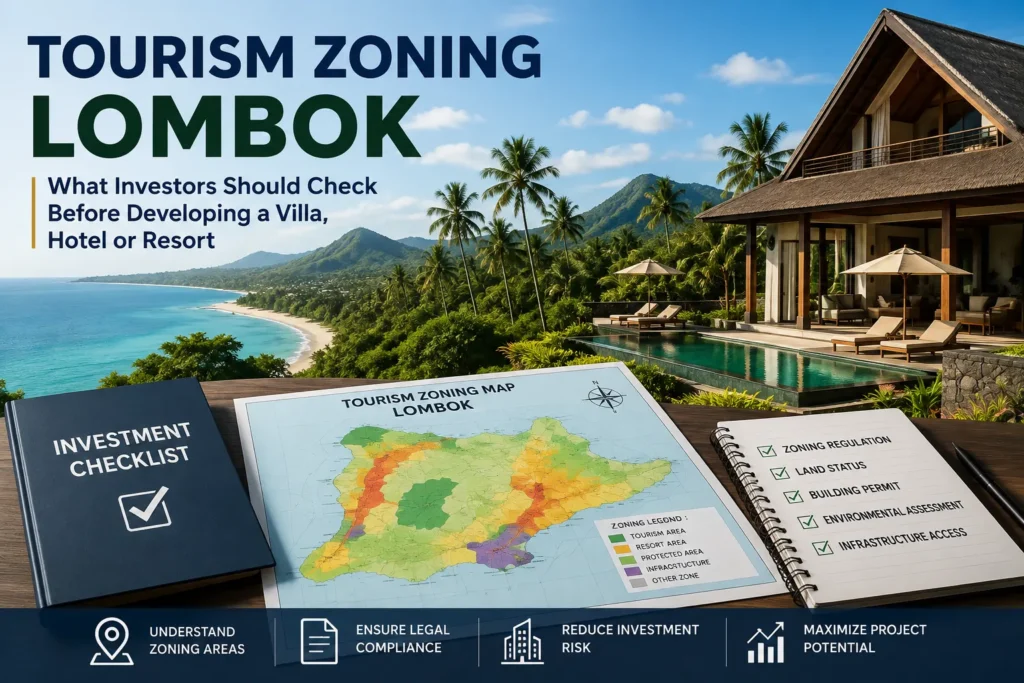
Land marketed for villas, resorts or hospitality projects in Lombok can look commercially attractive long before its legal development potential has been confirmed. For an investor, however, location, sea views and nearby tourism activity do not by themselves establish that the proposed project is spatially permitted.
A proper tourism zoning Lombok review asks a more precise question: does the intended use of this exact land parcel conform to the spatial plan and zoning rules currently applicable to that location?
Indonesia’s national spatial-planning framework is governed by Government Regulation No. 21 of 2021 on Spatial Planning Implementation. The regulation covers planning, spatial utilization, control and conformity between proposed activities and spatial plans. At provincial level, West Nusa Tenggara has its own RTRW, while more detailed land-use controls can be established through regency or city RTRW, RDTR and zoning regulations.
For investors, the practical lesson is simple: verify the legal spatial status before treating land as suitable for a tourism project.
For the broader planning framework, read our Company Setup Guide in Lombok. For help with your project, see our Business Setup services.
Tourism Zoning Lombok: What Does It Actually Mean?
The phrase “tourism zoning” is commonly used in property and investment discussions to describe land expected to accommodate tourism-related development. Legally, however, investors should rely on the applicable spatial-planning instruments rather than only on a marketing label.
A parcel may sit within a wider tourism-development area while still being affected by more detailed rules concerning permitted activities, building intensity, protected areas, infrastructure, environmental constraints or other spatial controls.
RTRW Sets the Broader Spatial Direction
RTRW, or *Rencana Tata Ruang Wilayah*, is the regional spatial plan. It establishes the broad structure and spatial pattern for a province, regency or city.
The current provincial framework is contained in NTB Provincial Regulation No. 5 of 2024 on the 2024–2044 Spatial Plan.
For an individual tourism investment, however, provincial-level planning is not necessarily detailed enough to answer every parcel-level question.
RDTR Provides More Detailed Spatial Rules
RDTR, or *Rencana Detail Tata Ruang*, provides more detailed spatial planning at the regency or city level and is accompanied by zoning regulations. The Ministry of Agrarian Affairs and Spatial Planning describes RDTR as a detailed spatial plan for a regency or city that includes zoning regulations.
Where an effective RDTR covers the proposed location, it can provide more specific information about what may be developed and under what spatial conditions.
KKPR Connects the Proposed Activity With the Spatial Plan
KKPR, or “Kesesuaian Kegiatan Pemanfaatan Ruang”, concerns conformity between a proposed spatial-utilization activity and the applicable spatial plan.
This distinction matters because knowing the general zoning category is not identical to confirming that a particular project, footprint and activity is spatially compatible.
Why a Tourism Label Is Not Enough
An investor should avoid assuming that a land listing described as “tourism zone” automatically authorizes any tourism project.
A hotel, villa complex, restaurant, beach club, resort and tourism attraction can involve different development characteristics and different business activities.
The Exact Project Still Matters
Spatial review should consider what will actually be developed, including matters such as:
- Intended land use
- Type of tourism activity
- Site coordinates and boundaries
- Proposed building footprint
- Access to the site
- Environmental or protected-area constraints
- Applicable local spatial rules
A zoning conclusion should therefore relate to a specific parcel and a defined project concept, not simply to the name of a village or tourism destination.
How to Check Tourism Zoning Before Buying or Leasing Land
For tourism investors, zoning due diligence should happen before a substantial deposit, long-term lease commitment or acquisition structure is finalized.
1. Identify the Exact Land Parcel
Obtain reliable information about the land location, boundaries and certificate or underlying land documentation.
Do not base the review only on a Google Maps pin, broker brochure or approximate village location.
2. Define the Intended Project
Be specific about what you plan to build and operate.
For example:
- Private villa
- Commercial rental villas
- Hotel
- Resort
- Restaurant
- Tourism attraction
- Mixed hospitality development
The intended use is essential because spatial conformity is assessed against an activity, not against an abstract investment idea.
3. Check the Applicable Spatial Plan
Identify the currently effective RTRW and, where available, RDTR and zoning regulations covering the parcel.
This step is particularly important because planning instruments can be revised. Official DPRD material from Central Lombok, for example, documented legislative discussion of a replacement RTRW for 2025–2045 in late 2025. Investors should therefore confirm which local instrument is legally effective at the time of the transaction rather than relying on an old zoning screenshot.
4. Check Spatial-Utilization Conformity
Determine what KKPR or related spatial-conformity process applies to the proposed activity and location.
The purpose is to establish whether the planned utilization of the land aligns with the applicable spatial plan before later licensing stages are treated as certain.
5. Record the Result in the Transaction Due Diligence
Zoning findings should be considered together with title and transaction documentation.
Lombok Legal ID‘s existing provides a broader explanation of zoning verification before purchasing land, while its cover land-document and zoning-related verification services.
Zoning Is Only One Part of Tourism Project Due Diligence
Suitable zoning does not by itself establish that a tourism development is ready to build or operate.
A complete review may also need to address separate issues such as:
- Land title and ownership status
- Encumbrances or disputes
- Legal access
- Lease or acquisition documentation
- Environmental requirements
- Building approvals
- Business entity structure
- KBLI classification
- OSS business licensing
- Tourism-sector operational requirements
This distinction is critical. Land-use compatibility, building legality and business-operation legality are related but separate questions.
For the ownership side of the transaction, investors can also review Lombok Legal ID’s land certificate checking guide.
Common Tourism Zoning Mistakes in Lombok
Relying on the Seller or Broker’s Statement
A statement that land is “tourism zoned” should be independently verified against official planning information.
Checking Only the Surrounding Area
The fact that nearby hotels or villas exist does not prove that the subject parcel has identical planning conditions.
Buying First and Checking Later
Discovering a spatial-use problem after signing a long lease or completing an acquisition can significantly weaken the investor’s position.
Treating Zoning as the Final Permit
Spatial conformity is an important part of development planning, but additional building, environmental and business permissions may still apply.
A Pre-Acquisition Checklist for Tourism Land
Before committing to tourism land in Lombok, investors should ideally confirm:
- Exact parcel and boundaries
- Current land certificate or underlying rights documentation
- Current RTRW applicable to the location
- Available RDTR and zoning provisions
- Spatial compatibility of the intended tourism activity
- KKPR pathway where applicable
- Access and infrastructure considerations
- Environmental and protected-area constraints
- Building-approval requirements
- Business structure and licensing pathway
- Terms of the purchase or lease agreement
A negative or uncertain result does not always mean that a project is impossible. It does mean that the issue should be understood before the investment price, development budget and transaction documents are finalized.
Conclusion
For a tourism investor, tourism zoning Lombok should be treated as a parcel-specific legal due-diligence question rather than a marketing category.
The strongest sequence is to define the proposed project, identify the exact parcel, verify the currently effective RTRW and RDTR, assess spatial-use conformity, and then coordinate zoning findings with land-title, building, environmental and business-licensing reviews.
Completing those checks before acquisition or a long-term lease provides a clearer basis for deciding whether the land actually supports the tourism project you intend to develop.
Verify the Land Before You Commit to a Tourism Project
A villa, hotel or resort project should begin with confirmation that the proposed use fits the land’s current spatial-planning status. Reviewing zoning together with land documentation and the intended development can identify material issues before they are built into the investment structure.
For a consultation on zoning, PPAT, property documentation or business setup in Lombok, discuss the proposed parcel and project with Lombok Legal ID before finalizing the transaction.
FAQ – Tourism Zoning Lombok
What does tourism zoning mean in Lombok?
Tourism zoning is commonly used to describe land intended or permitted for tourism-related development, but investors should verify the exact legal position through the currently effective RTRW, RDTR, zoning regulations and applicable spatial-conformity process.
Can I build a villa on any land described as a tourism zone?
Not automatically. The exact parcel, proposed use, applicable zoning rules, spatial-conformity requirements, building approvals and other regulatory conditions should be checked before development.
What is the difference between RTRW and RDTR?
RTRW provides the broader regional spatial-planning framework, while RDTR provides more detailed spatial planning and is accompanied by zoning regulations for the area it covers.
What is KKPR?
KKPR refers to conformity between a planned spatial-utilization activity and the applicable spatial plan. It is an important concept when determining whether a proposed business or development activity fits the spatial rules for a location.
Is a broker’s zoning map enough for due diligence?
No. Broker information can be useful for preliminary screening, but material investment decisions should be based on current official spatial-planning information and parcel-specific verification.
Does tourism zoning automatically allow a hotel or resort?
No. Zoning compatibility is only one part of the review. The project may also require building, environmental, business and sector-specific approvals depending on its characteristics.
Should zoning be checked before signing a land lease?
Yes. For a development-driven lease, verifying whether the intended activity can be carried out on the land before committing to a long-term agreement can help identify material restrictions early.
Can nearby hotels prove that my land has tourism zoning?
No. Nearby developments may be subject to different parcel boundaries, zoning provisions, historical approvals or project conditions. The subject parcel should be checked independently.
Is zoning the same across all of Lombok?
No. Lombok spans multiple local government jurisdictions, and relevant spatial-planning instruments can differ by regency and location. Investors should identify the plan that legally applies to the specific parcel.
What should I check in addition to zoning before buying tourism land?
A broader review can include certificate and ownership status, encumbrances, boundaries, access, transaction documentation, environmental restrictions, building requirements, corporate structure, KBLI and business licensing.
References & Sources
- Government Regulation No. 21 of 2021 on Spatial Planning Implementation – JDIH ATR/BPN
- NTB Provincial Regulation No. 5 of 2024 on the 2024–2044 Provincial Spatial Plan
- Ministry of Agrarian Affairs and Spatial Planning – Spatial Planning Information
- Central Lombok DPRD – Discussion of Draft RTRW 2025–2045