

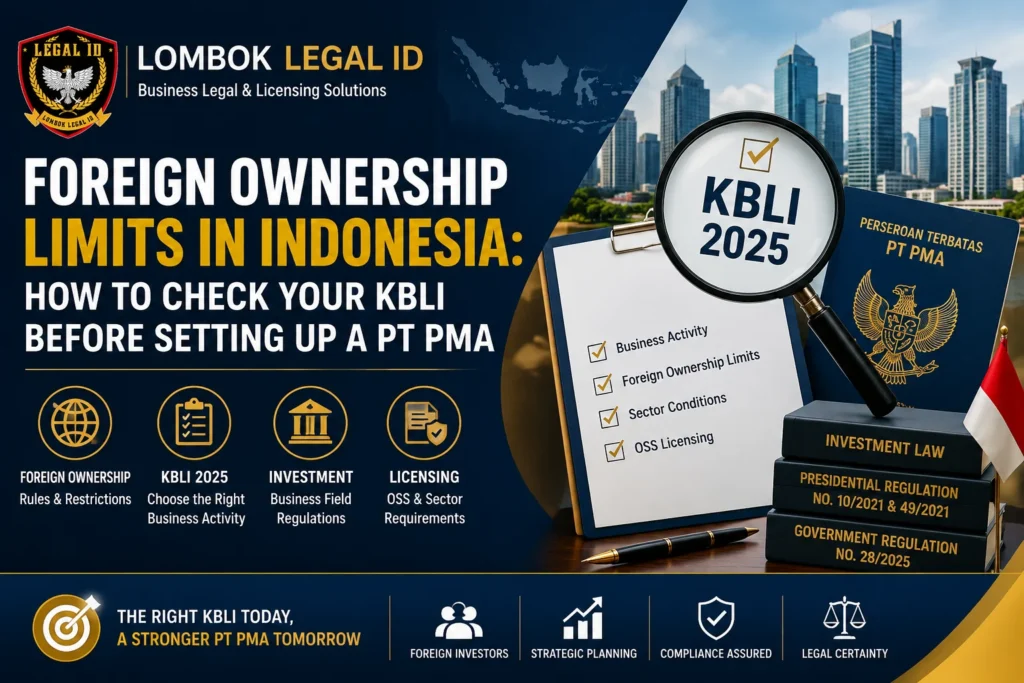
Foreign Ownership Limits Indonesia: Before setting up a PT PMA, a foreign investor should identify the company’s actual business activity, select the correct KBLI code, and check whether that activity is open to foreign investment and whether any ownership cap, special licensing condition, or other investment requirement applies.
As of August 2026, KBLI 2025 is the current Indonesian business-activity classification. Statistics Indonesia (BPS) issued KBLI 2025 through Regulation of BPS No. 7 of 2025, which is listed as in force, and the official OSS KBLI page now identifies the classification as KBLI 2025.
This matters because Indonesia’s foreign-investment rules under Presidential Regulation No. 10 of 2021, as amended by Presidential Regulation No. 49 of 2021, predate KBLI 2025. The amended regulation remains listed as in force and provides that commercial business fields are generally open to investment unless they are closed, reserved for activities carried out only by the Central Government, or subject to specific investment conditions. Those conditions can include foreign ownership limits, domestic-investor requirements, special licensing, or other sector-specific requirements.
The practical result is simple: do not decide whether your PT PMA can be 100% foreign-owned by looking only at a business description or an old KBLI list. You need to connect the current KBLI 2025 activity to the applicable investment and licensing rules.
Why KBLI Is Critical Before You Establish a PT PMA
KBLI, or Klasifikasi Baku Lapangan Usaha Indonesia, is Indonesia’s standard classification of economic activities. BPS issued KBLI 2025 to replace and update the previous classification so that new and changing business models can be classified more accurately.
For a PT PMA, the KBLI is not just an administrative code. It helps determine what the company is legally registered to do and connects the business activity with Indonesia’s OSS risk-based licensing system.
One company can have several KBLIs, but each must reflect a real activity
A PT PMA may carry out more than one business activity where legally permitted, but each selected KBLI should correspond to an activity the company genuinely intends to conduct. Map each revenue-generating or operational activity first, then select the KBLI whose official description most closely matches it.
The business description matters more than the code number alone
A five-digit KBLI code has an official title and description. Two activities that sound commercially similar may fall under different codes and different licensing requirements.
For example, “property services” could mean development, brokerage, management, accommodation, or consulting. Those are not necessarily the same legal activity. The correct KBLI should follow what the company will actually do, not merely how it markets itself.
The Current Foreign Ownership Framework
Presidential Regulation No. 10 of 2021, as amended by Presidential Regulation No. 49 of 2021, is the key investment-business-field framework used to determine whether a commercial activity is open to investment and whether conditions apply. The official BKPM legal database lists Presidential Regulation No. 49 of 2021 as in force.
Under the amended framework, commercial business fields are generally open to investment except for fields that are closed to investment or activities that can only be carried out by the Central Government. For business fields with specific conditions, the regulation expressly recognizes several types of requirements, including limits on foreign capital ownership and special licensing requirements.
“Open to investment” does not always mean 100% foreign ownership
This is one of the most important distinctions for a foreign investor.
A sector can be open to investment but still carry a condition. Depending on the activity, that condition may relate to:
- a maximum percentage of foreign share ownership;
- a requirement applicable to domestic investors;
- a special license or approval;
- restrictions under separate sector-specific legislation; or
- other investment conditions specified by regulation.
Therefore, the correct question is not simply, “Is this sector open?” It is:
“Is this exact KBLI activity open to my proposed foreign ownership percentage, at my proposed location, under the current investment and sector rules?”
Do not rely only on the phrase “Positive Investment List”
The phrase “Positive Investment List” is widely used in business discussions, but the operative legal references are the investment business-field regulations themselves—principally Presidential Regulation No. 10 of 2021 as amended by Presidential Regulation No. 49 of 2021, together with any applicable sector-specific rules.
For due diligence, work from the regulation, its annexes, current OSS data, and applicable sectoral rules.
KBLI 2025 Changed the Checking Process
KBLI 2025 was enacted in December 2025 through BPS Regulation No. 7 of 2025. BPS states that it updates the earlier KBLI framework to reflect changes in economic activities and business models.
In April 2026, BPS also explained the government’s transition mechanism from KBLI 2020 to KBLI 2025. The government prepared conversion tables, and BPS stated that existing business licenses issued before implementation of KBLI 2025 remain valid. Where the change is only a code conversion without a substantive change in the company’s purposes or scope of business, the adjustment can be handled through system conversion; substantive changes can require action through OSS/AHU.
Why this matters for a foreign ownership review
Presidential Regulations No. 10 and 49 of 2021 were issued before KBLI 2025. Because some KBLI codes were recoded, split, merged, or otherwise updated in the 2025 classification, a current foreign-investment review should not mechanically compare a new KBLI 2025 code against an older annex without checking the relevant conversion and the actual activity description. This is a practical inference from the timing of the regulations and the official 2020–2025 conversion process.
The safe approach is to confirm both the current KBLI 2025 classification and how the corresponding business activity is treated under the investment-business-field rules.
How to Check Your KBLI Before Setting Up a PT PMA
A practical pre-incorporation review can be completed in seven steps.
Step 1: Define the actual business activity
Start with what the company will actually sell, provide, manufacture, operate, manage, build, distribute, or develop.
Write a plain-English description of the activity before choosing a code. Note the product or service, customer, whether the company owns, manages, builds, sells, rents, or advises, the operating location, and any separate revenue-generating supporting activities. This reduces the risk of selecting a code based only on a similar-sounding title.
Step 2: Search the current KBLI 2025 classification
Use the official OSS KBLI 2025 directory and review the complete description of the candidate activity, not just the heading. The OSS page currently identifies the classification as KBLI 2025.
Check any exclusions or broader classification notes that affect the activity’s legal meaning.
Step 3: Check whether the activity is open to foreign investment
Next, review Presidential Regulation No. 10 of 2021 as amended by Presidential Regulation No. 49 of 2021 and identify whether the relevant business field is:
- generally open;
- subject to foreign ownership limits;
- subject to a special license;
- subject to another investment condition; or
- excluded from private investment under the applicable rules.
The amended regulation expressly provides for business fields with foreign-capital ownership restrictions and special licensing requirements.
Step 4: Account for the KBLI 2020-to-2025 conversion where necessary
Because the investment-business-field regulations were issued before KBLI 2025, check whether the activity’s code changed between KBLI 2020 and KBLI 2025.
BPS confirmed that the government prepared conversion tables between the two classifications and that OSS/AHU were to implement the adjustment mechanism.
If a KBLI 2025 code is new, split from an older code, or combines activities differently, legal review should focus on the underlying activity and applicable investment rule—not merely a code-to-code match.
Step 5: Check sector-specific regulations
Foreign ownership is only one layer. A business can be permitted for foreign investment and still require sector-specific approvals or qualifications concerning operations, technical standards, location, construction, environmental requirements, or professional qualifications. An “open” ownership result is therefore not the end of the licensing review.
Step 6: Check the OSS risk-based licensing requirements
Indonesia’s current overarching risk-based business licensing framework is Government Regulation No. 28 of 2025, which the BKPM legal database lists as in force.
OSS uses the business activity and its risk profile to determine the licensing pathway. The exact output can include an NIB, Standard Certificate, business license, or supporting business licenses depending on the activity and its regulatory classification.
For a practical explanation of the licensing stage after incorporation, see Lombok Legal ID’s NIB OSS RBA registration guide.
Step 7: Test the ownership structure and investment plan together
Finally, do not review foreign ownership separately from the company’s investment plan.
Under Minister of Investment and Downstream Industry/Head of BKPM Regulation No. 5 of 2025, a PMA is categorized as a large-scale business and is generally subject to a total investment value of more than IDR 10 billion, excluding land and buildings, per five-digit KBLI business field per project location, subject to specified exceptions and different calculation rules for certain sectors. The same regulation generally requires at least IDR 2.5 billion in placed/paid-up capital per PT PMA unless another rule provides otherwise.
This means the final feasibility check should combine:
- the intended shareholder percentages;
- the correct KBLI 2025 activity;
- the foreign ownership rule;
- the investment amount;
- the project location; and
- the licenses required to operate.
Common Mistakes Foreign Investors Make When Checking KBLI
Choosing a broad code because it appears easier
A broad-looking activity is not automatically safer. If the KBLI does not accurately describe the real business, licensing and later corporate or OSS updates can become more complicated.
Assuming 100% foreign ownership from a website summary
Third-party lists can be useful for orientation, but they may omit exceptions, sector-specific rules, or later classification changes. Verify the result against primary legal and OSS sources.
Checking ownership but ignoring licensing
Foreign ownership eligibility answers only whether the shareholding structure may be permitted. It does not establish that the business can immediately operate.
Risk-based licensing and sector-specific requirements remain separate questions under the current licensing framework. (official PP 28/2025 reference)
Using an old KBLI code without checking the 2025 classification
As of 2026, KBLI 2025 is the current classification and the official OSS KBLI page reflects it. Businesses and advisers should therefore check current classification data rather than rely solely on KBLI 2020 materials.
A Simple Decision Framework for Foreign Investors
Before proceeding with incorporation, use this checklist:
| Question | Why it matters |
|---|---|
| What exactly will the company do? | Determines the correct business classification |
| What is the current KBLI 2025 code? | Connects the activity to OSS and regulatory data |
| Did the code change from KBLI 2020? | May require conversion analysis when reading older investment rules |
| Is the activity open to foreign investment? | Determines whether PT PMA ownership is possible |
| Is foreign ownership capped or conditioned? | Determines the permitted shareholder structure |
| Is a special sector license required? | Determines whether ownership alone is sufficient |
| What is the risk-based licensing pathway? | Determines the OSS licensing outputs and prerequisites |
| Does the investment plan meet PMA requirements? | Helps test whether the proposed structure is viable |
Resolve unclear points before signing shareholder arrangements or finalizing the deed of establishment.
Read More: Business Setup Lombok: Complete Guide to Starting a Company in Indonesia
Why This Review Should Happen Before Incorporation
Changing a company structure after incorporation can require corporate amendments, OSS updates, and potentially additional regulatory steps. For that reason, the strongest sequence is:
activity → KBLI → foreign ownership check → investment plan → licensing map → incorporation.
Foreign investors considering a company in Lombok can first review the existing PT PMA setup guide for the broader incorporation process.
For projects that need a wider company-formation review, the verified business setup services cover PT PMA setup, PT PMDN setup, NIB/OSS registration, amendments, and related business-setup support.
Final Takeaway
Foreign ownership limits in Indonesia should be checked at the level of the actual business activity, not by assuming that every PT PMA can be wholly foreign-owned.
Start with the current KBLI 2025 classification, confirm how the activity is treated under Presidential Regulation No. 10 of 2021 as amended by Presidential Regulation No. 49 of 2021, account for the KBLI 2020-to-2025 conversion where relevant, and then check sector-specific and OSS licensing requirements.
Only after those points are clear should the shareholder percentages, investment value, and incorporation documents be finalized.
Verify Your KBLI and Foreign Ownership Structure Before Incorporation
A PT PMA structure should be designed around the actual business activity, the current KBLI 2025 classification, the permitted foreign ownership level, and the licenses the company will need to operate. Reviewing these points before the deed is finalized can reduce the risk of choosing a structure that later requires amendments or a different licensing path.
For the next step, review Lombok Legal ID’s verified business setup services and prepare your proposed activities, shareholder percentages, project location, and investment plan for a structured pre-incorporation review.
FAQ – Foreign Ownership Limits Indonesia
What is KBLI and why does it matter for a PT PMA?
KBLI is Indonesia’s standard classification of economic activities. For a PT PMA, the selected KBLI connects the company’s actual activity with investment restrictions and the OSS licensing framework. As of 2026, the current classification is KBLI 2025.
Is every business in Indonesia open to 100% foreign ownership?
No. The investment framework generally opens commercial business fields to investment, but some activities are closed, limited to Central Government activities, or subject to conditions such as foreign ownership limits, special licensing, or other requirements.
Which regulation should I check for foreign ownership limits?
The key business-field framework is Presidential Regulation No. 10 of 2021 as amended by Presidential Regulation No. 49 of 2021. The BKPM legal database currently lists the amending regulation as in force. Sector-specific laws and regulations may also apply.
Should I use KBLI 2020 or KBLI 2025 when setting up a new PT PMA?
Use the current KBLI 2025 classification. BPS Regulation No. 7 of 2025 is in force, and the official OSS KBLI page now displays KBLI 2025. Where older investment rules refer to classifications established before KBLI 2025, check the official conversion and the underlying business activity rather than relying only on the old code number.
What if my KBLI code changed from KBLI 2020 to KBLI 2025?
BPS confirmed a government conversion mechanism between KBLI 2020 and KBLI 2025. Existing licenses issued before implementation remain valid, and non-substantive code conversions may be handled through the system; a substantive change in the company’s purposes or scope of business can require further adjustment through OSS/AHU.
Can one PT PMA register more than one KBLI?
A company can have multiple business activities where legally permitted, but each selected KBLI should accurately represent an activity the company intends to conduct. Each activity should also be checked separately for investment and licensing implications.
Does an open KBLI automatically mean the business can start operating after incorporation?
No. Foreign-ownership eligibility and operational licensing are separate issues. Government Regulation No. 28 of 2025 governs the current risk-based business licensing framework, and the required OSS outputs depend on the activity and its regulatory risk classification.
What is the general minimum investment requirement for a PT PMA?
Under Minister of Investment and Downstream Industry/Head of BKPM Regulation No. 5 of 2025, PMA is generally categorized as large-scale business and generally requires total investment of more than IDR 10 billion, excluding land and buildings, per five-digit KBLI business field per project location. The regulation contains sector-specific exceptions and different calculation rules, so the requirement must be checked against the actual activity.
What is the general minimum paid-up capital for a PT PMA?
The same 2025 BKPM regulation generally requires minimum placed/paid-up capital of IDR 2.5 billion per limited liability company, unless another applicable regulation provides otherwise.
When should I verify the KBLI and foreign ownership percentage?
Do it before finalizing shareholder arrangements and incorporation documents. A practical sequence is to define the real activity, select the current KBLI, verify foreign ownership and sector conditions, map OSS licensing, test the investment plan, and then finalize the PT PMA structure.
Rujukan & Referensi
- BPS Regulation No. 7 of 2025 on the Indonesian Standard Industrial Classification (KBLI)
- Presidential Regulation No. 49 of 2021 amending Presidential Regulation No. 10 of 2021 on Investment Business Fields
- Government Regulation No. 28 of 2025 on Risk-Based Business Licensing
- Minister of Investment and Downstream Industry/Head of BKPM Regulation No. 5 of 2025
- BPS Announcement on Implementation of KBLI 2025 in Business Licensing
- Official OSS KBLI 2025 Directory