

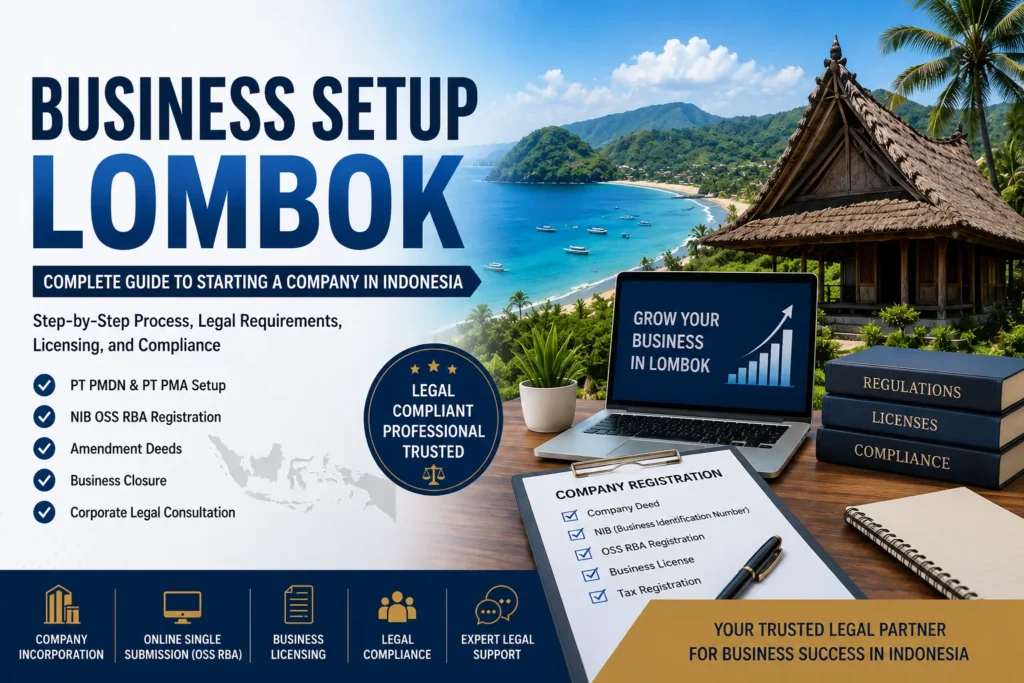
Starting a company in Lombok involves several connected decisions: who will own it, what it will do, where it will operate and which approvals must be completed before launch. This Company Setup Guide explains how to organize those decisions. Use the linked topic guides for detailed questions about foreign investment, incorporation documents and specific licenses.
A useful starting file describes the proposed activities, shareholders, management, premises and first operating phase. Preparing that file before incorporation can reveal an ownership restriction, unsuitable location or missing sector requirement while the plan can still be changed.
1. Define the business before choosing the entity
Describe the actual products and services, customers and source of revenue. Separate the company’s registered office from factories, accommodation premises, warehouses or other project locations. An address suitable for correspondence may not satisfy the requirements of the proposed operating site.
Discuss whether a domestic-investment PT, a foreign-investment PT PMA or another permitted entity route fits the owners and activities. Review the relevant eligibility requirements rather than selecting a structure solely for its advertised setup cost. The PT PMA versus PT PMDN comparison explains the ownership distinction.
2. Check activity and investment eligibility
Map each intended activity to the applicable KBLI description and current OSS requirements. Review foreign-ownership conditions where foreign investment is involved. Keep an explanation of how the registered activities relate to the business plan; copying a competitor’s activity code is an unreliable shortcut.
Investment value and paid-up capital are separate planning questions. Read the foreign ownership and KBLI guide and the PT PMA investment and paid-up capital guide for the detailed checks. Confirm the applicable requirements for the proposed activity before using figures in the financial plan.
3. Prepare the incorporation file
Agree the company name, shareholders, management, registered address, activities and proposed capital arrangements. Collect the identity and corporate records needed to verify the parties and signing authority. Documents issued overseas may require additional preparation; confirm the appointed professional’s requirements before scheduling signatures.
The incorporation route determines the deed and registration steps. Reconcile the issued company records with the agreed structure, and preserve the supporting documents. Use the PT PMA incorporation guide or the PT PMDN incorporation guide for the relevant document workflow.
4. Coordinate company records, tax registration and OSS
Keep the entity’s name, management, address and activities consistent across the relevant government records. Establish who controls the OSS account and who will retain submissions and respond to requests. Enter project information from the actual operating plan, rather than treating every location as the same record.
The NIB identifies the business through the applicable OSS registration process. Operating readiness must also be assessed against each activity’s risk-based requirements, basic requirements and supporting permissions. The NIB and OSS registration guide addresses that registration stage.
5. Identify what must be completed before operations
Create a launch checklist with a document, current status, responsible person and outstanding condition for each requirement. Distinguish company incorporation, business registration, premises suitability and sector approval. Review which activities are permitted during preparation and which require further verification or authorization before commercial operations.
For detailed OSS questions, use the medium-high risk standard certificate guide, high-risk licensing guide and spatial conformity guide. This company guide provides the overall sequence; those articles address the individual requirements.
6. Select the sector guide that matches the project
- Contractors: Business Certification Guide.
- Mining projects: Mining Licensing Guide.
- Manufacturing: Industrial Licensing Guide.
- Storage facilities: Warehouse Licensing Guide.
- Land acquisitions: Property and PPAT Guide.
- Contracts and signing preparation: Notarial Documents Guide.
- Accounting and reporting: Business Finance Guide.
7. Plan changes and ongoing compliance
After launch, assign responsibility for accounting, tax, applicable investment reporting and license conditions. Review amendments when ownership, management, activities or premises change. A change to the deed may need to be reflected in other systems; updating one record should not be assumed to update every record automatically.
If the business will close, assess the applicable corporate, creditor, employee, tax and licensing steps before removing activities from OSS. Maintain an evidence file for the closure process. The operational end date and completion of all legal obligations may be different milestones.
Questions to resolve before committing to an opening date
- Is the entity eligible for every intended activity?
- Are shareholder and signing documents ready?
- Does the actual operating site meet the relevant requirements?
- Which approvals or verifications remain outstanding?
- Who will manage accounts, reporting and updates after launch?
Estimate preparation and authority-review time separately. The schedule depends on file readiness and project requirements; incorporation alone is not a reliable opening-date forecast.
Discuss the incorporation work
For assistance with the company file, amendments or closure, see Business Setup services in Lombok. Provide the proposed activities, ownership and locations so the scope can be assessed.
Official starting point
OSS: current business licensing information and guidance. This guide provides a planning framework; confirm the current requirements for the entity and each project before filing.