

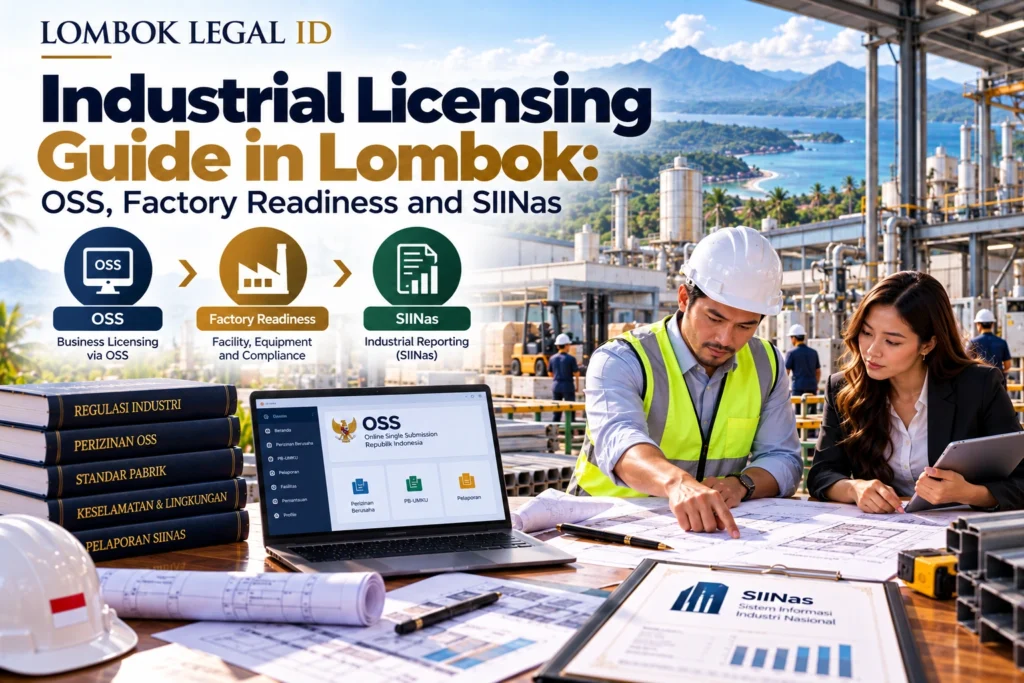
A manufacturing project in Lombok needs more than company incorporation and an NIB. The business should map the actual production activity, identify the correct OSS licensing route, confirm whether the proposed factory location is suitable, address environmental requirements and prepare for industrial reporting through SIINas.
This industrial licensing guide Lombok provides a practical sequence for owners and investors: define the manufacturing activity, align company and OSS records, check the risk-based licensing requirements, review the factory location, determine the environmental route, prepare the industrial project file and establish ongoing SIINas reporting.
Indonesia’s current overarching risk-based licensing framework is Government Regulation No. 28 of 2025 on Risk-Based Business Licensing. The regulation has been in force since 5 June 2025 and replaced Government Regulation No. 5 of 2021.
1. Define What the Factory Will Actually Do
Industrial licensing should begin with the production process rather than with a license name.
Prepare a written description covering:
- finished products
- raw materials and supporting materials
- production stages
- machinery and equipment
- planned production capacity
- workforce
- electricity, water and other utilities
- waste, emissions or wastewater generated by the process
- warehousing and distribution activities
Separate manufacturing from other activities such as trading, importing, warehousing, installation, repair or consulting. A company may conduct several activities, but each activity should be mapped to the current KBLI and OSS requirements applicable to the actual business model.
Do not select a KBLI merely because another manufacturer uses it. The classification should match what the company will actually produce and how the activity is carried out.
If the company is still being incorporated, use the Company Setup Guide in Lombok to coordinate ownership, entity structure, activities and operating locations before the industrial licensing file is finalized.
2. Align the Company, NIB and OSS Activity Records
The legal entity and the industrial project should tell the same story across the relevant records.
Check that the following are consistent:
- company name
- shareholder and management information
- registered address
- production location
- business activities
- relevant KBLI
- project data entered in OSS
The current OSS platform operates under the risk-based licensing framework and groups activities by risk level, with licensing obligations determined according to the applicable activity and project characteristics.
For the NIB stage, review the NIB OSS RBA Registration in Lombok guide before treating the NIB as evidence that all factory requirements are complete.
An NIB identifies the business within the OSS system, but it should not be treated as a universal authorization for every industrial project. The remaining licensing requirements depend on the relevant activity, risk level, basic requirements and sector-specific rules.
3. Check the Risk-Based Licensing Route Before Operations
Under Government Regulation No. 28 of 2025, risk-based licensing separates licensing requirements according to the risk level and applicable standards for the business activity.
A practical review should record:
| Licensing item | What to verify |
|---|---|
| NIB | Correct business entity, KBLI, location and project data |
| Risk level | Current OSS classification for the specific activity |
| Standard Certificate | Whether it applies and whether verification is required |
| Permit | Whether the activity requires a separate Permit before operational or commercial activity |
| Basic requirements | Spatial, environmental and building-related requirements where applicable |
| PB-UMKU | Supporting licensing required for particular activities, facilities, products or services |
For a high-risk industrial activity, do not assume that issuance of the NIB means the factory is commercially ready. The High-Risk OSS Licensing guide explains the distinction between the NIB, Permit requirements, authority verification and final Permit issuance.
4. Review the Factory Location Before Signing a Long-Term Lease
Factory location can affect whether an industrial project can proceed as planned.
Government Regulation No. 20 of 2024 on Industrial Zoning provides the current national framework for industrial zoning and industrial estates.
The regulation provides that an industrial company that will conduct industrial activities is generally required to locate within an Industrial Estate, while specified exceptions exist for particular circumstances and categories of industry. Certain exempt industrial companies must instead be located within a designated Industrial Allocation Area, or *Kawasan Peruntukan Industri*, where the regulation requires it.
This makes site review a key investment decision rather than an administrative step after the factory has already been leased or purchased.
Before committing to a location, review:
- exact parcel and address
- planned manufacturing activity
- applicable industrial-zoning position
- spatial conformity
- legal basis for using the premises
- existing building documentation
- factory layout
- loading and transport access
- utility capacity
- wastewater, emissions and waste handling needs
A lease clause stating that industrial use is allowed does not replace the regulatory review of the location.
5. Determine the Environmental Approval Route
Industrial projects should assess environmental requirements against the actual scale, activity, location and environmental impact.
Government Regulation No. 22 of 2021 on Environmental Protection and Management remains in force and provides the national framework for environmental approval.
The regulation requires businesses or activities with environmental impacts to follow the applicable environmental route and identifies Amdal, UKL-UPL and SPPL within that framework. Amdal applies to activities with significant environmental impacts, while the appropriate route for another project must be determined from the applicable criteria and project facts.
Do not assume that a small factory automatically has no environmental obligations or that every industrial project requires Amdal.
The environmental review should consider matters such as:
- production process
- production capacity
- wastewater
- air emissions
- noise
- waste generation
- hazardous materials where relevant
- water and energy use
- factory location
- surrounding environmental conditions
Environmental approval should be coordinated with OSS and site planning rather than treated as a document to address only after factory installation is complete.
6. Separate Industrial Licensing From Product-Specific Requirements
A factory can be properly registered as an industrial business while still facing additional requirements for its products or production process.
Depending on what is manufactured, review whether the project may involve separate requirements relating to:
- mandatory Indonesian National Standards
- food or beverage approvals
- product registration
- labeling
- import of raw materials or machinery
- technical standards
- hazardous or controlled materials
- product-specific PB-UMKU
Build a requirement matrix stating which items apply, which do not apply and the reason for each conclusion.
This prevents the team from assuming that one industrial license automatically covers every product manufactured or sold by the company.
7. Prepare the Industrial Project File Before Submission
A structured project file makes it easier to identify gaps before they become OSS or authority-review issues.
A practical readiness file can include:
| Area | Information to prepare |
|---|---|
| Company | Deed, legal-entity information, management and ownership |
| OSS | NIB, KBLI, project and location data |
| Production | Products, raw materials, process flow and capacity |
| Equipment | Machinery and supporting equipment |
| Factory | Address, layout, land or lease documents and building records |
| Spatial | Relevant location and industrial-zoning information |
| Environment | Applicable environmental documents and technical information |
| Utilities | Electricity, water and other major utility needs |
| Reporting | SIINas account responsibility and reporting records |
The exact statutory documents depend on the activity and project. This table is a preparation framework, not a universal attachment list.
SIINas Is Part of Ongoing Industrial Compliance
Industrial licensing does not end when OSS documents are issued.
Minister of Industry Regulation No. 13 of 2025 regulates the submission of industrial data, industrial-estate data and related information through the Sistem Informasi Industri Nasional, or SIINas. The regulation has been in force since 27 March 2025 and replaced Minister of Industry Regulation No. 2 of 2019.
The regulation requires industrial companies to submit accurate, complete and timely industrial data periodically through SIINas.
Kementerian Perindustrian’s official explanation of the 2025 regulation states that industrial reporting is now performed quarterly through SIINas rather than semi-annually. The regular deadlines described by the Ministry are 10 April for Quarter I, 10 July for Quarter II, 10 October for Quarter III and 10 January of the following year for Quarter IV. See the Ministry of Industry explanation of Permenperin 13/2025.
A company should assign responsibility for SIINas before the first reporting deadline rather than waiting until information needs to be reconstructed from accounting and factory records.
Data preparation may involve production, installed capacity, raw materials, workforce, utilities, machinery, investment and other information depending on the reporting category.
Build an Industrial Compliance Calendar
After operations begin, create a calendar that tracks obligations such as:
- OSS license conditions
- SIINas reporting
- environmental commitments
- relevant technical approvals
- product-related permissions
- corporate changes affecting OSS records
- factory expansion
- production-line changes
- changes in capacity
- relocation or additional production sites
Before adding machinery, expanding production or moving the factory, compare the proposed change against the current licensing, environmental and industrial records.
A modification to the business model can affect several systems at once. Updating one company record should not be assumed to update OSS, environmental documents or SIINas automatically.
Common Industrial Licensing Mistakes
Treating the NIB as the final factory license
The NIB is fundamental to the OSS process, but additional requirements can apply according to the activity and risk level.
Selecting KBLI without mapping the production process
The manufacturing classification should correspond to the real production activity, not merely to a competitor’s registration.
Signing the factory lease before checking the site
Industrial zoning, spatial conformity and environmental conditions can materially affect whether the premises are suitable.
Ignoring environmental requirements until machinery installation
Environmental approval and technical requirements may affect the project design and should be reviewed earlier.
Forgetting SIINas after licensing
Industrial reporting is an ongoing compliance obligation. Responsibility for data preparation and submission should be assigned from the start.
Mixing manufacturing and warehouse requirements
A factory may also operate storage or distribution facilities. Warehouse licensing should be reviewed separately where relevant instead of assuming that industrial licensing automatically resolves every storage requirement.
Frequently Asked Questions – Industrial Licensing Guide Lombok
Does a small factory only need an NIB?
Not necessarily. The relevant requirements depend on the actual industrial activity, its OSS risk classification, location, environmental route and applicable sector requirements. Business scale alone does not establish that the NIB is the only requirement.
Must every factory be inside an Industrial Estate?
Government Regulation No. 20 of 2024 establishes a general obligation for industrial companies to locate within an Industrial Estate, but the regulation also provides specified exceptions. The actual project should be tested against the exception provisions and applicable spatial planning before a location decision is made.
Does every factory need Amdal?
No. The environmental route depends on the project’s environmental impact and applicable criteria. Depending on the facts, the project may fall under Amdal, UKL-UPL or another applicable environmental route.
What is SIINas used for?
SIINas is the Ministry of Industry’s national industrial information system used for submission and management of industrial data and related information.
How often is industrial data reported through SIINas?
Under the current 2025 framework, the Ministry of Industry states that industrial data reporting is conducted quarterly. The applicable reporting category and required data should be checked for the specific industrial company.
Can production begin while a Permit or verification is still outstanding?
Do not assume so. The answer depends on the risk level, current OSS status and applicable Permit or Standard Certificate requirements. For a high-risk activity, the required Permit must be addressed before relying on the project as ready for operational or commercial activity.
Review the Factory Before Committing Capital
The strongest industrial licensing strategy starts before machinery is purchased or a long-term lease is signed.
Define the product and process, map the current KBLI, confirm the OSS risk-based licensing route, test the proposed factory location, determine the environmental pathway, identify product-specific requirements and prepare for SIINas reporting.
For industrial licensing assistance, review Industrial Licenses services at Lombok Legal ID. If the company is still at the business-registration stage, the NIB OSS RBA Registration in Lombok guide provides the appropriate starting point before the industrial-specific requirements are mapped.
This guide provides general information. Industrial licensing, site, environmental, reporting and product requirements should be verified against the actual manufacturing activity and the regulations in force when the project is implemented.