

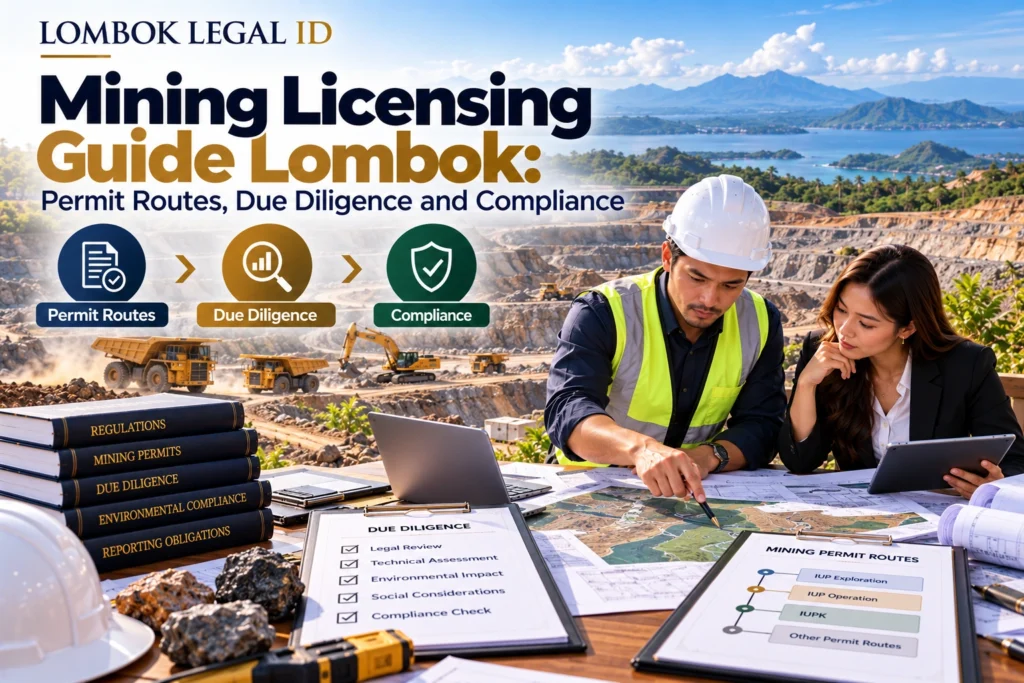
Mining licensing in Lombok should start with four facts: what activity will be performed, what commodity is involved, where the project is located and who will hold the authorization. Extraction, exploration, mining services and acquisition of an existing mining company involve different regulatory questions.
A company deed, NIB, land agreement or purchase of mining equipment does not by itself establish a right to extract minerals or rocks. The applicable mining authorization and area need to be confirmed separately.
This mining licensing guide Lombok provides a practical framework for identifying the permit route, checking the mining area, preparing an application, reviewing RKAB obligations and conducting due diligence before acquiring an existing mining business.
Indonesia’s current statutory framework includes Law No. 2 of 2025, the fourth amendment to the Mineral and Coal Mining Law. The current implementing framework also includes Government Regulation No. 39 of 2025, which amended Government Regulation No. 96 of 2021 for the second time. JDIH ESDM lists both PP 39/2025 and the current implementing regulations as in force.
1. Identify the Mining Activity Before Choosing a Permit
Do not begin by choosing a permit acronym from a service list. Begin by documenting what the applicant actually intends to do.
A project file should describe:
- commodity or material
- proposed coordinates and area
- exploration activity, if any
- extraction activity, if any
- processing or supporting activity
- transportation arrangements
- sales activity
- mining services performed for another permit holder
- applicant identity and ownership structure
These facts determine which mining authorization needs to be investigated.
IUP
IUP is one of the principal mining-business authorization routes within Indonesia’s mineral and coal framework. The application and operating position must be reviewed together with the relevant mining area, commodity and authorized stage.
Do not treat an IUP held for one area or stage as authority to conduct unrelated mining activity elsewhere.
IUPK
IUPK is a separate special mining-business authorization route. Its area and eligibility framework should be checked independently rather than treating it as an interchangeable alternative to IUP.
The current framework under PP 39/2025 includes updated rules concerning WIUP and WIUPK allocation and other mining-business implementation matters following the 2025 amendment to the Minerba Law.
IPR
IPR is the people’s mining authorization route. PP 39/2025 provides that IPR may be granted based on applications by local individual residents or cooperatives whose members are local residents.
The same regulation provides that an IPR application may only be submitted within an area that has been designated as a Wilayah Pertambangan Rakyat (WPR) and has the required WPR management document determined by the Minister.
This means a small-scale project should not assume that it qualifies for IPR merely because its production volume or land area is limited.
SIPB
SIPB remains a recognized authorization within the current mining framework and should be assessed for the specific rock-mining activity, applicant and area concerned.
Do not assume that every quarry, construction-material source or rock extraction project can automatically use the same permit route. The activity, material and location need to be mapped against the current rules before an application is prepared.
IUJP
IUJP concerns mining-services businesses rather than creating an independent extraction right for the contractor.
PP 39/2025 regulates the use of mining-services companies by IUP and IUPK holders and identifies mining-service fields including general investigation, exploration, feasibility study, mining construction, transportation and other mining-service activities within the applicable framework.
A contractor holding an IUJP should therefore not be treated as the mining-right holder merely because it performs work at the mine.
For assistance with route selection, review the live Mining Licenses services page before preparing the application file.
2. Verify the Mining Area Before Committing Capital
The mining right and the physical project need to correspond.
Prepare a location file containing:
- coordinates
- area map
- commodity
- proposed mining method
- applicant identity
- available mining-area documents
- land-access information
- relevant environmental information
A land lease, land purchase or agreement with a surface-right holder does not itself create a mining authorization.
This distinction is especially important for quarry and construction-material proposals. A project may have legal access to a parcel while still lacking the mining authorization necessary to extract material from it.
Before buying land, machinery or production equipment, verify the regulatory status of the proposed mining area and the permit route applicable to the commodity and applicant.
3. Separate Mining Rights From Land, Environmental and Forestry Issues
A mining authorization does not automatically replace every other approval or legal right required to operate the project.
Depending on the location, project review may need to consider:
- land access and surface rights
- spatial compatibility
- environmental approval
- forestry-area interfaces
- infrastructure access
- water requirements
- reclamation and post-mining obligations
These issues should be mapped separately rather than assuming that one permit resolves all project requirements.
Where the investor is acquiring land access or another property interest alongside the mining project, keep the property transaction and the mining-right analysis in separate due-diligence workstreams.
4. Prepare a Mining Licensing Readiness File
Once the permit route and project area are understood, build a structured application file.
A practical readiness matrix can include:
| Review area | Information to prepare |
|---|---|
| Applicant | Deed, legal-entity information, ownership and management |
| Business registration | NIB and relevant registered activities |
| Mining activity | Commodity, proposed stage and technical scope |
| Area | Coordinates, maps and applicable mining-area records |
| Technical | Project concept, technical documents and supporting specialists where required |
| Environment | Applicable environmental documents and commitments |
| Financial | Financial evidence required for the selected route |
| Compliance | Existing approvals, reporting and outstanding authority requests |
This table is a preparation framework, not a universal statutory attachment list. The exact documents and application sequence depend on the permit route and project.
If a new company must first be established, use the Company Setup Guide in Lombok before treating company incorporation as equivalent to mining approval.
5. Distinguish an Application From an Issued Mining Authorization
An application receipt, OSS status or submission confirmation should not automatically be treated as authority to begin mining.
Before relying on a mining authorization, verify material details such as:
- permit holder
- permit type
- commodity
- authorized area
- authorized stage
- effective and expiry information
- relevant conditions
- consistency with the project’s actual activity
For investors, this distinction matters before construction contracts, equipment purchases, financing or off-take commitments are made.
A project schedule should identify which regulatory conditions must be completed before each operational stage rather than assuming that all activities can begin once the company has entered the licensing system.
6. Treat RKAB as an Ongoing Operational Requirement
Mining compliance continues after the underlying authorization has been issued.
The current RKAB framework is governed by Minister of Energy and Mineral Resources Regulation No. 17 of 2025 as amended by Minister of Energy and Mineral Resources Regulation No. 6 of 2026. JDIH ESDM records Permen ESDM 6/2026 as promulgated on 12 June 2026.
The framework regulates preparation, submission and approval of the Rencana Kerja dan Anggaran Biaya (RKAB) as well as reporting on mineral and coal mining-business activities.
An operating compliance review should therefore examine the RKAB position together with the mine’s actual activity rather than checking only whether the principal mining permit exists.
PP 39/2025 also provides regulatory consequences for mining outside the applicable authorization or conducting mining without the required approved RKAB in circumstances covered by the regulation.
A practical compliance file should track:
- current RKAB status
- production and sales records
- technical obligations
- mining-safety obligations
- environmental commitments
- reclamation and post-mining obligations
- government payments where applicable
- required reports
- correspondence with the responsible authority
Do not allow one approved document to become the basis for assuming that all conditions for the next operational stage have been satisfied.
7. Conduct Mining Due Diligence Before an Acquisition
Buying shares in a mining company is not the same as acquiring an unquestionably usable mining project.
A buyer should verify the underlying mining right and current compliance before relying on the target’s equipment, production history, reserve presentation or seller representations.
The live Mining Due Diligence Acquisition guide provides a more detailed transaction framework. At minimum, the buyer should review:
Mining permit
Confirm the permit type, holder, commodity, area, stage, status and supporting amendments.
Mining area
Compare the legal mining area with pits, production locations, processing or stockpile areas, roads and other assets included in the transaction.
Corporate ownership
Check the target’s shareholders, management and proposed ownership changes against current mining-sector requirements.
RKAB and operating history
Compare approved or recorded work plans and reports with actual production, sales, investment and development activity.
Government obligations
Reconcile material government payment records and compliance evidence rather than relying only on financial statements supplied by the seller.
Reclamation and post-mining exposure
Review the relevant plans, guarantees, implementation records and unresolved obligations.
Environmental, land and forestry interfaces
Determine whether project operations depend on rights or approvals outside the mining permit itself.
A share acquisition does not erase historical compliance issues. Where an unresolved permit or area problem is fundamental to the investment thesis, the issue should be identified before transaction documents are finalized.
Mining Services and Mine Ownership Are Different
Investors and contractors should distinguish the company that holds the mining right from companies providing mining services.
Under PP 39/2025, IUP and IUPK holders may use mining-services companies within the regulated framework, and the regulation addresses activities performed by IUJP holders.
The service contractor’s authorization therefore does not automatically transfer the underlying mining right from the mine operator to the contractor.
Contracts should identify clearly:
- permit holder
- contractor
- activity performed by the contractor
- area where services are performed
- technical responsibility
- reporting responsibility
- supporting authorization relied on by each party
This separation is particularly important when evaluating a mining-services company whose revenue depends on contracts with third-party mine operators.
Current Regulatory Framework to Check
For a 2026 mining project, the legal review should not rely solely on older summaries prepared under the pre-2025 framework.
The current framework includes:
- Law No. 2 of 2025, which amended the Minerba Law for the fourth time
- Government Regulation No. 39 of 2025, the second amendment to PP 96/2021
- Minister of Energy and Mineral Resources Regulation No. 18 of 2025, which JDIH ESDM lists as an in-force Minerba implementing regulation
- Minister of Energy and Mineral Resources Regulation No. 6 of 2026, which amended the 2025 RKAB and reporting framework
Because mining rules are activity-, commodity-, area- and stage-specific, the project should be checked against the rules in force when the application or transaction occurs.
Frequently Asked Questions – Mining Licensing Guide Lombok
Does an NIB allow a company to start mining?
No. An NIB is part of the business-registration framework but should not be treated as the mining right itself. The applicable mining authorization, area and operational requirements must be checked separately.
Does owning the land give the owner the right to mine?
No. Land access and the right to conduct mining are separate legal questions. A landowner agreement or property transaction should not be treated as a substitute for the applicable mining authorization.
Can an IUJP holder extract minerals for itself?
IUJP is a mining-services authorization. The mining-right holder and the service contractor need to be distinguished. A service authorization should not be presented as the contractor’s independent right to own and operate the mine.
Who can apply for an IPR?
Under the current PP 39/2025 framework, IPR applications may be submitted by local individual residents or cooperatives whose members are local residents, and the application must relate to a designated WPR with the required WPR management document.
Is an approved mining permit enough to operate indefinitely?
No. Ongoing obligations can include RKAB, reporting, technical, safety, environmental, reclamation, financial and other requirements applicable to the permit and activity.
Should an investor verify the permit before buying a mining company?
Yes. The permit holder, area, commodity, authorized stage, RKAB position and other compliance records should be reconciled with the target company’s corporate and operational records before the buyer relies on the project description.
Review the Permit Route Before Funds Are Committed
The strongest mining licensing strategy begins before land, equipment or company shares are purchased.
Define the activity and commodity, confirm the proposed coordinates, identify the applicant, determine the relevant mining permit route and check the area’s regulatory status. For an operating project, add RKAB and ongoing compliance to the review. For an acquisition, reconcile the permit and mining area with the company being purchased.
For project-specific assistance, review Mining Licenses services at Lombok Legal ID. If the project involves acquiring an existing mining company, use the Mining Due Diligence Acquisition guide before relying on the seller’s permit and operational representations.
This guide provides general information. Mining authorization, area eligibility, applicant requirements, RKAB obligations and related approvals should be verified against the project’s commodity, coordinates, activity and stage under the regulations in force at the time of filing or investment.