

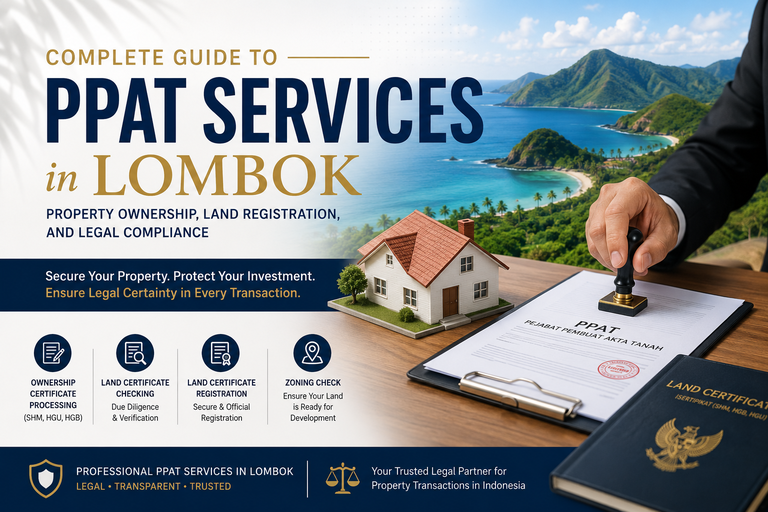
A land transaction in Lombok should begin with a review of the property, parties, proposed land right and intended use. This Property and PPAT Guide organizes the checks from initial due diligence to deed preparation and registration. It links to detailed articles for certificate records, zoning and individual land rights.
Keep three questions separate: can the proposed party hold the relevant right, can the transaction be completed on the available evidence, and can the property be used for the intended project? A favorable answer to one does not establish the others.
Identify the property and proposed transaction
Collect the location, certificate information, available survey records and the seller’s or other right-holder’s documents. Identify what is being acquired: an existing land right, a lease interest, shares in a company or another interest. The transaction structure determines which reviews and documents are needed.
For a foreign party or foreign-investment company, assess eligibility under the applicable structure before agreeing that a particular right will be transferred. Use the foreign property eligibility guide for that focused question. Do not infer eligibility from a seller’s assurance that other buyers have used the same arrangement.
Understand the land right before comparing properties
SHM, HGB and HGU represent different legal rights. Their purpose, eligible holders and applicable conditions need separate review. A certificate label should not be used as a shortcut for deciding whether a villa, hotel, agricultural operation or other project is suitable.
Use the SHM versus HGB versus HGU guide for the comparison. This pillar addresses the transaction sequence; the comparison article addresses the characteristics of the rights. Check the actual certificate and official records rather than relying on a marketing description such as freehold or commercial title.
Review certificate records and authority to transact
Arrange the appropriate certificate and land-office record checks. Review the registered holder, relevant encumbrances or restrictions and the documents supporting the proposed party’s authority. Identify any consents or further evidence needed before the transaction can proceed.
The land certificate checking guide explains that stage. Certificate checking is one part of the review; it does not independently establish physical boundaries, vacant possession, lawful access or every potential dispute. Record outstanding questions and who will verify them.
Check the site and the intended use
Compare the documented parcel with the physical site. Review access, occupation and the proposed use alongside spatial and building requirements. For a tourism development, warehouse or factory, use the precise location and activity rather than assuming nearby development proves that the same use is permitted.
Use the Lombok zoning check guide for spatial review and the tourism zoning guide where accommodation development is the specific issue. If buildings already exist, also assess the relevant building records and whether they match the actual premises.
Organize transaction conditions before payment
Create a list of required evidence, unresolved issues, completion conditions and the person responsible for each. Discuss when deposits or other payments become due, how a failed condition will be handled and which documents must be available at completion. Align those conditions with the actual checks and proposed deed route.
For a lease, use the leasehold due diligence checklist. For contractual drafting and signing preparation, use the Notarial Documents Guide. The contract and the property review serve connected but different purposes.
Coordinate the applicable land deed
A PPAT is authorized to prepare specified deeds concerning land rights. Confirm the appropriate official and deed route for the proposed legal act. Where the same individual also acts as a notary, distinguish the appointment used for each document.
For a sale and purchase, review the Akta Jual Beli (AJB) guide. Coordinate parties’ authority, the property file and applicable tax and consent requirements before the deed stage. A preliminary contract should not be treated as evidence that every deed or registration condition has been satisfied.
Track registration separately from signing
Confirm the required land-office submission, supporting records and responsibility for follow-up. Keep the submission evidence and check the final registered information against the intended transaction. Deed signing and completion of registration should appear as separate milestones in the transaction file.
Use the land certificate registration guide for that process. For applications concerning the relevant land right or certificate processing, see the certificate processing guide. Outstanding queries should be tracked until resolved rather than treated as automatic approval.
Keep an evidence-based property file
- Property identification, maps and available certificate records.
- Parties’ identity, company records and signing authority.
- Record-check results and outstanding consents or restrictions.
- Site, access, occupation and proposed-use review.
- Agreed completion conditions, deed records and registration evidence.
Processing time depends on the transaction, record completeness and required checks. Identify preparation and authority-review stages before setting a completion date. The review should make unresolved risk visible; it cannot guarantee that no later dispute will arise.
Discuss the property transaction
For assistance with certificate checks, land documents, registration or zoning coordination, see PPAT Services in Lombok. Provide the actual property records, proposed parties and intended use for an initial scope review.
Official references
- Government Regulation 18/2021: land rights and land registration.
- Directorate General of Taxes: the distinction between notary and PPAT roles.
This guide provides a transaction planning framework. Confirm the current requirements and competent official for the particular property and legal act.