

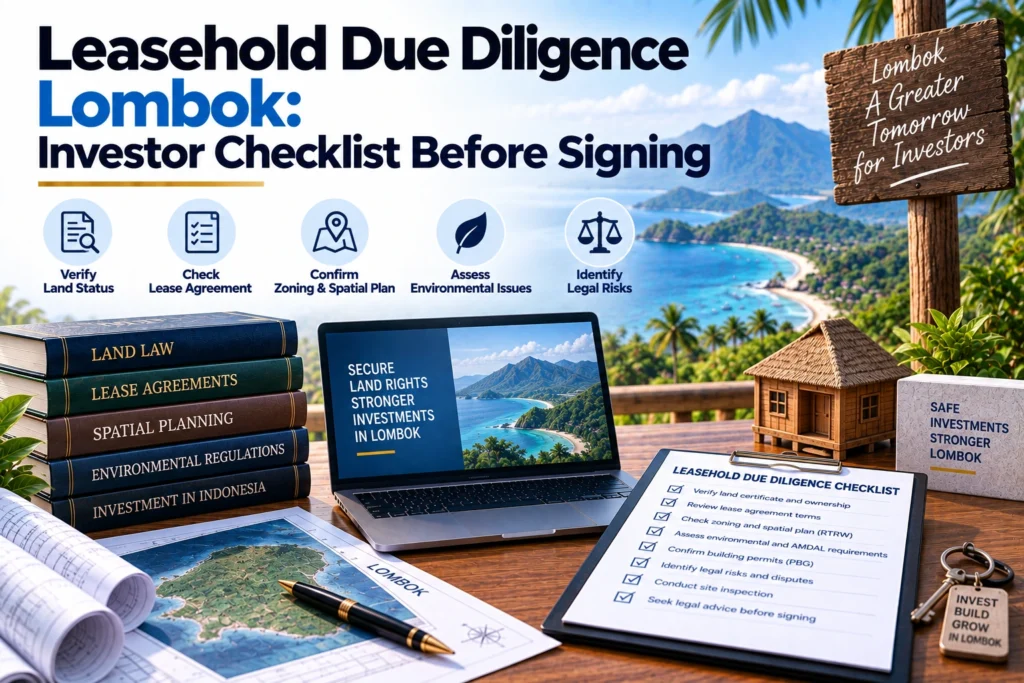
A leasehold due diligence Lombok review should answer more than whether the lease agreement looks professionally drafted. Before signing or paying a substantial deposit, an investor should verify that the landlord, registered land right, physical parcel, access, intended use, lease economics, construction rights, and exit provisions all describe the same workable investment.
That contractual right should not be confused with the underlying registered land-right position. The land-right background should also be checked against Law No. 5 of 1960 on Basic Agrarian Principles, which the BPK regulations database lists as in force.
Leasehold Due Diligence Lombok: What Should You Verify First?
Start with four questions:
- Does the proposed landlord have documented authority over the property?
- Does the land record match the parcel being offered?
- Can the property legally and practically support the intended use?
- Does the lease give the investor workable rights for the entire investment period?
If any one of these remains unclear, the investor should avoid treating the transaction as ready merely because the price and lease term have been agreed.
Leasehold Is a Contractual Use Arrangement, Not a Substitute for Title Review
A lease gives contractual use of property for the agreed period; it does not make certificate verification irrelevant.
Current land-right and registration review should also account for Government Regulation No. 18 of 2021, which remains in force and regulates land management rights, land rights, condominium units, and land registration.
The investor should therefore review two connected layers:
| Layer | Main Question |
|---|---|
| Underlying property | What registered right, holder, parcel and legal conditions exist? |
| Lease agreement | What use, duration, payment, renewal, construction, transfer and exit rights does the lessee receive? |
A strong lease draft cannot cure a fundamental mismatch between the party granting the lease and the property the investor believes is being leased.
9 Critical Leasehold Due Diligence Checks
1. Verify the Landlord’s Identity and Authority
Confirm who is actually granting the lease.
Review the identity of the certificate holder or other relevant right holder and determine whether the person signing acts personally, through a valid representative, or for a legal entity.
If several people appear to have rights or interests in the property, do not assume one signature is sufficient without checking the legal basis for that person’s authority.
The due-diligence file should explain why the proposed lessor can grant the promised use for the proposed period.
2. Verify the Underlying Land Right and Certificate
Request the available land certificate and supporting records before relying on the lease.
Check:
- name of the registered holder
- type of land right
- certificate number and parcel details
- relevant registration information
- available evidence of encumbrances or restrictions
- inconsistencies between documents supplied by the landlord
Lombok Legal ID’s verified PPAT Services Lombok guide includes certificate checking, property due diligence, zoning verification, and land-related support as relevant property-review areas.
3. Match the Certificate to the Physical Parcel
Investors should verify that the land shown during inspection is the same land described in the documentation.
Compare:
- parcel location
- stated area
- boundaries
- survey or map information where available
- buildings and improvements
- neighboring parcels
- access points
A document can be genuine while still not describing the exact area the investor believes is included in the lease.
Where boundaries are unclear, disputed, or commercially important, obtain appropriate survey or cadastral assistance rather than relying only on a visual site inspection.
4. Verify Legal and Practical Access
A valuable property can become difficult to operate if access depends on another parcel or an informal arrangement.
Review how the property connects to the public road and whether any access crossing third-party land is properly documented.
For a villa, hotel, restaurant, warehouse, or other operating business, also consider whether the physical access is commercially suitable for guests, deliveries, emergency access, construction, or utilities.
Access due diligence may therefore need both documentary review and physical inspection.
5. Check Zoning and Intended Use
Do not separate the lease from the project the investor intends to operate.
A long-term lease for land that cannot support the planned activity can be commercially ineffective even when the landlord and certificate are genuine.
The verified PPAT Services Lombok guide identifies zoning verification as a property due-diligence issue. For a specific site, current spatial-planning information and project-specific licensing requirements should be checked before the investor commits to construction or commercial use.
Do not assume that an existing building, neighboring business, or seller statement proves that the intended future use is permitted.
6. Review the Lease Term and Extension Formula
The headline lease duration is only part of the economic deal.
Review:
- commencement date
- expiry date
- handover date
- extension option
- notice deadline
- method for setting extension rent
- who can exercise the option
- whether the extension binds successors where legally effective
An extension clause saying that the parties “may agree later” is commercially different from a clause with a defined mechanism or formula.
If the investment depends on operating beyond the initial period, model the extension risk before valuing the leasehold.
7. Review Construction, Alteration and Building Rights
Investors planning a villa, hospitality project, restaurant, or other development should know what the lease allows them to do with the property.
The agreement should address, where relevant:
- construction and renovation permission
- responsibility for permits
- financing of improvements
- ownership or treatment of improvements during the term
- removal of movable assets
- treatment of buildings at expiry
- restoration obligations
The exact construction allocation should nevertheless be drafted for the actual transaction rather than assumed from general lease rules.
8. Review Assignment, Sublease and Corporate Use
If the investment may later be sold, refinanced, transferred to a company, operated by a management entity, or subleased, check whether the agreement permits the required structure.
Relevant questions include:
- Can the lease be assigned?
- Is landlord consent required?
- Can the property be subleased?
- Can a PT PMA or other operating company use the property?
- What happens if the lessee’s company changes ownership?
- Can the investor transfer the business together with the lease?
These rights can materially affect exit value and should be negotiated before the investment is built around the lease.
9. Review Payment, Default and Exit Protection
Large upfront payments increase the importance of conditions and remedies.
Before releasing material funds, review:
- deposit amount
- payment milestones
- conditions that must be satisfied before payment
- refund provisions if due diligence fails
- landlord default
- lessee default
- cure periods
- early termination
- property damage or loss
- inability to obtain required project approvals
- treatment of prepaid rent on termination
- dispute resolution
Where the project requires licensing, construction, or financing, consider whether the lease should make key payments conditional on specified verification or approvals.
Leasehold Due Diligence Red-Flag Matrix
The following matrix helps convert findings into decisions rather than merely collecting documents.
| Finding | Initial Response |
|---|---|
| Landlord does not match documented right holder | Stop payment and verify authority |
| Certificate or parcel description is inconsistent | Obtain land and boundary clarification |
| Access depends on undocumented third-party land | Resolve access before signing |
| Intended use is not verified | Complete spatial and licensing review |
| Extension price is entirely undefined | Reassess long-term economics or renegotiate |
| Construction rights are unclear | Clarify lease and project responsibilities |
| Assignment or sublease is prohibited | Test whether the restriction conflicts with the exit plan |
| Large rent is prepaid before verification | Consider conditions, escrow-style controls where appropriate, or revised milestones |
| Material title, dispute, or boundary concern remains unresolved | Escalate to specialist review or reconsider the transaction |
The objective is not to make every issue fatal. It is to distinguish correctable drafting points from defects that change the economics or viability of the investment.
Documents to Request Before Signing
A leasehold due-diligence data room may include, depending on the property:
Land and Party Documents
- land certificate or available evidence of the underlying right
- identity documents of the proposed landlord
- corporate documents where a legal entity is involved
- powers of attorney or representation documents where applicable
- parcel maps or survey material
Property and Project Documents
- existing building documents where relevant
- spatial or zoning information
- access documentation
- utility information where material
- development or construction plans
Transaction Documents
- draft lease
- payment schedule
- extension terms
- side letters
- broker or intermediary agreements where relevant
- proposed assignment, sublease, management, or operating arrangements
Lombok Legal ID’s verified Notary Services in Lombok guide covers land lease agreements, agreement documentation, certificate verification, and property due diligence as part of its published property-document support.
Conclusion
Leasehold due diligence in Lombok should verify both the property and the contract before the investor commits substantial funds.
Proceed when the proposed landlord’s authority is clear, the land documents and physical parcel align, access and intended use are workable, and the lease gives commercially usable rights for the planned investment period.
Renegotiate where extension economics, construction rights, assignment, sublease, payment conditions, or exit rights are too uncertain. Require specialist land, survey, zoning, corporate, notarial, PPAT, or licensing review where the risk falls outside a straightforward contract check. Reconsider the transaction where a fundamental title, authority, access, or parcel issue cannot be resolved before signing.
Verify the Property Before You Commit to the Lease
A long-term lease can support a substantial property or hospitality investment, but the contract should not be signed in isolation from the land certificate, landlord authority, parcel, access, intended use, and project structure.
For lease documents, certificate verification, property due diligence, or PPAT and notarial coordination in Lombok, discuss the transaction with Lombok Legal ID and review the verified PPAT Services Lombok guide before committing material funds.
FAQ – Leasehold Due Diligence Lombok
What is leasehold due diligence in Lombok?
It is a pre-signing review of the proposed landlord, underlying land right, certificate, parcel, access, intended use, lease terms, extension rights, construction provisions, transfer rights, payment structure, and material legal risks.
Is checking the lease agreement enough?
No. The lease should be reviewed together with the underlying property documents and the investor’s intended project. A well-written lease does not resolve a mismatch in landlord authority, parcel identity, access, or land status.
What should be checked on the land certificate?
The review should confirm the holder, type of land right, parcel information, registration details, and any available information relevant to restrictions, encumbrances, disputes, or inconsistencies with the property being offered.
Why is the lease extension clause important?
For a long-term investment, value may depend on operating beyond the initial term. The investor should understand whether the extension is a defined contractual option or only a future negotiation and how the extension price will be determined.
Should access be checked before signing a Lombok lease?
Yes. Investors should confirm both physical access and the documentary basis for any access that crosses third-party property, especially where the project depends on guests, deliveries, construction vehicles, utilities, or emergency access.
Should zoning be checked for a leasehold property?
Yes when the investment depends on a particular development or commercial use. The current site-specific spatial and licensing position should be checked rather than inferred from neighboring buildings or the landlord’s description.
Can leasehold due diligence guarantee that a property investment is safe?
No. Due diligence can identify and clarify legal and documentary risks, but technical, survey, environmental, tax, construction, financing, and business risks may require separate specialist review.
References & Sources
- Supreme Court of Indonesia – Termination of Lease Agreements
- Law No. 5 of 1960 on Basic Agrarian Principles
- Government Regulation No. 18 of 2021 on Land Rights and Land Registration