

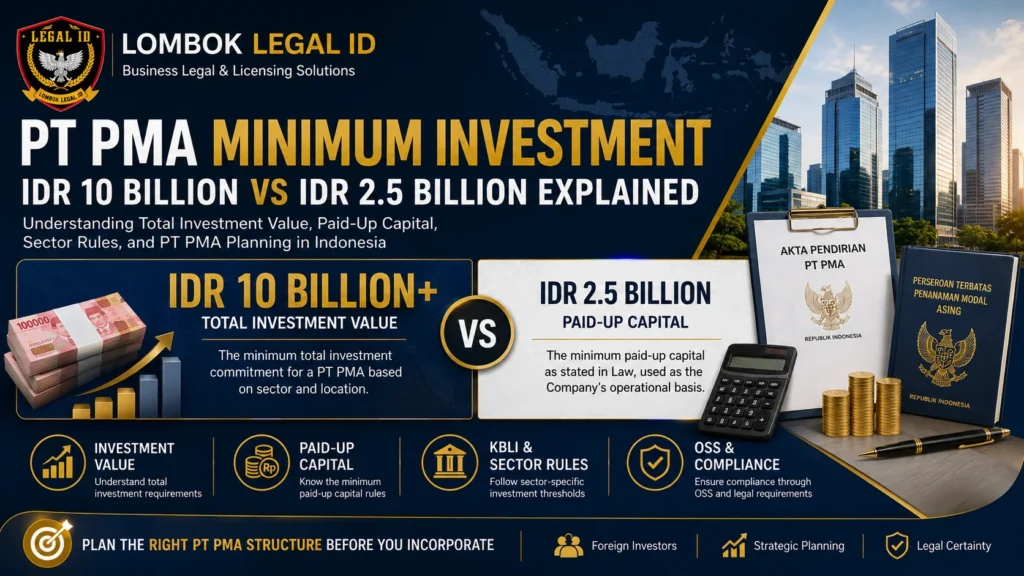
PT PMA Minimum Investment: Foreign investors setting up a company in Indonesia frequently encounter two numbers: IDR 10 billion and IDR 2.5 billion. They are often treated as if they describe the same PT PMA capital requirement. They do not.
Under Indonesia’s current investment framework, the general rule is that a foreign investment company must plan a total investment value of more than IDR 10 billion, subject to the applicable calculation method and exceptions. Separately, a PT PMA established as a limited liability company is generally required to have at least IDR 2.5 billion in placed and paid-up capital per company, unless another regulation provides otherwise.
These rules appear in Minister of Investment and Downstream Industry/Head of BKPM Regulation No. 5 of 2025, which the official BKPM legal database currently lists as in force.
The practical difference is critical: IDR 2.5 billion is not a reduced version of the IDR 10 billion investment requirement. One relates to corporate capital; the other relates to the scale and value of the investment project.
PT PMA Minimum Investment and Paid-Up Capital: Why the Two Numbers Are Different
The easiest way to understand the rule is to separate the two concepts from the beginning.
| Requirement | General Rule | What It Measures |
|---|---|---|
| PT PMA investment value | More than IDR 10 billion | Total investment in the relevant business activity/project |
| PT PMA placed/paid-up capital | At least IDR 2.5 billion | Capital placed and paid into the PT PMA |
The PT PMA minimum investment and paid-up capital requirements therefore operate together rather than replacing one another.
A company may have IDR 2.5 billion in paid-up capital while planning a substantially larger investment in equipment, fit-out, machinery, operating infrastructure, development costs, or other investment components. The applicable components depend on the activity and the specific calculation rules.
Indonesia’s consolidated Investment Law provides the broader legal framework for foreign investment, while Regulation No. 5 of 2025 provides important current implementation rules concerning investment value, capital, and OSS procedures.
PT PMA Minimum Investment: Understanding the More-Than-IDR-10-Billion Rule
Article 26 of Regulation No. 5 of 2025 categorizes PMA businesses as large-scale businesses and requires them to comply with minimum investment-value requirements unless another regulation provides otherwise.
PT PMA Minimum Investment Is Generally More Than IDR 10 Billion
The general rule is total investment of more than IDR 10 billion, excluding land and buildings, per five-digit KBLI business field per project location.
The wording “more than IDR 10 billion” matters. It should not be simplified into a statement that the minimum is exactly IDR 10 billion.
Three elements are particularly important:
- KBLI — the calculation is generally connected to a five-digit business classification.
- Project location — the general calculation is applied per project location.
- Land and buildings — these are generally excluded, but important sector-specific exceptions exist.
This means an investor should not establish a PT PMA using only a company-wide headline budget. The investment plan should first be mapped against the company’s actual KBLI activities and project locations.
PT PMA Paid-Up Capital: Why IDR 2.5 Billion Does Not Replace the Investment Test
The same regulation separately requires a PT PMA in limited liability company form to maintain minimum placed/paid-up capital of at least IDR 2.5 billion per PT, unless another applicable regulation provides otherwise.
This is a corporate capital requirement. It does not mean a foreign investor can plan only IDR 2.5 billion of total investment where the more-than-IDR-10-billion investment rule applies.
For incorporation planning, think of the requirements as two different questions:
- Investment test: Is the planned project investment sufficient under the PMA rules?
- Capital test: Does the company have the required placed and paid-up capital?
Both should be checked before the corporate structure and OSS investment data are finalized.
How the IDR 10 Billion Investment Value Is Calculated
The general five-digit-KBLI-per-project-location formula is not applied identically to every sector. Regulation No. 5 of 2025 specifies several alternative calculation methods.
Wholesale Trade
For wholesale trade, the more-than-IDR-10-billion investment calculation, excluding land and buildings, is applied based on the first four digits of the KBLI rather than the general five-digit rule.
This can materially affect companies planning several related wholesale activities.
Food and Beverage Services
For food and beverage services, the threshold is calculated based on the first two digits of the KBLI per one location point, excluding land and buildings.
The regulation further states that, for this provision, the location point applies per regency or city.
A restaurant or food-service investor should therefore map the intended locations before assuming how the investment threshold will be calculated.
Construction Services
For construction services, the investment threshold is calculated based on the first four digits of the KBLI, excluding land and buildings.
This is different from simply multiplying the threshold by every individual five-digit construction code.
Industrial Activities
For industrial activities producing different types or varieties of products within one production line, the regulation also provides a special investment calculation approach rather than applying the general rule mechanically to each activity.
These distinctions demonstrate why selecting KBLI codes solely for incorporation purposes can create problems. The selected activities can affect both licensing and investment-value calculations.
Property and Accommodation Require Special Attention
Property and hospitality projects deserve particular attention for investors considering Lombok because the treatment of land and buildings differs from the general rule.
Under Regulation No. 5 of 2025, where a PMA carries out specified activities including:
- property development, sale, and/or rental;
- short-term or long-term accommodation;
- agriculture;
- plantations;
- livestock; and
- aquaculture,
the investment-value criteria can include land and buildings.
Property Development Has Additional Calculation Rules
For development and operation of property, the regulation distinguishes between different project structures.
Where the project involves an entire building or an integrated residential complex, the more-than-IDR-10-billion investment value may include land and buildings.
Where property units are not within one entire building or one integrated residential complex, the regulation provides a different treatment under which the relevant investment value is calculated outside land and buildings.
For a villa, resort, accommodation, or property project, this makes it particularly important to determine the actual business model before preparing the investment plan.
A developer, accommodation operator, property manager, and property trader may have commercially related activities but should not automatically be treated as having the same investment calculation.
Other Special Investment Calculations
Regulation No. 5 of 2025 also contains rules for activities that do not fit the standard calculation.
For example, development and operation of public electric vehicle charging stations is subject to an investment calculation within one province.
Activities located in certain Special Economic Zones are subject to the investment-value provisions under the applicable presidential regulation concerning investment business fields.
These exceptions are a strong reason to conduct a project-specific assessment rather than relying on the statement “every PT PMA needs IDR 10 billion.”
The more accurate statement is that PMA generally requires total investment of more than IDR 10 billion, but the calculation basis and exceptions depend on the business activity, KBLI, project location, and applicable special rules.
What Happens to the IDR 2.5 Billion After It Is Paid In?
Another common misunderstanding is that paid-up capital must remain permanently frozen and unusable in the company’s bank account.
That is not an accurate description of the current rule.
Regulation No. 5 of 2025 provides that the placed/paid-up capital covered by the provision may not be transferred from the business entity’s account for at least 12 months from the date it is placed or paid, except for specified business purposes.
The Regulation Allows Certain Business Uses
The permitted purposes stated in the regulation include:
- purchasing assets;
- construction of buildings; and/or
- business operations.
In other words, the rule should not be interpreted as requiring IDR 2.5 billion to sit untouched as idle cash for 12 months.
The important issue is that capital movement and use should correspond to legitimate business purposes and the applicable OSS commitments.
The regulation also provides for a self-declaration commitment when the business applies for business licensing through OSS.
Foreign investors should therefore plan both how the capital will enter the PT PMA and how it will be deployed after incorporation.
Practical Examples: IDR 10 Billion vs IDR 2.5 Billion
The following simplified examples illustrate the distinction. They are not substitutes for a KBLI-specific legal review.
Example 1: Foreign-Owned Consulting Company
Assume a foreign investor establishes a consulting PT PMA with one relevant five-digit KBLI at one project location and no special sector exception.
The structure would generally need to address:
- investment value of more than IDR 10 billion, excluding land and buildings; and
- placed/paid-up capital of at least IDR 2.5 billion per PT.
The IDR 2.5 billion forms part of the company’s capital structure but does not convert the total investment test into IDR 2.5 billion.
Example 2: Accommodation Project in Lombok
Assume a PT PMA plans a qualifying accommodation business.
Because accommodation is specifically addressed in the regulation, land and buildings can be included when applying the relevant investment-value criteria.
This is materially different from applying the standard exclusion of land and buildings without further review.
The investor should still verify the KBLI, location, ownership eligibility, licensing, and exact project structure before finalizing the investment plan.
For the broader company establishment process, Lombok Legal ID’s PT PMA setup guide for foreign investors provides a separate overview of incorporation, OSS registration, NIB, and business licensing.
Example 3: Restaurant or Food-Service Business
For food and beverage services, the regulation applies the more-than-IDR-10-billion threshold using the first two digits of the KBLI per location point, with the location-point rule applied per regency or city.
A company planning several food-service activities should therefore map its KBLI activities and locations before calculating the investment requirement.
PT PMA Minimum Investment and Paid-Up Capital Are Also Different From Operating Costs
An investment plan is not simply a forecast of monthly expenditure.
Investors should distinguish among:
- total investment value;
- corporate paid-up capital;
- asset purchases;
- building and fit-out expenditure;
- operating expenditure;
- working capital; and
- ongoing business revenue and expenses.
The classification of expenditure should be reviewed in the context of the actual project and OSS investment data rather than estimated only from the amount of money expected to be spent during the first month of operations.
Read More: Business Setup Lombok: Complete Guide to Starting a Company in Indonesia
Common PT PMA Capital Planning Mistakes
Mistake 1: Assuming IDR 2.5 Billion Replaced the IDR 10 Billion Rule
This is the most important misconception to avoid.
The 2025 regulation establishes a minimum paid-up-capital rule and a separate investment-value rule. The lower figure does not automatically replace the higher investment test.
Mistake 2: Treating IDR 10 Billion as an Exact Universal Number
The regulation generally says more than IDR 10 billion, not exactly IDR 10 billion, and the calculation varies for specified sectors.
Mistake 3: Ignoring Multiple KBLIs
Under the general rule, investment value is linked to a five-digit KBLI business field per project location. Adding activities without considering their investment implications can therefore materially change the investment plan.
Mistake 4: Automatically Excluding Land and Buildings
The general rule excludes land and buildings, but property, accommodation, agriculture, plantations, livestock, and aquaculture receive different treatment.
Mistake 5: Treating Paid-Up Capital as Frozen Cash
The regulation restricts transfers for at least 12 months but expressly allows specified uses for assets, building construction, and business operations.
Mistake 6: Planning Capital Without Checking Foreign Ownership
Meeting the investment threshold does not automatically make a business activity eligible for the proposed foreign ownership percentage.
Foreign investors should separately verify the business field under Indonesia’s investment-business-field framework, including Presidential Regulation No. 49 of 2021, which amends Presidential Regulation No. 10 of 2021.
PT PMA Capital Planning Before OSS Registration
Before finalizing the deed and OSS investment data, prepare a structured investment review.
Step 1: Identify the Actual Business Activities
Determine exactly what the company will sell, operate, manage, manufacture, develop, or provide.
Step 2: Confirm the KBLI
Map every genuine business activity to the current KBLI classification and determine whether several KBLI activities are necessary.
Step 3: Verify Foreign Ownership
Confirm whether each business activity permits the proposed level of foreign ownership and whether sector-specific conditions apply.
Step 4: Map the Project Locations
The number and location of projects can affect the investment calculation.
Step 5: Determine the Applicable Investment Formula
Identify whether the general five-digit-KBLI rule applies or whether the activity falls within a specific exception for wholesale, food and beverage, construction, industry, property, accommodation, agriculture, or another regulated category.
Step 6: Prepare the Paid-Up-Capital Structure
Confirm that the PT PMA’s placed/paid-up capital meets the applicable minimum and is consistent with the company’s incorporation documents and investment strategy.
Step 7: Map the Licensing Requirements
Capital compliance does not replace business licensing. Indonesia’s current risk-based business licensing framework is governed by Government Regulation No. 28 of 2025.
The resulting licensing requirements depend on the activity and its risk classification. Lombok Legal ID’s NIB OSS RBA registration guide explains the licensing stage separately.
Final Takeaway
The most important point about PT PMA minimum investment and paid-up capital is that IDR 10 billion and IDR 2.5 billion measure different things.
Under the current general rule, a PMA must plan total investment of more than IDR 10 billion, subject to the applicable KBLI, location, sector calculation, and exceptions. A PT PMA must separately maintain at least IDR 2.5 billion in placed/paid-up capital per limited liability company, unless another regulation applies.
For many investors, particularly those entering hospitality, property, restaurants, construction, trading, or multi-location businesses, the investment calculation cannot safely be determined from the two headline numbers alone.
The stronger sequence is:
business activity → KBLI → foreign ownership review → investment-value calculation → capital structure → project location → OSS licensing.
Completing those checks before incorporation makes it easier to design the PT PMA around the actual business project rather than correcting the structure after registration.
Review Your PT PMA Investment Plan Before Finalizing the Company
The IDR 10 billion investment test and IDR 2.5 billion paid-up-capital requirement should be reviewed together with your KBLI, foreign ownership percentage, project location, and licensing requirements. A pre-incorporation review can help identify which investment calculation applies before the deed and OSS data are finalized.
For a practical next step, review Lombok Legal ID’s business setup services for PT PMA investors and prepare your proposed shareholders, KBLI activities, project locations, and investment budget for assessment.
FAQ – PT PMA minimum investment
What is the minimum investment for a PT PMA in Indonesia?
Under Minister of Investment and Downstream Industry/Head of BKPM Regulation No. 5 of 2025, the general PMA rule is total investment of more than IDR 10 billion, excluding land and buildings, per five-digit KBLI business field per project location. Specific sectors have different calculation rules and exceptions.
Is the PT PMA minimum investment IDR 10 billion or IDR 2.5 billion?
They are separate requirements. More than IDR 10 billion generally refers to total PMA investment value, while IDR 2.5 billion is the general minimum placed/paid-up capital requirement per PT PMA, unless another regulation provides otherwise.
Does IDR 2.5 billion paid-up capital replace the IDR 10 billion investment requirement?
No. Regulation No. 5 of 2025 provides separate rules for minimum investment value and minimum placed/paid-up capital. Compliance with the paid-up-capital requirement does not by itself satisfy the total investment-value requirement.
Is the PT PMA investment requirement exactly IDR 10 billion?
The regulation generally states that total investment must be more than IDR 10 billion. It should therefore not be described as an exact IDR 10 billion minimum without qualification.
Are land and buildings included in the IDR 10 billion calculation?
Generally, land and buildings are excluded. However, Regulation No. 5 of 2025 provides different treatment for specified activities including property, accommodation, agriculture, plantations, livestock, and aquaculture. The actual activity must therefore be checked before calculating the threshold.
Does every KBLI require a separate IDR 10 billion investment?
The general rule is based on a five-digit KBLI business field per project location, but important exceptions apply. Wholesale trade, food and beverage services, construction, and certain industrial activities use different calculation bases.
Can the IDR 2.5 billion paid-up capital be used by the company?
The current regulation restricts transfer of the relevant placed/paid-up capital from the business entity’s account for at least 12 months, but expressly provides exceptions for purchasing assets, constructing buildings, and business operations. It should therefore not be described simply as cash that must remain untouched.
How is the PT PMA investment threshold calculated for restaurants?
For food and beverage services, Regulation No. 5 of 2025 applies the more-than-IDR-10-billion threshold, excluding land and buildings, based on the first two digits of the KBLI per one location point. For this provision, the location point is applied per regency or city.
How is the investment requirement calculated for a hotel or accommodation PT PMA?
Accommodation activities receive special treatment under Regulation No. 5 of 2025, including treatment of land and buildings in the investment-value criteria. The exact calculation should be reviewed against the KBLI, project structure, property arrangement, and location.
Should the investment plan be checked before establishing the PT PMA?
Yes. Investors should ideally confirm the business activities, KBLI, foreign ownership eligibility, project locations, applicable investment calculation, paid-up capital, and OSS licensing requirements before finalizing incorporation and investment data.
References & Sources
- Minister of Investment and Downstream Industry/Head of BKPM Regulation No. 5 of 2025
- Government Regulation No. 28 of 2025 on Risk-Based Business Licensing
- Consolidated Law No. 25 of 2007 on Investment with Law No. 6 of 2023
- Presidential Regulation No. 49 of 2021 on Investment Business Fields
Related Articles
- complete PT PMA setup guide for foreign investors
- NIB OSS RBA registration and business licensing guide