

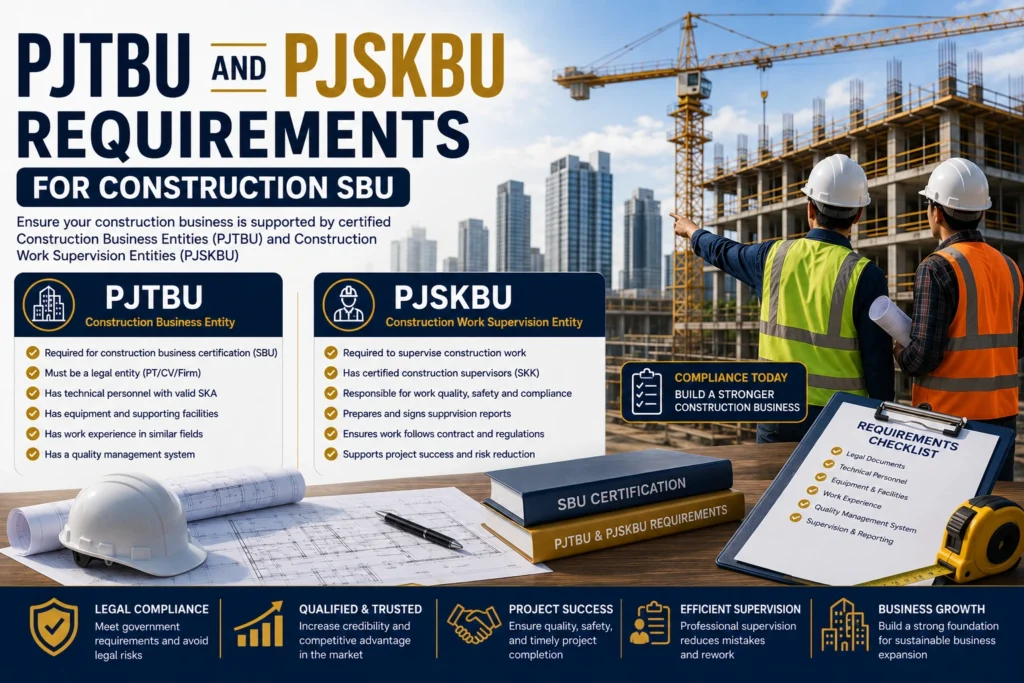
The main PJTBU and PJSKBU Requirements for Construction SBU are not simply to appoint two people. A construction business must map its personnel to the SBU scope it is requesting, ensure the relevant construction workers are permanent personnel of the BUJK, avoid prohibited simultaneous positions at another BUJK, and make sure PJSKBU coverage matches the company’s sub-classifications.
Under Minister of Public Works and Housing Regulation No. 8 of 2022, the Construction SBU personnel assessment includes the availability of Penanggung Jawab Badan Usaha (PJBU), Penanggung Jawab Teknis Badan Usaha (PJTBU) and/or Penanggung Jawab Subklasifikasi Badan Usaha (PJSKBU).
Construction certification also sits within Indonesia’s current wider licensing framework under Government Regulation No. 28 of 2025.
PJTBU and PJSKBU Requirements for Construction SBU: The Short Answer
A practical company-level checklist is:
- Identify the SBU classification, sub-classifications and qualification being requested
- Determine the PJTBU required for the business certification structure
- Map PJSKBU coverage to the company’s sub-classifications
- Confirm that personnel are permanent workers of the BUJK
- Check that they do not hold prohibited simultaneous positions at another BUJK
- Verify that the relevant competency and field of knowledge fit the construction scope
- Check whether one PJSKBU is being assigned to more sub-classifications than permitted
The personnel plan should therefore be built from the intended SBU scope, not assembled after the business has already selected multiple sub-classifications.
PJTBU vs PJSKBU: What Is the Difference?
PJTBU and PJSKBU are both part of the construction-worker availability assessment for business certification, but they are not interchangeable labels.
PJTBU means *Penanggung Jawab Teknis Badan Usaha*. It belongs to the technical-responsibility layer of the construction business entity.
PJSKBU means *Penanggung Jawab Subklasifikasi Badan Usaha*. Its availability is directly assessed against the number and qualification of the sub-classifications held by the company.
For PJSKBU, Article 13 ties the personnel assessment to the number and qualification of the business entity’s sub-classifications.
That distinction matters when a BUJK expands from one construction sub-classification to several. The company’s personnel capacity may need to change with the certification scope.
Permanent Worker and No-Dual-Position Rule
The personnel used for SBU capability assessment cannot simply be borrowed temporarily from another construction company.
The same Article 13 personnel rule states that the construction workers assessed for this purpose are permanent workers of the BUJK and may not simultaneously hold a position at another BUJK.
Why This Should Be Checked Early
A candidate can have relevant technical competence but still create a problem for the SBU application if that person’s employment or role at another BUJK conflicts with the personnel requirement.
Before relying on a PJTBU or PJSKBU, the company should therefore verify both competency and current organisational status.
This is especially important when recruiting personnel who have previously supported another contractor’s SBU.
How Many PJSKBU Does a Construction Company Need?
The answer depends on the company’s certification scope rather than a universal one-person rule.
The regulation provides that one PJSKBU may cover a maximum of five sub-classifications within one classification for one BUJK.
This creates an important planning limit.
A company requesting several related sub-classifications within one classification may be able to allocate them to one eligible PJSKBU within the permitted maximum. But that does not mean the same person can automatically cover unlimited sub-classifications or different classifications.
Example of the Planning Logic
Suppose a construction company wants to expand its SBU scope. The useful questions are not only how many sub-classifications it wants, but also:
- Are the sub-classifications within the same classification?
- Does the proposed PJSKBU have the appropriate competency and field of knowledge?
- Would the person’s assigned coverage exceed five sub-classifications?
- Does another PJSKBU need to be added before the SBU scope is expanded?
This is why personnel mapping should happen before the company finalises its certification expansion plan.
SKK and Field-of-Knowledge Alignment
An SKK Construction should not be treated as universally suitable for every PJTBU or PJSKBU position.
A PJSKBU must have the field of knowledge corresponding to the relevant construction-services business sub-classification, as mapped in the regulation’s annex.
The exact competency level required can also depend on the type of construction activity, business qualification and sub-classification. For that reason, it is safer to map the proposed SBU scope first and then verify the person’s SKK and professional discipline against that scope rather than applying one universal SKK level to every BUJK.
For readers who need the individual competency route itself, Lombok Legal ID maintains a verified Building Construction SKK service page.
Limited PJSKBU Exception for Certain Small BUJK
There is a narrow exception that should not be turned into a general shortcut.
The regulation contains a limited exception for certain small-qualified BUJK: where the prescribed PJSKBU level cannot yet be fulfilled, Article 13 allows specified secondary-school graduates with construction-services experience to serve as PJSKBU for one SBU application, subject to the stated conditions.
The provision refers to high-school graduates with at least four years of construction-services experience or vocational high-school graduates with at least three years of construction-services experience. The regulation further limits this alternative to one SBU application.
This should be treated as an exception requiring careful eligibility review, not as the standard PJSKBU pathway for small companies.
7-Point Personnel Audit Before an SBU Application
Before submitting or expanding Construction SBU, review these seven points.
1. Confirm the Intended SBU Scope
List the construction classification, each requested sub-classification and the intended business qualification.
2. Identify the PJTBU
Confirm who will occupy the technical-responsibility position and whether that person’s construction competency fits the relevant company scope.
3. Map Every Sub-Classification to PJSKBU
Create a simple matrix showing each sub-classification and the PJSKBU proposed to support it.
4. Check the Five-Subclassification Limit
If one person is assigned several sub-classifications, verify that the assignments remain within one classification and do not exceed the regulatory maximum.
5. Verify Permanent-Worker Status
Confirm that the personnel used for SBU assessment are permanent workers of the applicant BUJK.
6. Check Other BUJK Positions
Confirm that the proposed personnel do not simultaneously occupy prohibited positions at another BUJK.
7. Match Competency to Scope
Review the SKK, job position, qualification and field of knowledge against the SBU sub-classification being supported.
This audit is more useful than asking only whether the company already has a PJTBU and PJSKBU. The real issue is whether the right people support the right SBU scope under the current personnel rules.
Personnel Are Only One Part of SBU Capability
Even a correct PJTBU and PJSKBU structure does not complete the entire Construction SBU assessment.
Personnel are only one part of SBU readiness: a new Construction SBU application also includes information on annual sales, financial capability or asset value, construction-worker availability, equipment capability where applicable, anti-bribery management and association membership.
Under the current PUPR certification procedure, SBU certification is conducted by an LSBU and a new application is initiated through OSS using PB-UMKU connected to the integrated Construction Services Information System.
Companies should therefore review the personnel file together with the wider business-capability evidence rather than treating PJTBU and PJSKBU appointments as a standalone certificate requirement.
For company-level certification assistance, Lombok Legal ID maintains a verified Construction SBU service page.
Related guide: To calculate personnel coverage across SBU sub-classifications, read PJSKBU Subclassification Mapping.
Conclusion
PJTBU and PJSKBU are important parts of Construction SBU personnel readiness, but the correct configuration depends on the company’s actual certification scope.
The most important checks are whether the personnel are permanent workers of the BUJK, whether they avoid prohibited overlapping roles at another BUJK, whether their competency and field of knowledge fit the intended construction scope, and whether the PJSKBU structure can support all requested sub-classifications without exceeding the permitted coverage.
Before filing or expanding an SBU, map the classification → sub-classification → qualification → PJTBU/PJSKBU → competency relationship. That sequence makes it easier to identify a personnel gap before it becomes an SBU application problem.
Check the Personnel Structure Before Your Construction SBU Application
A Construction SBU application can have complete company documents and still require personnel correction if the PJTBU or PJSKBU does not align with the requested qualification and sub-classifications.
For a certification review in Lombok, discuss the intended scope with Lombok Legal ID or review the verified Construction SBU service and Building Construction SKK service where personnel competency also needs review.
FAQ – PJTBU and PJSKBU Requirements for Construction SBU
What is PJTBU in Construction SBU?
PJTBU stands for Penanggung Jawab Teknis Badan Usaha and forms part of the construction-worker availability assessment supporting business-entity certification.
What is PJSKBU?
PJSKBU stands for Penanggung Jawab Subklasifikasi Badan Usaha. Its availability is assessed according to the number and qualification of the construction sub-classifications held by the BUJK.
Can one PJSKBU cover several SBU sub-classifications?
Yes, but Regulation No. 8 of 2022 limits one PJSKBU to a maximum of five sub-classifications within one classification for one BUJK, and the person’s field of knowledge must fit the relevant sub-classifications.
Can PJTBU or PJSKBU work for another construction company at the same time?
The construction workers counted for the SBU personnel-availability assessment must be permanent workers of the BUJK and may not simultaneously hold positions at another BUJK.
Does every PJSKBU need SKK Construction?
The normal personnel pathway requires competency appropriate to the applicable construction role and certification scope. The regulation also contains a limited one-application alternative for certain small-qualified BUJK when the prescribed PJSKBU level cannot yet be fulfilled, subject to specified education and experience conditions.
Is one PJTBU and one PJSKBU always enough for every Construction SBU?
No. The required personnel configuration depends on the construction activity, qualification and number of sub-classifications. PJSKBU capacity in particular must be mapped to the company’s certification scope.
Are PJTBU and PJSKBU the only Construction SBU requirements?
No. Personnel availability is only one capability component. The SBU application also includes other business-capability and supporting information such as sales, financial capability, equipment where applicable and other certification data required by the PUPR framework.