

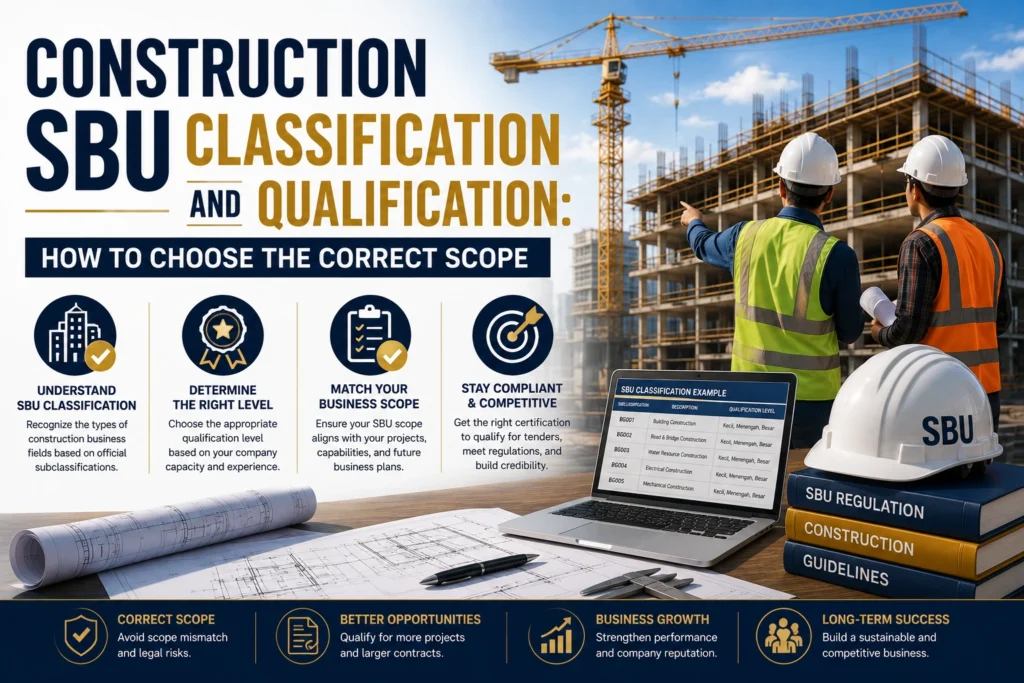
Choosing a Construction SBU should start with the service the company will actually perform, not with the largest qualification or the longest list of sub-classifications. For Construction SBU Classification and Qualification: How to Choose the Correct Scope, the practical sequence is service → classification → sub-classification → qualification → capability check.
Under Minister of Public Works and Housing Regulation No. 8 of 2022, SBU is proof of recognition of the classification and qualification of a construction business entity’s capability.
Construction certification also operates within Indonesia’s current risk-based licensing framework under Government Regulation No. 28 of 2025.
Construction SBU Classification and Qualification: How to Choose the Correct Scope
The practical answer is to make three separate decisions:
- Classification — which broad construction-service group fits the work
- Sub-classification — which specific business scope inside that classification matches the contracted service
- Qualification — what capability level the business can support for that sub-classification
Do not reverse the order. Choosing a qualification first and then searching for projects that fit it can produce an SBU portfolio that does not match the company’s real activity or evidence.
Classification vs Sub-Classification vs Qualification
These terms describe different parts of the certification structure.
Qualification answers a different question: what level of business capability can the company support for the selected scope?
For a general BUJK, the qualification assessment considers annual sales, financial capability, construction-worker availability and equipment capability.
The table below is a decision aid showing how the three concepts should be used in sequence rather than treated as interchangeable labels.
| Decision | Question |
|---|---|
| Classification | What broad construction field is this business in? |
| Sub-classification | What specific construction service will the company provide? |
| Qualification | What capability level can the company support for that scope? |
The main implication is that qualification should be assessed after the regulated scope has been identified. Classification tells the company where the service belongs, sub-classification defines the specific SBU scope, and qualification determines whether the company can support that scope at the intended capability level.
Why One Sub-Classification Is a Separate SBU Scope
Scope selection has a direct certification consequence.
This means adding another sub-classification is not simply adding another descriptive label to one certificate. It creates another SBU scope that needs to be supported within the certification framework.
For a general BUJK, qualification is assessed for each proposed sub-classification, so selecting several SBU scopes creates separate capability questions rather than one company-wide qualification decision.
If a BUJK holds several sub-classifications with different qualification levels, the regulation provides that the company’s administrative qualification is based on the highest qualification among the sub-classifications it holds.
Step 1: Define the Service the Company Will Actually Sell
Start with contracts and commercial activity, not certification codes.
Write down exactly what the company intends to provide. For example, distinguish between:
- Construction consultancy
- General construction work
- Specialist construction work
- Integrated construction work where the business model genuinely falls into that regulated category
The purpose is not to collect as many possible scopes as possible. It is to identify the certification scope that corresponds to the services the business genuinely intends to perform.
Ask a Contract-Level Question
Before selecting a sub-classification, ask:
What will this company be contractually responsible for delivering?
That question is often more useful than asking which SBU code looks closest to the company’s marketing description.
Step 2: Select the Classification and Sub-Classification
Once the service is clear, identify the appropriate classification and then the sub-classification inside it.
Do not treat two related activities as automatically interchangeable. A project can involve several forms of construction work while the company’s actual contractual service remains narrower.
The worksheet below is designed to force each proposed SBU scope to connect to an actual service and a supportable business capability before it is retained in the application plan.
| Planned Service | Proposed Classification | Proposed Sub-Classification | Evidence Company Can Perform It? |
|---|---|---|---|
| Service 1 | Verify | Verify | Yes / No |
| Service 2 | Verify | Verify | Yes / No |
| Service 3 | Verify | Verify | Yes / No |
The practical implication is that a proposed sub-classification should survive three tests at the same time: it matches the real service, belongs in the correct classification and can be supported by company evidence. If one of those tests fails, adding the scope merely increases certification complexity without resolving the underlying mismatch.
Step 3: Choose a Qualification the Company Can Support
Qualification should follow capability, not ambition.
For a general BUJK, the official assessment considers annual sales, financial capability, construction workers and equipment. Specialist businesses use a different capability framework: the regulation assesses annual sales, asset value, construction-worker availability and equipment capability for specialist BUJK.
This means a company should not assume that one financial or operational profile supports every business type and qualification.
Qualification Decision Checklist
For each proposed sub-classification, ask:
- Can the company support the applicable sales or experience assessment?
- Does its financial capability or applicable asset evidence support the intended level?
- Are the required construction personnel available?
- Can the applicable equipment requirement be satisfied?
- Is the proposed business type correctly categorized as general or specialist?
If several answers are unresolved, the qualification should be reviewed before the application proceeds.
Step 4: Test Personnel and Equipment Consequences
Adding a sub-classification can change more than the certificate list.
Scope selection also affects personnel because the SBU personnel assessment includes PJBU, PJTBU and/or PJSKBU, while PJSKBU quantity is assessed according to the number and qualification of the sub-classifications held.
A wider SBU portfolio can therefore create a new personnel requirement even when the company already has certified workers.
Equipment can also change the appropriate qualification decision because the regulation sets different minimum equipment capability according to the applicable BUJK qualification and excludes construction consultancy business entities from this equipment-capability requirement.
The lesson is simple: never add an SBU scope without checking its personnel and equipment consequences.
Step 5: Remove Unsupported or Unnecessary Scope
Before filing, challenge every proposed sub-classification.
Keep it when:
- The company genuinely intends to sell that service
- The classification and sub-classification fit the activity
- The company can support an appropriate qualification
- Personnel can support the scope
- Equipment can be supported where applicable
Remove or postpone it when the only reason for adding it is that the company may possibly need it in the future.
A narrower, supportable certification scope is generally more useful than a broad list that creates capability gaps.
Three Scope-Selection Scenarios
Scenario 1: One Clearly Defined Construction Service
A company intends to perform one clearly defined construction activity.
The efficient route is normally to identify the matching sub-classification, determine the qualification that its capability can support and build the evidence around that scope.
There is little value in adding unrelated sub-classifications only to make the SBU portfolio look broader.
Scenario 2: Several Related Services
A business genuinely provides several related services.
Map each one separately because one SBU corresponds to one sub-classification. Then check whether personnel can cover the combined portfolio and whether each proposed sub-classification can support its qualification.
This is where a PJSKBU-capacity problem can emerge even though every individual scope appears reasonable on its own.
Scenario 3: Specialist or Integrated Business Model
Do not automatically force a specialist or integrated business into the capability assumptions used for general construction work.
Specialist BUJK use the separate capability assessment described above, while integrated work should be confirmed against the applicable integrated construction scope before the company builds its certification strategy.
The critical decision is the regulated business model, not the fact that all three operate broadly within construction.
Wrong-Scope Warning Signs
Review the SBU plan if any of these conditions apply:
- The company selected codes before defining its actual services
- Several sub-classifications have been added without identified projects or commercial purpose
- The desired qualification was selected before financial capability was reviewed
- Personnel are assumed to support every new scope merely because they hold SKK
- Equipment requirements were not checked per proposed construction scope
- A consultancy is being prepared using the same equipment assumptions as construction work
- The company cannot explain which contract activity each proposed sub-classification will cover
These are scope-design problems. Adding more documents will not necessarily solve them.
Filing After the Scope Is Confirmed
After the scope is mapped, the current OSS PB-UMKU directory lists Construction SBU as available under the Public Works sector.
The certification file should then be built around the selected sub-classifications and their applicable capability requirements rather than around a generic checklist.
For businesses that need assistance after identifying the intended scope, Lombok Legal ID maintains a verified Construction SBU service page.
Related guides: Compare the company activity with Construction KBLI vs SBU Subclassification, then review Construction SBU Qualification Upgrade when capability increases.
Conclusion
Choosing the correct Construction SBU scope is not primarily a code-selection exercise.
The safer sequence is:
actual service → classification → sub-classification → qualification → financial capability → personnel → equipment where applicable → certification
Classification tells you the broad construction-service group. Sub-classification defines the specific SBU scope. Qualification reflects the capability the company can support for that scope.
Because one SBU corresponds to one sub-classification and qualification is assessed per proposed sub-classification for general BUJK, every extra scope should have a clear business reason and a supportable capability file. The correct SBU portfolio is therefore the one that matches what the company genuinely plans and is able to perform, not simply the widest portfolio available.
Confirm the Construction Scope Before Filing the SBU
A classification or qualification decision affects the financial, personnel and equipment evidence required for the certification file. Confirming the actual construction service first can prevent the company from preparing unsupported or unnecessary SBU scopes.
For a Construction SBU consultation in Lombok, discuss the intended classification and sub-classifications with Lombok Legal ID or review the verified Construction SBU service.
FAQ – Construction SBU Classification and Qualification
What is the difference between Construction SBU classification and sub-classification?
Classification is the broader grouping of construction-service businesses, while sub-classification is the more specific division within that classification. The current SIJKT public portal states that one SBU consists of one sub-classification.
What does Construction SBU qualification mean?
For a general BUJK, qualification reflects the capability assessed for a proposed sub-classification using factors including annual sales, financial capability, construction workers and equipment capability.
Can one company have more than one Construction SBU?
Yes. The current Ministry of Public Works SIJKT portal states that one BUJK can hold more than one SBU and that one SBU consists of one sub-classification.
Can different SBU sub-classifications have different qualifications?
Yes. Regulation No. 8 of 2022 provides that qualification assessment for a general BUJK is performed for each proposed sub-classification. If the company holds sub-classifications with different qualifications, its administrative qualification is based on the highest one held.
Should a construction company choose the highest qualification available?
Not automatically. The intended qualification should be supported by the company’s applicable sales or experience, financial capability, construction personnel and equipment requirements. A higher qualification without supporting capability is not a sound scope-selection strategy.
Does adding a new sub-classification affect personnel requirements?
It can. PJSKBU quantity is assessed according to the number and qualification of the sub-classifications held, and one PJSKBU may cover a maximum of five sub-classifications within one classification for one BUJK under the cited regulation.
Does every Construction SBU scope require equipment?
No. Equipment requirements depend on the construction business type and qualification, and construction consultancy business entities are exempt from the equipment-capability requirement under the cited PUPR framework.
Where is Construction SBU filed after the scope is selected?
Construction SBU is currently listed in OSS as a PB-UMKU under the Public Works sector. The certification file should be prepared against the selected sub-classification and applicable capability requirements before filing.
References & Sources
- Official Text of Minister of Public Works and Housing Regulation No. 8 of 2022 on Construction Services Standard Certification
- SIJKT Portal Data – Sertifikat Badan Usaha Masa Reguler
- Government Regulation No. 14 of 2021 on the Construction Services Implementing Framework
- Government Regulation No. 28 of 2025 on Risk-Based Business Licensing
- OSS RBA – Construction Business Entity Certificate