

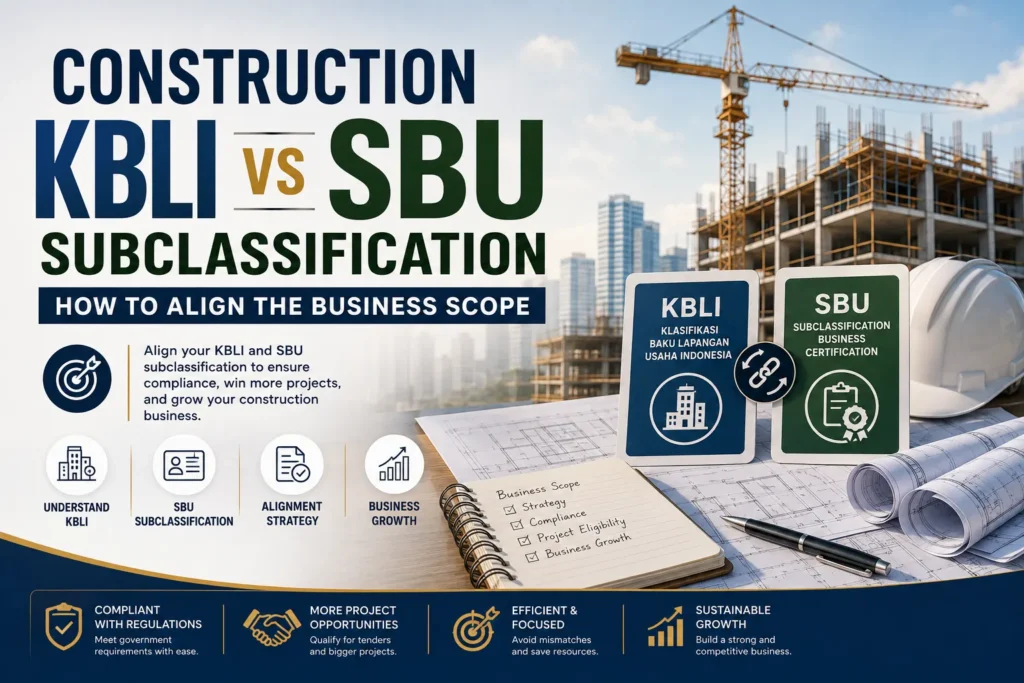
Construction KBLI vs SBU Subclassification starts with one principle: the two classifications should describe the same real-world construction activity, but they do so for different regulatory purposes.
KBLI classifies the company’s economic activity in Indonesia’s business-registration system. An SBU sub-classification identifies the specific construction-services scope recognized through the construction business certification framework.
The current economic-activity layer is KBLI 2025, established through BPS Regulation No. 7 of 2025, which the BPS legal database lists as in force.
The construction-certification layer is different: Minister of Public Works and Housing Regulation No. 8 of 2022 defines SBU as proof of recognition of the classification and qualification of a construction-services business entity’s capability.
Indonesia’s current overarching licensing framework is Government Regulation No. 28 of 2025, which JDIH BKPM lists as in force. The construction-certification procedure remains current: the BPK regulations database lists Minister of Public Works and Housing Regulation No. 8 of 2022 as in force.
Construction KBLI vs SBU Subclassification
Do not choose an SBU sub-classification merely because its wording resembles the company’s KBLI title.
The safer sequence is:
actual contracted service → KBLI activity → OSS construction mapping → SBU sub-classification → qualification and capability check
If those layers describe different activities, the company can have an OSS registration problem, an SBU scope problem, or both.
KBLI vs SBU Subclassification: Decision Matrix
The table below separates the two systems by function so the company knows what must be aligned.
| Comparison | Construction KBLI | SBU Subclassification |
|---|---|---|
| Main purpose | Classify economic activity | Define specific construction-services certification scope |
| Current reference | KBLI 2025 | PUPR construction classification framework |
| Main system | OSS business licensing | OSS PB-UMKU connected to construction certification system |
| Main question | What economic activity does the company conduct? | What construction service capability is the BUJK recognized for? |
| Capability test | Not itself an SBU capability certificate | Connected to SBU classification, qualification and certification evidence |
| One-to-one relationship? | Not necessarily | Must be checked against the relevant KBLI and actual service |
The implication is important: matching the KBLI title is only the beginning of the alignment exercise. The company must still verify the specific construction sub-classification that corresponds to the work and whether its SBU capability supports that scope.
What Construction KBLI Actually Classifies
KBLI is Indonesia’s standard classification of economic activities.
BPS Regulation No. 7 of 2025 establishes the current KBLI 2025 framework. For current OSS work, the OSS conversion guide explains that new applications, changes, expansions, updates, renewals and PB-UMKU processes use KBLI 2025 as the primary reference and provides a mechanism for converting older KBLI records.
For a construction business, the KBLI should therefore describe the economic activity the company actually intends to perform.
But selecting the right KBLI does not by itself establish which specific SBU construction capability the company has been certified for.
What an SBU Subclassification Actually Classifies
PUPR uses a construction-services classification structure inside the SBU framework.
The SBU therefore answers a narrower sector question than KBLI: which construction-service scope and qualification has the business entity been recognized as capable of performing?
The two classification layers meet operationally in OSS because the PUPR procedure sends a new SBU application through the OSS PB-UMKU menu connected to the integrated Construction Services Information System.
The current OSS directory lists Construction SBU as an available PB-UMKU under the Public Works sector.
Why KBLI-to-SBU Mapping Is Not Always One-to-One
Current OSS data shows why a simple universal conversion table can be misleading.
A current OSS example shows that KBLI 41019 Konstruksi Gedung Lainnya displays the PUPR sub-classification codes BG009 and BG011.
The same pattern appears elsewhere: KBLI 42919 shows construction sub-classification codes BS017 and BS021.
Some KBLI records are narrower. The current OSS record for KBLI 42206 Konstruksi Sentral Telekomunikasi shows the construction sub-classification BS009.
These examples support a practical conclusion: do not assume every construction KBLI automatically determines one unique SBU sub-classification.
Where OSS displays several construction sub-classification possibilities, the actual service scope must determine which one the company needs to certify.
Six Steps to Align KBLI and SBU Scope
Step 1: Define the Contracted Construction Service
Start with what the company will actually be responsible for delivering.
Do not start from an SBU code list or choose the broadest KBLI available. Describe the work in operational terms first.
Step 2: Verify the Current KBLI 2025 Activity
Search the current OSS KBLI database and confirm that the description covers the planned activity.
Check the description, exclusions and scope, not only the five-digit code title.
Step 3: Inspect the Construction Subclassification Mapping
Review the construction sub-classification code or codes displayed for the KBLI in OSS where available.
If more than one appears, do not select all of them automatically. Compare each construction scope with the service the company genuinely intends to perform.
Step 4: Match the SBU Subclassification to the Actual Work
Choose the SBU sub-classification that corresponds to the company’s construction service, not merely the one whose wording looks most commercially attractive.
This is where technical scope review matters most.
Step 5: Verify Qualification and Capability
Once the sub-classification is identified, verify whether the company can support the applicable qualification and SBU capability requirements.
This can involve construction experience, financial capability, construction personnel and equipment where applicable.
Step 6: Check Both OSS and SBU Before Expanding Scope
When the company adds a new construction service, review both layers again.
A new KBLI activity in OSS does not automatically extend the company’s existing SBU certification to that construction scope, while adding SBU scope should also be checked against the company’s registered business activities.
Three Mismatch Scenarios
Scenario 1: Correct KBLI, Wrong SBU Subclassification
The company’s OSS activity accurately describes its construction business, but the existing SBU covers a different construction service.
The priority is an SBU scope review. Do not change the KBLI merely to make it resemble the current SBU if the actual activity is already classified correctly.
Scenario 2: Existing SBU, but KBLI Data Is Outdated or Misaligned
The company has an SBU that matches the work, but its OSS activity record still reflects an older or different business classification.
The OSS and KBLI layer should be reviewed. The company should also check whether KBLI 2020 data requires conversion to the current KBLI 2025 framework.
Scenario 3: The Company Adds a New Construction Service
A company begins offering a materially different construction service.
Review both questions:
- Does the current KBLI 2025 activity cover the new economic activity?
- Does the existing Construction SBU sub-classification and qualification cover the new construction service?
If either answer is no, that layer requires adjustment before the company assumes its licensing scope is complete.
KBLI 2025 Migration: Check Older OSS Records
Businesses established under older OSS data should not assume their historical KBLI record is already identical to the current classification.
OSS now provides a formal KBLI 2020-to-KBLI 2025 conversion mechanism. This matters because an alignment review conducted only against an old KBLI description can produce the wrong conclusion about the company’s current registered activity.
For an existing construction business, check:
- Which KBLI version appears in the current OSS record
- Whether conversion to KBLI 2025 is required for the intended transaction
- Whether the converted KBLI still maps logically to the existing SBU scope
- Whether expansion or amendment creates a new SBU review requirement
Final Scope-Alignment Checklist
Before filing or signing a materially new construction scope, confirm:
- Actual service — what will the company contractually deliver?
- KBLI 2025 — does the current OSS activity description match that service?
- OSS mapping — which PUPR construction sub-classification codes are associated with the KBLI?
- SBU scope — which sub-classification actually matches the work?
- Qualification — can the company support the required SBU capability level?
- Personnel and equipment — are the applicable supporting resources aligned?
- Existing records — does an older KBLI or existing SBU require amendment or review?
The goal is not to make the KBLI code and SBU code look similar. The goal is to make both classification systems accurately describe the same real business operation from their respective regulatory perspectives.
For OSS and company-activity matters, Lombok Legal ID maintains a verified Business Setup service. For construction certification and SBU scope review, the verified Construction SBU service is the relevant next step.
Related guide: After aligning KBLI and SBU scope, review Construction SBU Classification and Qualification.
Conclusion
Construction KBLI and SBU sub-classification are connected, but neither should be used as a substitute for the other.
Use KBLI to identify the company’s economic activity in the current OSS framework. Use the SBU sub-classification to identify the specific construction-services capability the BUJK is certified to perform.
If the KBLI is correct but the SBU scope is wrong, review the SBU. If the SBU matches the work but the OSS activity is outdated, review the KBLI and OSS record. If the company is adding a new construction activity, review both layers together.
The safest alignment rule is therefore activity first, codes second: define the work, verify KBLI 2025, identify the applicable SBU sub-classification, and then confirm that the qualification and capability evidence support the construction scope.
Align the OSS Activity and Construction SBU Before Expanding the Scope
A construction company can have the correct KBLI but the wrong SBU sub-classification, or the correct SBU while its OSS business activity is outdated. These are different problems and should be reviewed separately.
For a coordinated scope review in Lombok, discuss the activity with Lombok Legal ID. Use the verified Business Setup service for KBLI and OSS matters and the Construction SBU service for construction certification.
FAQ – Construction KBLI vs SBU Subclassification
Is Construction KBLI the same as an SBU sub-classification?
No. KBLI classifies the company’s economic activity, while an SBU sub-classification identifies the specific construction-services scope recognized through SBU certification.
Does one construction KBLI always correspond to one SBU sub-classification?
No. Current OSS data shows examples where one KBLI is associated with multiple construction sub-classification codes, including KBLI 41019 with BG009 and BG011 and KBLI 42919 with BS017 and BS021.
Which should be selected first: KBLI or SBU sub-classification?
Start with the actual construction service. Then identify the correct current KBLI and use the construction scope and OSS mapping to determine the relevant SBU sub-classification. The activity should drive both classifications.
Can a company add a construction KBLI without changing its SBU?
It depends on whether the existing SBU already covers the actual new construction service. Adding an OSS activity does not by itself prove that the company’s existing SBU classification and qualification cover that scope.
Can an existing SBU remain correct after KBLI conversion to KBLI 2025?
Possibly, but it should be checked. OSS now uses KBLI 2025 as the primary reference for current application and amendment processes, so the converted activity should be compared with the company’s existing construction SBU scope.
Why can one KBLI show two SBU sub-classification codes?
A KBLI economic-activity category can encompass business activity that is divided more specifically inside the PUPR construction certification framework. The actual contracted construction service determines which sub-classification is relevant.
What should be reviewed before adding a new construction activity?
Check the actual service, current KBLI 2025 activity, OSS construction mapping, SBU sub-classification, qualification, personnel and equipment where applicable. Review both OSS and SBU if the business scope is changing.
References & Sources
- BPS Regulation No. 7 of 2025 on the Indonesian Standard Industrial Classification
- OSS Guide to Converting KBLI 2020 to KBLI 2025
- Official Text of Minister of Public Works and Housing Regulation No. 8 of 2022 on Construction Services Standard Certification
- BPK Regulations Database – Minister of Public Works and Housing Regulation No. 8 of 2022
- Government Regulation No. 28 of 2025 on Risk-Based Business Licensing
- OSS RBA – Construction Business Entity Certificate
- OSS RBA – KBLI 41019 Konstruksi Gedung Lainnya
- OSS RBA – KBLI 42919 Other Civil Engineering Construction N.E.C.
- OSS RBA – KBLI 42206 Telecommunications Central Construction