

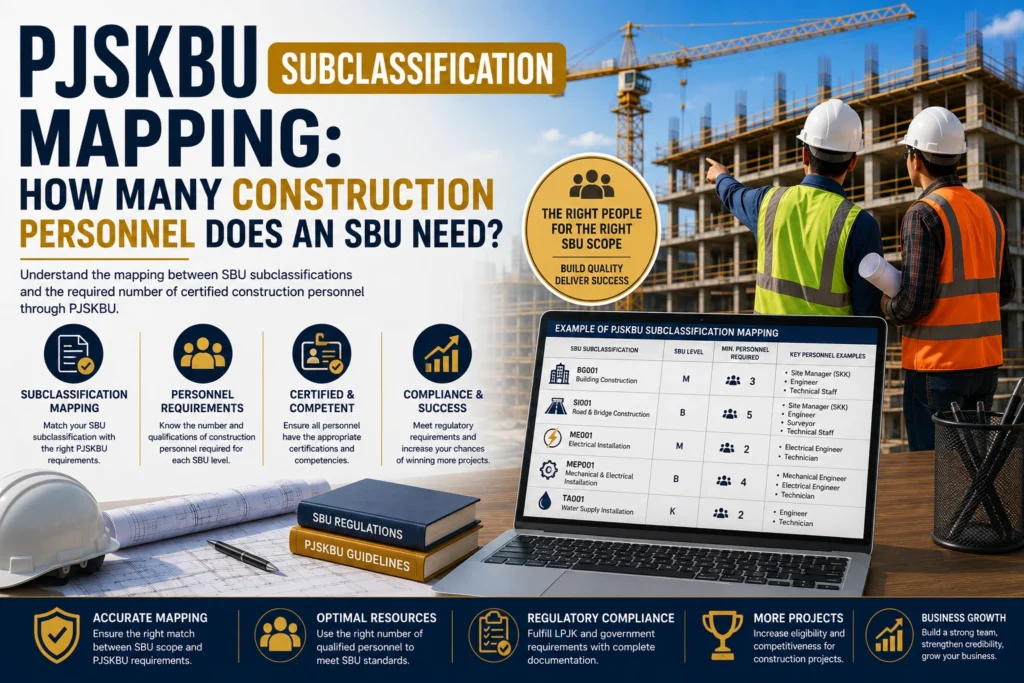
The answer to PJSKBU Subclassification Mapping: How Many Construction Personnel Does an SBU Need? is not one fixed number. The personnel requirement depends on the number of sub-classifications, how those sub-classifications are grouped into classifications, the company’s qualification and whether the proposed PJSKBU personnel have the competency and field of knowledge required for those scopes.
Under Minister of Public Works and Housing Regulation No. 8 of 2022, the construction-worker availability assessment for SBU includes PJBU, PJTBU and/or PJSKBU.
The starting rule is that the number of personnel serving as PJSKBU is assessed according to the number and qualification of sub-classifications held by the BUJK.
Construction certification also operates within Indonesia’s current wider business-licensing system under Government Regulation No. 28 of 2025.
PJSKBU Subclassification Mapping: The Short Answer
The practical rule is:
Group the SBU sub-classifications by classification first. Then calculate PJSKBU capacity inside each classification separately.
Article 13 further provides that one PJSKBU may cover a maximum of five sub-classifications within one classification for one BUJK.
This means five is a maximum coverage limit, not a universal staffing formula.
A company with four compatible sub-classifications in one classification may potentially map them to one suitable PJSKBU. A company with six sub-classifications in the same classification will need to consider additional PJSKBU capacity. If the sub-classifications are spread across different classifications, they cannot simply be combined into one five-subclassification block.
The Core Rule: Maximum Five Sub-Classifications per Classification
The regulatory wording has three important boundaries:
- Maximum five sub-classifications
- They must be within one classification
- The coverage applies within one BUJK
Those three conditions should be read together.
For example, a company should not assume that one PJSKBU can cover three building sub-classifications plus two unrelated civil classifications merely because the total is five.
Coverage is not purely numerical because PJSKBU must also have the field of knowledge corresponding to each supported construction-services sub-classification.
How to Calculate PJSKBU Personnel for an SBU
A practical mapping process has four steps.
Step 1: List Every Requested Sub-Classification
Start with the actual SBU scope, not the number of personnel currently employed.
Record each requested sub-classification and its classification.
Step 2: Group Them by Classification
Create separate groups for each classification. Do not pool all sub-classifications together.
For example:
| Classification | Requested Sub-Classifications | Initial Coverage Question |
|---|---|---|
| Classification A | 4 | Can one qualified PJSKBU support all four? |
| Classification B | 3 | A separate personnel mapping is required for this classification |
The key point is that the numerical ceiling is applied inside each classification, not across the company’s entire SBU portfolio.
Step 3: Apply the Five-Subclassification Ceiling
Within one classification, divide the requested sub-classifications into groups of no more than five.
As a planning calculation:
minimum capacity blocks = requested sub-classifications in one classification ÷ maximum five per PJSKBU, rounded upward
This is only a planning calculation. It does not replace competency review.
Step 4: Verify Legal and Technical Suitability
For each proposed PJSKBU, confirm:
- The person has suitable construction competency
- The field of knowledge fits the supported sub-classifications
- The worker is a permanent worker of the BUJK
- The person is not simultaneously occupying a prohibited position at another BUJK
- The company’s qualification and sub-classification requirements are otherwise satisfied
The same Article 13 framework requires the construction workers counted for this personnel assessment to be permanent workers of the BUJK and prohibits them from simultaneously holding a position at another BUJK.
Four PJSKBU Mapping Scenarios
Scenario 1: Four Sub-Classifications in One Classification
A company has four requested sub-classifications, all inside one classification.
Numerically, the scope falls below the five-subclassification maximum. One PJSKBU may therefore be sufficient only if that person has the required competency and field-of-knowledge coverage for all four assignments.
The number four by itself does not establish eligibility.
Scenario 2: Six Sub-Classifications in One Classification
A company wants six sub-classifications inside one classification.
Because one person may cover no more than five, the company cannot place all six under one PJSKBU. It should plan additional personnel capacity for the remaining scope.
A simple capacity estimate would be two PJSKBU blocks, followed by competency and role verification for the actual assignments.
Scenario 3: Three Sub-Classifications in One Classification and Three in Another
The company has only six sub-classifications in total, but they belong to two classifications.
The total number six is not the correct starting point. Each classification requires its own mapping analysis.
The company should therefore review one personnel allocation for the first classification and another for the second, even though neither group exceeds five.
Scenario 4: An Existing SBU Adds New Sub-Classifications
A company currently has four sub-classifications in one classification and adds two more.
Its earlier PJSKBU arrangement may have been sufficient for four, but the expanded scope now exceeds the five-subclassification ceiling. The personnel structure should be reviewed before assuming the existing arrangement can simply continue.
This is why PJSKBU planning is not only an initial-application issue. It can also become relevant when the company expands its SBU scope.
Why Five Sub-Classifications Does Not Automatically Mean One Person Is Enough
The five-subclassification rule is frequently the easiest part to understand and the easiest part to misuse.
A company may have five or fewer sub-classifications and still require further personnel review.
The main reason is that field-of-knowledge and competency alignment remain necessary. A PJSKBU who is numerically available does not automatically fit every sub-classification within the classification.
A second issue is employment status. Personnel counted toward SBU capability must satisfy the permanent-worker and no-dual-position rules.
A third issue is business qualification. Article 13 ties PJSKBU personnel assessment to the number and qualification of the company’s sub-classifications, so the same number of sub-classifications can still require different competency review depending on the certification scope.
PJSKBU Mapping Worksheet Before Filing
A company can use the following matrix before submitting or expanding its Construction SBU:
| Sub-Classification | Classification | Proposed PJSKBU | Field of Knowledge Matches? | Permanent Worker? | Other BUJK Position? | Capacity Count |
|---|---|---|---|---|---|---|
| Scope 1 | Classification A | Person 1 | Verify | Verify | Verify | 1 of 5 |
| Scope 2 | Classification A | Person 1 | Verify | Verify | Verify | 2 of 5 |
| Scope 3 | Classification A | Person 1 | Verify | Verify | Verify | 3 of 5 |
| Scope 4 | Classification B | Person 2 | Verify | Verify | Verify | 1 of 5 |
This worksheet separates three questions that are often mixed together:
- Capacity: is the proposed PJSKBU within the five-subclassification limit?
- Classification: are all assignments grouped correctly within one classification?
- Eligibility: does the person actually satisfy the competency, knowledge and employment requirements?
Only when all three are satisfied should the company treat the mapping as ready for the certification file.
What Happens When the SBU Scope Expands?
Adding a new sub-classification can create a new personnel requirement even when the company already has an SBU and existing PJSKBU.
Before expanding the scope, compare the proposed new sub-classification against:
- Its classification
- The current number of sub-classifications assigned to the proposed PJSKBU
- The person’s competency and field of knowledge
- The company’s qualification
- Whether another PJSKBU will be needed after expansion
The same analysis should be repeated if the company changes classification or qualification.
A limited exception exists for certain small-qualified BUJK: where the prescribed PJSKBU level cannot yet be fulfilled, Article 13 permits specified secondary-school graduates with construction-services experience to serve as PJSKBU for one SBU application, subject to its conditions.
This exception should not be used as the normal basis for long-term PJSKBU planning.
PJSKBU Mapping Is Only One Part of Construction SBU
Even a technically correct personnel map does not complete the SBU application.
PJSKBU capacity is only one part of the certification file because a new Construction SBU application also evaluates other business-capability information, including annual sales, financial capability or asset value, construction-worker availability and equipment capability where applicable.
Under the current construction-services certification procedure, Construction SBU certification is conducted by an LSBU.
The personnel map should therefore be checked together with the company’s wider classification, qualification and capability file.
For company-level certification assistance, Lombok Legal ID maintains a verified Construction SBU service page. If the issue is the individual’s competency certification, the verified Building Construction SKK service is the more relevant pathway.
Related guide: For broader personnel eligibility and role requirements, read PJTBU and PJSKBU Requirements for Construction SBU.
Conclusion
There is no universal answer such as ‘one PJSKBU per company’ or ‘one PJSKBU for every five SBU codes.’
The safer method is to group sub-classifications by classification, apply the maximum five-subclassification coverage rule inside each classification, and then verify competency, field-of-knowledge, qualification and employment eligibility for every proposed PJSKBU.
For a company with a small, compatible scope, one person may support several sub-classifications. As the SBU expands across more sub-classifications or classifications, the personnel requirement can increase. The correct number therefore comes from the company’s actual certification map, not from a fixed staffing number.
Map PJSKBU Capacity Before Expanding Your Construction SBU
A company can stay within the numerical five-subclassification limit and still have a personnel mismatch if the PJSKBU does not fit the relevant classification, competency or field-of-knowledge requirements.
For a Construction SBU review in Lombok, discuss the intended classification and sub-classifications with Lombok Legal ID or review the verified Construction SBU service before finalising the personnel map.
FAQ – PJSKBU Subclassification Mapping
How many sub-classifications can one PJSKBU cover?
Minister of Public Works and Housing Regulation No. 8 of 2022 permits one PJSKBU to cover a maximum of five sub-classifications within one classification for one BUJK, subject to the other competency and eligibility requirements.
Does five sub-classifications always mean one PJSKBU is enough?
No. Five is a maximum numerical coverage limit. The proposed PJSKBU must still have the appropriate field of knowledge, competency and employment status for the supported sub-classifications.
Can one PJSKBU cover sub-classifications from two different classifications?
The Article 13 coverage rule is framed as a maximum of five sub-classifications within one classification for one BUJK. Different classifications should therefore be mapped separately rather than combined into one five-subclassification group.
How many PJSKBU are needed for six sub-classifications in one classification?
One PJSKBU cannot cover all six because the maximum is five. The company should plan additional personnel capacity for the remaining sub-classification and then verify competency and field-of-knowledge alignment.
Do PJSKBU personnel have to be permanent workers?
Yes. The construction workers counted in the SBU personnel-availability assessment must be permanent workers of the BUJK and may not simultaneously hold positions at another BUJK.
Does adding a new SBU sub-classification require a new PJSKBU?
Not automatically. It depends on the existing PJSKBU’s current coverage, the classification of the new sub-classification, the five-subclassification limit and whether the person’s competency and field of knowledge fit the additional scope.
Is PJSKBU mapping enough to obtain Construction SBU?
No. PJSKBU mapping is only one part of SBU capability. The business must also satisfy the other applicable company, financial, personnel, equipment and certification requirements.