
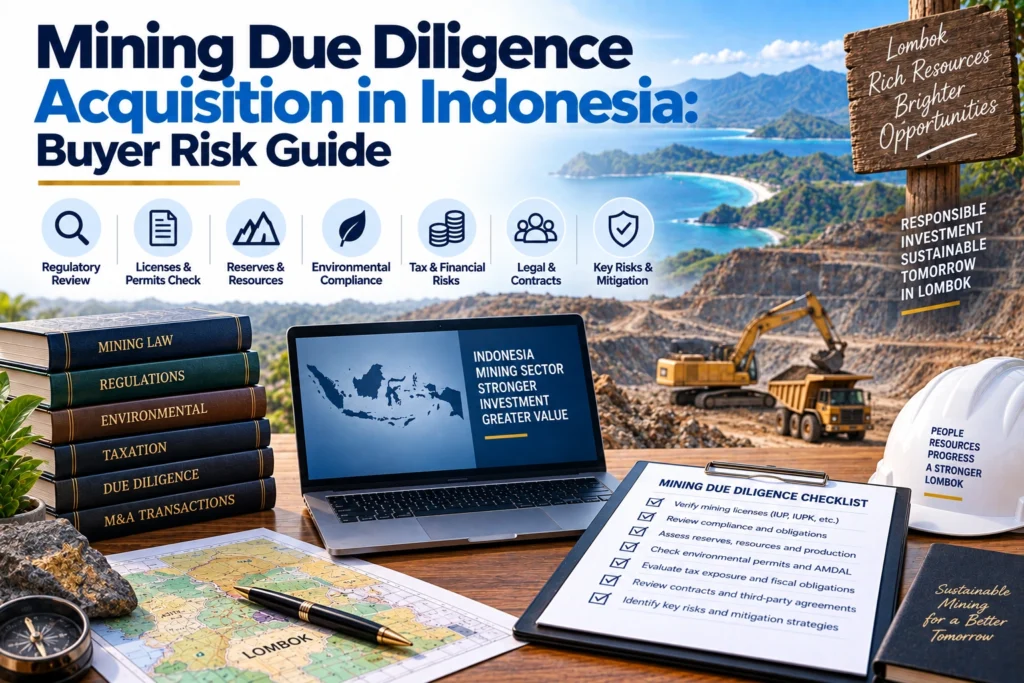
A mining due diligence acquisition review should answer a more fundamental question than whether the target owns mining equipment or has a copy of an IUP: does the company legally hold a usable mining right, and can the buyer acquire control without inheriting unresolved licensing, operational, environmental, or compliance problems?
Indonesia’s current statutory mining framework includes Law No. 2 of 2025, the fourth amendment to the Mineral and Coal Mining Law, which the BPK regulations database lists as in force.
The implementing framework also includes Government Regulation No. 96 of 2021, which remains in force but has been amended by Government Regulation No. 25 of 2024 and Government Regulation No. 39 of 2025. The latest major amendment is Government Regulation No. 39 of 2025, effective from 11 September 2025.
The current implementing layer also includes Minister of Energy and Mineral Resources Regulation No. 18 of 2025, which the ESDM legal database lists as in force.
Mining Due Diligence Acquisition: What Buyers Must Verify First
Before relying on valuation, reserves, production forecasts, or seller representations, verify four layers:
- Mining right — what permit exists, who holds it, and what activity does it authorize?
- Mining area — does the WIUP align with the project and assets being acquired?
- Corporate control — can the proposed ownership change be implemented under the mining framework?
- Operational compliance — are RKAB, reporting, payment, reclamation, environmental, and other obligations sufficiently documented?
A weakness in any one of these layers can change the acquisition structure or the buyer’s willingness to proceed.
Mining Acquisition Due Diligence Matrix
Use the matrix below as a screening tool before detailed legal, technical, environmental, and financial review.
| Review Area | Buyer Question | Potential Consequence |
|---|---|---|
| IUP or IUPK | Is the permit valid and held by the target? | Fundamental title or licensing risk |
| WIUP | Does the licensed area match the project? | Asset and permit mismatch |
| Share ownership | Does the transaction require mining-sector approval? | Closing condition or restructuring |
| RKAB | Is the current operational plan properly approved or recorded? | Operating and reporting risk |
| PNBP and payments | Are relevant government payment records reconciled? | Financial or compliance exposure |
| Reclamation | Are obligations and guarantees adequately documented? | Environmental and closure exposure |
| Land and forestry | Can the target lawfully access and use the project area? | Operational restriction |
| MinerbaOne records | Do digital records match corporate documents? | Administrative inconsistency |
| Transaction documents | Do warranties and conditions address identified risks? | Post-closing exposure |
The table does not replace specialist review. It helps determine where the buyer needs stronger evidence before signing or closing.
1. Verify the IUP or IUPK Holder and Permit Status
Start with the permit itself.
Do not rely only on a PDF copy supplied by the seller. Verify:
- legal name of the permit holder
- permit type
- exploration or operation-production stage
- commodity
- issue and expiry information
- amendments and extensions
- WIUP references
- consistency with the target company’s corporate identity
A corporate acquisition is only commercially useful if the target actually holds the mining right that supports the investment thesis.
Lombok Legal ID maintains a verified Mining Licenses service covering IUP, IUPK, and other mining permit categories relevant to this review.
2. Match the WIUP to the Asset Being Acquired
The permit holder and the physical project must describe the same mining business.
Compare the WIUP coordinates and area with:
- mine plans
- pits and production areas
- processing or stockpile facilities
- access roads
- land arrangements
- technical reports
- seller presentations
A mine can look commercially attractive while the legal mining area does not fully correspond with the assets or activities shown to the buyer.
Treat any discrepancy as a due-diligence issue rather than assuming it can be corrected after closing.
3. Review Share Ownership and Acquisition Approval Risk
A share acquisition changes corporate ownership, but mining-sector rules must still be considered separately.
A buyer should not assume that a mining-company share transfer is only a corporate-law matter because the Ministry of Energy and Mineral Resources currently publishes a specific approval service for changes in share ownership involving PKP2B, KK, and IUP companies.
The published service requirements include corporate, permit, financial, payment, ownership, and proposed transaction documentation. The exact current approval route and requirements should be reconfirmed for the target permit and transaction before signing.
This is especially important where the transaction changes control, introduces a new shareholder, or changes foreign-versus-domestic ownership.
4. Check the Current RKAB and Mining Reports
An acquisition buyer needs more than a valid permit. The target should also be checked against its current operating-plan and reporting obligations.
Operational due diligence should include the target’s current RKAB because Minister of Energy and Mineral Resources Regulation No. 17 of 2025 requires relevant IUP and IUPK holders to prepare and submit an annual RKAB.
The RKAB framework was further updated by Minister of Energy and Mineral Resources Regulation No. 6 of 2026, which took effect on 12 June 2026.
Compare the current RKAB and reports with actual production, sales, investment, development, and operating activity. Material differences deserve explanation before the buyer relies on the seller’s forecast.
5. Reconcile PNBP, Production and Payment Evidence
Mining acquisitions require a payment and production reconciliation, not simply a review of financial statements.
Request evidence supporting material government payments and compare it with:
- reported production
- sales volumes
- permit stage
- RKAB data
- accounting records
- seller disclosures
A payment discrepancy is not automatically proof of a liability, but it should be resolved before the buyer treats the target as compliant.
6. Review Reclamation and Post-Mining Exposure
Reclamation and closure obligations can survive long after production assumptions change.
Review the target’s reclamation and post-mining documents, guarantees, implementation records, and any correspondence with regulators. The RKAB framework itself includes reclamation-related documentation among relevant submission requirements.
The buyer should understand whether future closure or rehabilitation costs have been fully reflected in the transaction model rather than treating them as an operational issue for later.
7. Verify Environmental, Land and Forestry Interfaces
An IUP or IUPK should not be treated as a substitute for every other right required to operate the project.
Depending on the site, due diligence may need to examine:
- environmental approvals and reporting
- land access or land-right arrangements
- forestry-area interfaces
- water or infrastructure approvals
- community or compensation arrangements
- overlap with other rights or concessions
The relevant issues are location-specific, so this article does not assume that every mining acquisition requires the same additional approvals.
8. Reconcile MinerbaOne and Corporate Records
Digital mining records should align with the transaction documents.
As part of the record review, buyers should also reconcile company and licensing data with the current MinerbaOne system rather than relying only on historical copies of mining documents.
Compare available mining-system information with:
- company deeds
- shareholder records
- directors and commissioners
- beneficial ownership information
- permit documents
- WIUP data
- proposed acquisition structure
A mismatch should be clarified before corporate documents are amended after closing.
9. Convert Findings Into Acquisition Conditions
Mining due diligence becomes useful when findings change the deal decision.
Possible responses include:
- requiring additional regulatory evidence
- making mining-sector approval a closing condition
- requiring correction of corporate or digital records
- requiring RKAB or reporting remediation
- quantifying unpaid or disputed obligations
- adjusting valuation for reclamation or closure exposure
- strengthening warranties and indemnities
- restructuring the transaction
- stopping the acquisition where a fundamental permit issue cannot be resolved
The appropriate response depends on the materiality and legal effect of the finding.
Mining Acquisition Red-Flag Matrix
The matrix below helps buyers prioritize unresolved issues.
| Red Flag | Initial Risk Level | Buyer Response |
|---|---|---|
| Permit holder does not match target | High | Stop and verify title before proceeding |
| WIUP does not match project area | High | Technical and legal boundary review |
| Share approval path unresolved | High before closing | Confirm sector approval requirement |
| Current RKAB unavailable | High | Verify operating authorization and reporting status |
| Material payment discrepancy | Medium to high | Reconcile before valuation is finalized |
| Reclamation guarantee unclear | Medium to high | Quantify and verify regulatory exposure |
| MinerbaOne and corporate records differ | Medium | Reconcile and remediate |
| Environmental or land rights incomplete | Case-specific, potentially high | Specialist site review |
The purpose is not to label every discrepancy as fatal. It is to prevent the buyer from pricing the acquisition as though unresolved regulatory information were already clean.
Documents to Request From the Mining Target
A focused mining data room may include, as relevant:
Permit and Area Documents
- IUP, IUPK, or other applicable mining permit
- amendments and extensions
- WIUP maps and coordinates
- technical reports and reserve or resource documentation
- current mining-system records
Operational and Compliance Documents
- current and prior RKAB documents where relevant
- production and sales reports
- evidence of material PNBP and related payments
- reclamation and post-mining plans and guarantees
- environmental approvals and reports
- regulatory correspondence and sanctions, if any
Corporate and Transaction Documents
- current shareholder structure
- beneficial ownership information
- director and commissioner records
- proposed share purchase documentation
- prior mining-sector ownership approvals or filings
- corporate deeds and amendments
The depth of review should follow the transaction structure, permit type, commodity, operational stage, project location, and identified red flags.
Conclusion
Mining acquisition due diligence in Indonesia should not start and end with checking whether an IUP exists.
The buyer should verify the permit holder, mining stage, commodity, WIUP, ownership structure, sectoral share-change requirements, current RKAB, payment evidence, reclamation obligations, operational compliance, and digital mining records as connected parts of the same acquisition risk.
Proceed when the mining right and company records are aligned, material operating obligations are understood, and required ownership or licensing actions can be completed within the transaction structure. Require remediation or closing conditions where deficiencies are fixable. Reconsider the transaction where a fundamental permit, area, or ownership issue cannot be resolved before control changes.
Verify the Mining Right Before You Acquire the Company
A mining acquisition can carry regulatory risk even when the corporate transaction appears straightforward. The permit holder, WIUP, ownership structure, RKAB, operational records, and required mining-sector approvals should be reviewed together before closing.
Investors evaluating a mining transaction can discuss the licensing and corporate context with Lombok Legal ID and review the verified Mining Licenses service for IUP, IUPK, and related mining permit matters.
FAQ – Mining Due Diligence Acquisition in Indonesia
What is mining due diligence in an acquisition?
It is a pre-acquisition review of the target mining company’s permits, WIUP, ownership, operational approvals, reporting, payments, environmental obligations, and other material regulatory risks before the buyer acquires control.
Is checking the IUP enough before buying a mining company?
No. The buyer should also verify the permit holder, mining stage, WIUP, amendments, ownership structure, RKAB, payment records, reclamation obligations, environmental matters, and current mining-system records.
Does buying shares automatically transfer the IUP to the buyer?
A share acquisition changes ownership of the company. It should not be treated as identical to transferring the mining permit itself. Mining-sector ownership and approval requirements must be reviewed separately for the specific transaction.
Should share ownership changes in an IUP company be reviewed with ESDM before closing?
Yes. ESDM currently publishes a specific approval service for changes in share ownership involving IUP and certain other mining-right holders. The exact current procedure and requirements should be confirmed for the target and transaction.
Why is the RKAB important in mining acquisition due diligence?
The RKAB is part of the current annual mining operating and reporting framework. Buyers should compare the approved or recorded operating plan with actual production, sales, investment, and compliance information.
Should reclamation obligations affect acquisition valuation?
Potentially. Reclamation and post-mining obligations can create future cash requirements and regulatory exposure, so the buyer should verify relevant plans, guarantees, implementation, and any unresolved regulator correspondence.
What should a buyer do if MinerbaOne records do not match the corporate documents?
The discrepancy should be investigated and corrected or otherwise resolved before the buyer relies on the records for closing. The significance depends on whether the mismatch concerns ownership, management, permit identity, or another material mining record.
References & Sources
- Law No. 2 of 2025: Fourth Amendment to the Mineral and Coal Mining Law
- Government Regulation No. 96 of 2021 on Mineral and Coal Mining Business Activities
- Government Regulation No. 39 of 2025: Second Amendment to Government Regulation No. 96 of 2021
- Minister of Energy and Mineral Resources Regulation No. 18 of 2025
- Ministry of Energy and Mineral Resources – Mining Licensing Services
- Minister of Energy and Mineral Resources Regulation No. 17 of 2025 on RKAB and Mining Activity Reporting
- Minister of Energy and Mineral Resources Regulation No. 6 of 2026
- MinerbaOne