

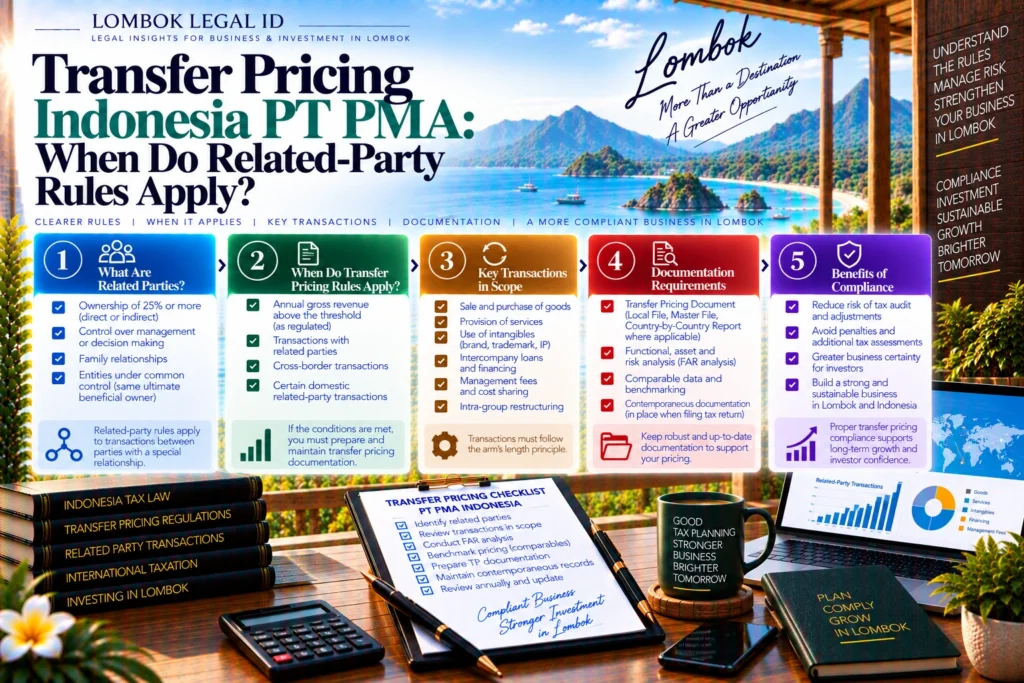
A PT PMA does not become a transfer-pricing case merely because it has foreign shareholders. The practical trigger is whether the Indonesian taxpayer conducts transactions influenced by a special relationship, after which the company must consider the arm’s-length principle and, separately, whether it meets the thresholds for formal transfer-pricing documentation.
For investors who are still establishing the Indonesian entity and ownership structure, Lombok Legal ID’s verified PT PMA setup guide for Lombok provides the adjacent company-formation context; this article focuses on related-party pricing after transactions arise.
Indonesia’s current detailed transfer-pricing regulation is Minister of Finance Regulation No. 172 of 2023, which the Ministry of Finance JDIH lists as effective from 29 December 2023 and still in force. The same official record confirms that PMK No. 172 of 2023 revoked the former transfer-pricing documentation, MAP and APA regulations, including PMK No. 213/PMK.03/2016, PMK No. 49/PMK.03/2019 and PMK No. 22/PMK.03/2020 under the current JDIH history.
Transfer Pricing Indonesia PT PMA: What Actually Triggers the Rules?
The first question is not whether the company is a PT PMA. It is whether the taxpayer is dealing with a party connected through a relationship recognized by the tax rules and whether there is a transaction influenced by that relationship.
Article 2 states that a special relationship can arise because of ownership or capital participation, control, or specified family relationships under the current transfer-pricing regulation. For ownership-based relationships, Article 2 includes direct or indirect capital participation of at least 25 percent in another taxpayer among the conditions that can establish the special relationship under PMK No. 172 of 2023.
For a PT PMA, this can make transactions with a parent, shareholder, sister company, subsidiary or another controlled group entity relevant to the analysis. The relationship should be mapped before reviewing prices or documentation thresholds.
Step 1 — Identify the Special Relationship
Start with the legal and economic relationship between the parties. Shareholding is only one route. Control can also create a special relationship, so the review should not stop after checking whether one party directly owns shares in the other.
A useful transaction map should therefore identify the counterparty, its ownership or control relationship, the country or jurisdiction involved, the transaction type and annual value. This prevents a company from checking only obvious payments to its direct foreign shareholder while overlooking another group entity providing services or financing.
Step 2 — Apply the Arm’s-Length Principle
Article 3 requires taxpayers to apply the arm’s-length principle when exercising tax rights and fulfilling tax obligations relating to transactions influenced by special relationships under the current regulation.
Article 3 applies the principle by comparing the conditions and price indicators of the related-party transaction with the conditions and price indicators of the same or comparable independent transaction under PMK No. 172 of 2023.
This means transfer pricing is not simply a requirement to prepare a report after year-end. The commercial terms and economic support for a related-party transaction should be considered when the transaction is designed and carried out.
Goods and inventory
A PT PMA may buy products, components, equipment or inventory from a foreign group company or sell goods to another affiliated entity. The tax question is whether the conditions and pricing can be supported as arm’s length after considering the actual transaction and appropriate comparability factors.
The review should therefore look beyond the invoice price. Functions performed, assets used, risks assumed, product differences, contractual terms and market circumstances can matter to the pricing analysis.
Services, interest and intangible property
Other common group transactions include management or technical services, shareholder or intercompany loans, interest, licences, royalties and use of intangible property.
A company should first confirm that the transaction actually occurred and understand what each party contributed before deciding how the price should be tested. A management-fee invoice, for example, should not be treated as arm’s length merely because the amount appears reasonable in isolation.
Step 3 — Test Whether TP Documentation Is Mandatory
The formal documentation test is separate from the underlying arm’s-length obligation.
Article 16 requires master-file and local-file documentation for taxpayers with affiliated transactions when, among the specified tests, the previous tax year’s gross turnover exceeded Rp50 billion under PMK No. 172 of 2023.
Another Article 16 test applies where affiliated transactions in tangible goods in the previous tax year exceeded Rp20 billion under the current regulation. For each category of affiliated service provision, interest payment, use of intangible property or other affiliated transaction, Article 16 uses a previous-year threshold exceeding Rp5 billion under PMK No. 172 of 2023.
Article 16 also includes affiliated transactions with a related party located in a country or jurisdiction whose income-tax rate is lower than the Indonesian income-tax rate referenced by the regulation under the current rule.
Importantly, Article 16 states that a taxpayer with affiliated transactions that does not meet the transfer-pricing documentation thresholds must still comply with the arm’s-length principle in Article 3 under the same regulation.
That is the distinction PT PMA owners should remember: ‘not required to prepare master file and local file under these thresholds’ does not mean ‘free to use any related-party price.’
Documentation Timing and Tax-Return Link
Timing matters because documentation is not intended to be reconstructed only when an audit request arrives.
Article 18 requires the master file and local file to be available no later than four months after the end of the tax year under PMK No. 172 of 2023.
Article 19 requires a summary of the master file and local file to be submitted as an attachment to the relevant annual corporate income-tax return under the current rule.
For companies with material recurring group transactions, waiting until the filing deadline to identify counterparties, contracts and transaction values creates unnecessary compliance risk. A cleaner process is to maintain the related-party transaction register during the year. Where the review extends into tax reporting, accounting records or financial compliance, Lombok Legal ID’s verified Financial Consultant service is the relevant same-domain service path.
Share Transfer Is Not Automatically the Same as Transfer Pricing
Transfer pricing and a corporate share transfer are different legal and tax questions.
If an Indonesian PT PMA itself buys goods, pays a group service fee, receives or provides financing, licenses intellectual property or enters another affiliated transaction, the company may have a transfer-pricing issue. By contrast, a direct sale of shares by one shareholder to another is an equity-transfer transaction and should first be analysed according to the parties, structure and tax rules applicable to that share sale.
The two subjects can intersect in a more complex restructuring, but they should not be merged automatically. Identify the taxpayer and the transaction before selecting the compliance framework.
Five PT PMA Transfer-Pricing Checks Before Year-End
Use this sequence before closing the tax year:
- Map related parties. Identify ownership, control and other relationships that may create a special relationship under the tax rules.
- List affiliated transactions. Include goods, services, financing, interest, intangible use, reimbursements and other group charges rather than reviewing only cash paid to shareholders.
- Check the pricing support. Confirm the actual transaction, functions, assets, risks, contractual terms and the economic basis for the price or margin applied.
- Test the documentation criteria. Compare previous-year turnover, affiliated transaction values and counterparty jurisdictions with the Article 16 requirements.
- Plan the filing calendar. Where master-file and local-file obligations apply, organize the supporting information early enough to satisfy the four-month availability rule and annual-return summary requirement.
For a PT PMA, this review is especially useful when the Indonesian company relies heavily on overseas group services, funding or intellectual property. The objective is not to create paperwork for every group interaction but to identify which transactions have tax consequences and whether the chosen pricing can be supported.
Conclusion
Transfer pricing Indonesia PT PMA compliance begins with the relationship and the transaction, not with foreign ownership alone. Once a PT PMA enters transactions influenced by a special relationship, the arm’s-length principle becomes the central substantive requirement.
The documentation rules are a second test. A company may cross the current master-file and local-file thresholds because of turnover, transaction value or the jurisdiction of an affiliated counterparty, but falling outside those thresholds does not remove the arm’s-length obligation. The most useful control is therefore a year-round related-party transaction map that connects contracts, economic substance, pricing support and the applicable documentation requirements.
Review Related-Party Transactions Before Tax Filing
If your PT PMA in Lombok has recurring transactions with shareholders, parent companies or other group entities, Lombok Legal ID can assist with financial and business-compliance review based on the actual transaction structure and supporting records.
A focused review can help identify affiliated transactions, documentation triggers and areas that should be coordinated with the company’s tax-return and financial reporting process.
FAQ – Transfer Pricing Indonesia PT PMA
Does every PT PMA need transfer-pricing documentation?
No. Formal master-file and local-file obligations depend on the criteria in PMK No. 172 of 2023. However, a PT PMA that has affiliated transactions must still consider the arm’s-length principle even when it does not meet those documentation thresholds.
Does having a foreign shareholder automatically create a transfer-pricing adjustment?
No. Foreign ownership alone does not establish that a price is wrong. The analysis starts by identifying the special relationship and the actual transaction, then testing whether its conditions and pricing satisfy the arm’s-length principle.
What related-party transactions should a PT PMA review?
Common examples include purchases or sales of goods, management or technical services, intercompany financing and interest, royalties or other intangible-property charges, reimbursements and other transactions with shareholders or group entities.
What is the current gross-turnover threshold for master-file and local-file requirements?
Under Article 16 of PMK No. 172 of 2023, one of the tests applies where the previous tax year’s gross turnover exceeded Rp50 billion, provided the taxpayer conducts affiliated transactions. Other transaction-value and jurisdiction tests can also apply.
What are the affiliated transaction-value thresholds?
Article 16 uses a previous-year threshold exceeding Rp20 billion for affiliated tangible-goods transactions and exceeding Rp5 billion for each category of affiliated services, interest payments, use of intangible property or other affiliated transactions.
When must the master file and local file be ready?
PMK No. 172 of 2023 requires the master file and local file to be available no later than four months after the end of the tax year.
If a company is below the TP documentation thresholds, can it ignore arm’s-length pricing?
No. Article 16 expressly preserves the obligation to comply with the arm’s-length principle for taxpayers with affiliated transactions even when the formal documentation thresholds are not met.
References & Sources
- Minister of Finance Regulation No. 172 of 2023 on the Arm’s-Length Principle for Related-Party Transactions — jdih.kemenkeu.go.id
- Official Directorate General of Taxes Text of Minister of Finance Regulation No. 172 of 2023 — pajak.go.id
Recommended Next Articles
- PT PMA setup in Lombok — lomboklegalid.com