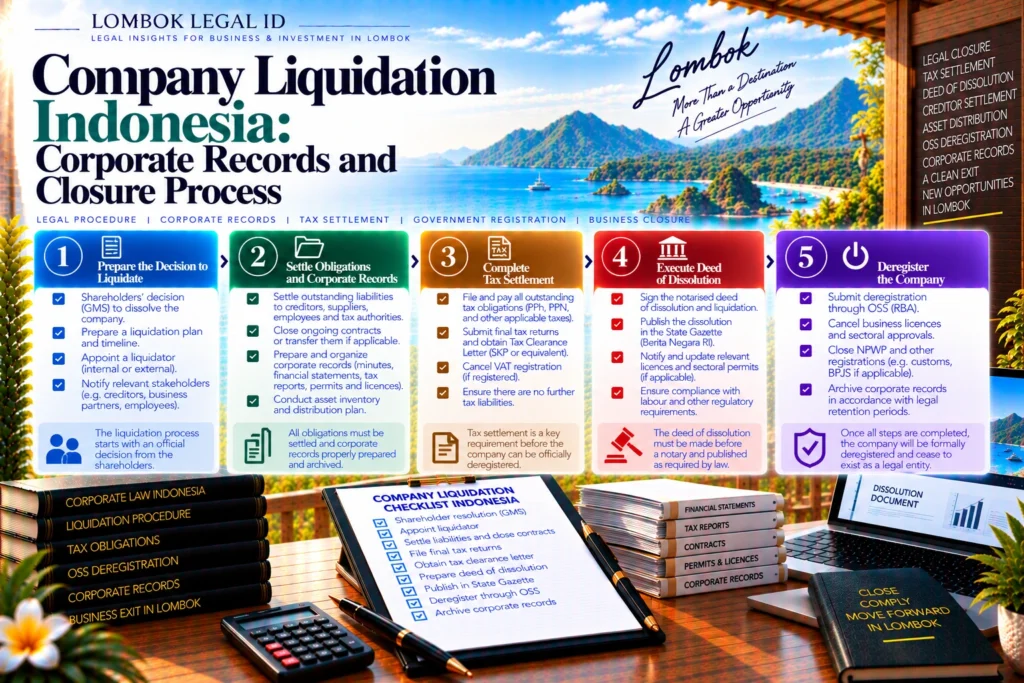
Company liquidation in Indonesia is not completed simply because shareholders decide to close the business. For an ordinary PT, the legal process moves through dissolution, liquidation, approval of the liquidator’s final accountability, and only then termination of the company’s legal-entity status.
Indonesia’s core liquidation framework for an ordinary PT remains Law No. 40 of 2007 on Limited Liability Companies, which the official BPK database lists as in force in amended form. The BPK status record identifies Law No. 6 of 2023 as the current amending law in the Job Creation amendment sequence relevant to the Company Law.
For investors reviewing the full company lifecycle, Lombok Legal ID’s PT PMA setup guide for Lombok provides the incorporation context. This article focuses on what happens at the other end of that lifecycle.
Company Liquidation Indonesia: Dissolution Is Not Immediate Deletion
The most important distinction is that dissolution does not immediately erase the company.
Article 143 states that dissolution does not cause the company to lose its legal-entity status until liquidation is completed and the liquidator’s accountability is accepted by the RUPS or the court under the Company Law.
That means a shareholder decision to dissolve the PT starts a settlement process. It is not the final administrative endpoint.
Step 1 — Identify the Legal Basis for Dissolution
Article 142 recognizes several grounds for dissolution, including a shareholders’ resolution, expiry of the duration stated in the Articles of Association, a court determination, specified bankruptcy or insolvency circumstances, and revocation of a business licence where the applicable rules require liquidation under the Company Law.
For an owner-initiated closure of an otherwise solvent PT, the usual starting point is a properly adopted RUPS decision or another valid shareholder decision permitted by the company’s governance framework. Court-driven, bankruptcy and licence-revocation closures follow different factual paths and should not be treated as interchangeable with a voluntary shutdown.
The practical review should therefore begin with the legal basis for dissolution, the latest Articles of Association, shareholder structure, outstanding disputes and the company’s financial position.
Step 2 — Appoint the Liquidator and Limit Company Activity
Once dissolution occurs, Article 142 requires liquidation by a liquidator or curator and restricts the company from undertaking legal acts except those needed to settle its affairs in liquidation under the official Company Law text.
For a dissolution based on a shareholders’ resolution, Article 142 states that the directors act as liquidator if the RUPS does not appoint another liquidator under the Company Law.
The company should therefore stop treating itself as an operating business pursuing new commercial transactions. Actions should instead be connected to collecting receivables, disposing of assets where appropriate, settling liabilities, handling claims and completing the liquidation.
The company still exists during liquidation
The company remains a legal entity during this stage, but its status must be visible.
From dissolution onward, Article 143 also requires the words ‘dalam likuidasi’ to be added after the company name in its outgoing correspondence under the official text.
This is useful for owners to remember when issuing notices, correspondence or settlement documents after the dissolution date.
Step 3 — Notify Creditors and the Minister
Liquidation is not a private arrangement among shareholders. Creditors must be given a formal opportunity to submit claims.
Article 147 requires the liquidator, within 30 days from the dissolution date, to notify creditors by announcing the dissolution in a newspaper and the State Gazette and to notify the Minister so the company is recorded as being in liquidation under the Company Law.
The announcement must identify the dissolution and its legal basis, the liquidator’s name and address, the procedure for submitting claims and the applicable claim period.
The creditor-notice period for submitting claims is 60 days from the date of that announcement under Article 147.
A company should therefore not distribute residual assets to shareholders before creditor exposure has been properly identified and addressed.
Step 4 — Settle Assets, Debts and Shareholder Residuals
The liquidator’s central job is to turn the company into a settled balance sheet rather than simply file paperwork.
Article 149 assigns the liquidator duties that include recording and collecting the company’s assets and debts, announcing the proposed distribution of liquidation assets, paying creditors, distributing any remaining assets to shareholders, and taking other steps necessary to complete the settlement under the Company Law.
This means the liquidation file should normally reconcile at least cash, bank accounts, receivables, inventory, fixed assets, shareholder balances, employee liabilities, supplier debts, loans, taxes, contractual obligations and disputed claims.
What if debts exceed assets?
A solvent voluntary liquidation should not be confused with an insolvent closure.
If the liquidator expects the company’s debts to exceed its assets, Article 149 requires a bankruptcy application unless another law provides otherwise or all known creditors agree to settlement outside bankruptcy under the Company Law.
That makes the company’s financial condition a legal decision point, not merely an accounting detail.
Step 5 — Approve the Final Liquidation Accountability
After assets and liabilities have been settled, the liquidator must close the accountability loop.
Article 152 makes the liquidator accountable to the RUPS or the court that appointed the liquidator for the liquidation performed under the Company Law.
The final report should therefore be supported by the underlying settlement records rather than treated as a formality. Owners should be able to explain how assets were realized, which claims were paid, how disputes were handled and how any remaining assets were distributed.
Step 6 — End the Company’s Legal-Entity Status in SABH
The corporate record must then move from ‘in liquidation’ to legally ended.
After the final liquidation accountability is accepted, Article 152 requires notification to the Minister and publication of the final liquidation result in a newspaper, after which the Minister records termination of the company’s legal-entity status and removes its name from the company register under the official Company Law text.
Article 152 gives a maximum period of 30 days from acceptance of the liquidator’s accountability for that notification and announcement under the Company Law.
The current Ministry administration procedure is Minister of Law Regulation No. 49 of 2025, which is in force from 17 December 2025 and revoked Minister of Law and Human Rights Regulation No. 21 of 2021.
Under Article 8 of the current Ministry procedure, both company dissolution and termination of the company’s legal-entity status are treated as changes to company data.
Article 12 of the current Ministry regulation requires dissolution documentation that matches the legal basis for the dissolution and, for termination of legal-entity status after liquidation, written liquidator or curator accountability, the newspaper announcement and the relevant final-accountability deed.
The result is a two-stage corporate record: first the dissolution is recorded, then the legal-entity status is ended after the liquidation has been completed and accepted.
Step 7 — Review Tax and Other Closure Records
Corporate legal closure should not be treated as the only administrative record that matters.
The Directorate General of Taxes’ current NPWP deletion service guide states that a corporate taxpayer that has been liquidated or dissolved can support its application with a copy of the dissolution deed or a similar document validated by the competent authority.
The tax record should therefore be reviewed separately from the corporate SABH record. Depending on the company’s activities, other licences, registrations, bank mandates, employment matters, contracts and operational records may also require separate closure or amendment steps.
Do not assume that one Ministry filing automatically closes every external registration connected to the company.
Eight Records to Prepare Before Starting Liquidation
Before the shareholders initiate a company liquidation Indonesia process, assemble a closure file containing at least:
- Latest deed and Articles of Association. Confirm shareholders, directors, commissioners and any special dissolution provisions.
- Shareholder decision documents. Prepare the RUPS or other valid shareholder decision supporting a voluntary dissolution.
- Creditor and debtor schedule. List suppliers, lenders, related parties, customers and disputed claims.
- Asset register. Reconcile cash, bank accounts, receivables, inventory, equipment, property rights and other assets.
- Employee and contract review. Identify obligations that must be settled or formally terminated.
- Tax and financial records. Bring accounting, tax returns and outstanding liabilities up to date before final settlement.
- Licence and registration inventory. List OSS, NIB, sector licences and other records that may require separate closure action.
- Evidence file for the liquidator. Keep announcements, creditor communications, settlement evidence, distribution calculations, minutes and final-accountability documents together.
A clean liquidation is therefore as much a records project as a legal filing. The stronger the underlying asset, debt and compliance records, the easier it is to support the liquidator’s final accountability.
Conclusion
Company liquidation Indonesia is a staged closure process. Dissolution starts the process, but the PT remains a legal entity while the liquidator identifies assets and liabilities, handles creditor claims and settles the company’s affairs.
Only after the liquidation has been completed, the final accountability has been accepted, the required announcements and Ministry notifications have been made, and the company’s legal status has been terminated does the corporate closure reach its legal endpoint.
Owners should then verify separate tax, licensing and operational records rather than assuming that termination in SABH automatically closes every obligation associated with the former business.
Prepare the Closure Before Passing the Dissolution Resolution
If your PT in Lombok is preparing to cease operations, Lombok Legal ID can assist with notarial documentation, company closure records and financial-compliance coordination based on the company’s actual legal and financial position.
A pre-liquidation review can help identify outstanding creditors, corporate documents and downstream tax or licensing records that should be resolved before the company reaches its final legal closure.
For help coordinating the documents and next steps discussed above, review our business setup in Lombok.
Read More: Company Setup Guide in Lombok: Entity Choice, OSS and Launch Planning
FAQ Company Liquidation Indonesia
Is dissolution the same as liquidation in Indonesia?
No. Dissolution triggers the liquidation process. The company generally remains a legal entity until liquidation is completed and the liquidator’s final accountability is accepted.
Who can act as liquidator after a voluntary company dissolution?
The RUPS may appoint a liquidator. If a dissolution based on an RUPS decision does not appoint another liquidator, the Company Law provides that the directors act as liquidator.
Can a company continue doing normal business after dissolution?
No. After dissolution, the company may carry out legal acts only as necessary to settle its affairs in liquidation.
How long do creditors have to submit claims?
Article 147 provides a 60-day claim period calculated from the date of the dissolution announcement.
When does the PT lose its legal-entity status?
The company does not lose legal-entity status immediately upon dissolution. After liquidation is completed and the final accountability is accepted, the required final notice and announcement are made and the Minister records the end of the legal-entity status.
Does liquidation automatically delete the company’s NPWP?
No. NPWP deletion is a separate tax-administration step. The current DJP service guide requires a dissolved or liquidated corporate taxpayer to provide appropriate dissolution documentation when applying for deletion.
What happens if the company owes more than its assets are worth?
Article 149 provides that the liquidator must apply for bankruptcy where the company’s debts are expected to exceed its assets, subject to the statutory exceptions stated in that article.
References & Sources
- Limited Liability Company Law No. 40 of 2007 — peraturan.bpk.go.id
- Law No. 6 of 2023 Establishing the Job Creation Government Regulation in Lieu of Law as Law — peraturan.bpk.go.id
- Official Text of Limited Liability Company Law No. 40 of 2007 — peraturan.bpk.go.id
- Minister of Law Regulation No. 49 of 2025 on Establishment, Changes and Dissolution of Limited Liability Companies — peraturan.bpk.go.id
- Official Text of Minister of Law Regulation No. 49 of 2025 — peraturan.bpk.go.id
- Directorate General of Taxes Guide to NPWP Deletion — pajak.go.id