
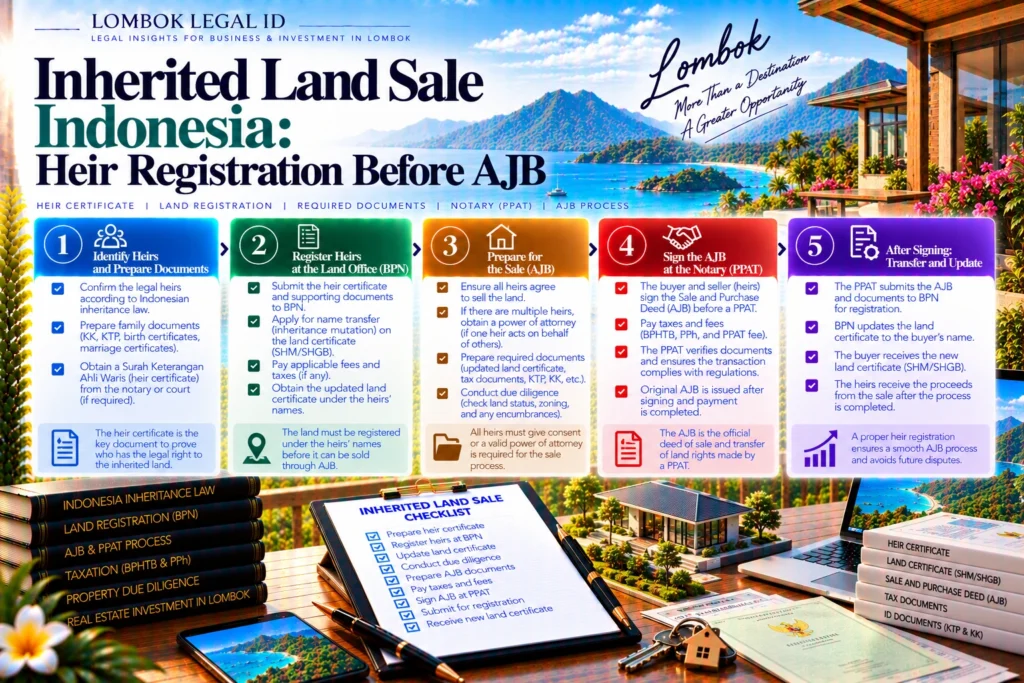
Selling inherited land in Indonesia is usually not an ordinary seller-to-buyer transaction from the first day. If the land certificate still records the deceased owner, the heirs first need to establish the inheritance position and bring the land-registration record into a form that supports the later sale.
The core framework remains Government Regulation No. 24 of 1997 on Land Registration, which the official BPK database lists as in force in amended form. Its current status record identifies Government Regulation No. 18 of 2021 as the amending regulation.
Inherited Land Sale Indonesia: Start With the Heir Record
The key question is not initially, ‘When can we sign the AJB?’ It is, ‘Who is legally entitled to the inherited land, and what does the current land record show?’
For registered inherited land, Article 42 requires the recipient of the inheritance to submit the relevant land certificate, the death certificate of the person recorded as the right holder and proof of heir status to the Land Office under the Land Registration regulation.
That inheritance-registration stage creates the bridge between the deceased registered holder and the person or persons who can later act on the seller side of an ordinary land transfer.
Step 1 — Prove the Inheritance
Start by assembling the documents that establish the deceased owner, the land right and the heir relationship.
The regulation’s explanation recognizes several forms of heir evidence depending on the applicable legal framework, but the exact document appropriate to a particular family should be confirmed from the facts rather than assumed from a generic checklist.
The practical review should therefore compare the certificate, death record, heir evidence, family information and any existing inheritance decision or deed. If those records conflict, the disagreement should be resolved before a buyer is asked to rely on a future AJB.
An inherited-land sale becomes significantly more complicated when the family knows informally who should receive the property but the inheritance documents and land-registration position say something different.
Step 2 — Decide How the Inherited Right Will Be Registered
Article 42 does not force every inheritance into one ownership structure. The registration result depends on the number of heirs and whether the estate has been divided.
One heir
If there is only one heir, Article 42 provides for registration of the inherited right to that person on the basis of the evidence of heir status under the same regulation.
Once the land record reflects that heir correctly, the later sale can be assessed from that person’s registered position rather than from the deceased owner’s record.
Several heirs with a division deed
Where several heirs submit a division deed stating that a particular land right falls to one specified heir, Article 42 allows the transfer to be registered to that heir on the basis of the heir evidence and the division deed under the regulation.
This route can be important where the family intends one heir to receive this particular parcel while other heirs receive different assets from the estate.
The division should be resolved before the sale structure is documented. A buyer should not be asked to assume that one family member can sell the entire parcel merely because the other heirs have verbally agreed.
Several heirs who remain joint holders
If several heirs remain entitled and no division deed allocates the property to one particular heir, Article 42 provides for registration of the inherited right as their joint right under the Land Registration regulation.
In that situation, the future transaction must be built around the actual joint-right structure. The heirs should identify early who must participate, whether a further division is intended and whether any disagreement could prevent the sale from proceeding.
This is a core inherited-land sale risk: several family members may agree that the land should be sold while still disagreeing over who has authority to sign, how the proceeds should be divided or whether the property should first be allocated to one heir.
Step 3 — Check BPHTB at the Inheritance Stage
Inheritance registration can have its own local-tax implications before the later buyer transaction is reached.
The national BPHTB framework is contained in Law No. 1 of 2022, which the official BPK database lists as in force.
Article 44 includes acquisition of land or building rights through inheritance within the BPHTB framework under Law No. 1 of 2022. For an inheritance acquisition, Article 49 places the BPHTB timing at the date the heir or the heir’s authorized representative registers the transfer of the right with the land authority under the national law.
Article 47 caps the BPHTB rate at 5 percent and requires the applicable rate to be set by regional regulation, so the inheritance-stage calculation should be checked under the rule applicable where the Lombok property is located under Law No. 1 of 2022.
For that reason, this article does not quote one inheritance BPHTB amount for all of Lombok. The property may fall within a different regency or the City of Mataram, and the current local regulation and applicable non-taxable acquisition value need to be checked for the actual location and taxpayer.
Step 4 — Make the Land Ready for the Later AJB
Inheritance registration and a sale AJB are different legal stages.
Once the heir-side land record is ready for an ordinary sale, Article 37 provides that a sale-and-purchase transfer is generally registered on the basis of a deed made by the authorized PPAT under the Land Registration regulation.
The PPAT office regulation remains in force in amended form. Its official status record identifies Government Regulation No. 24 of 2016 as the amendment, and that regulation remains in force.
Article 2 states that a PPAT performs specified land-registration work by making deeds evidencing legal acts, expressly including sale and purchase, that become the basis for changes to land-registration data under the PPAT office regulation.
Before execution, the certificate and registered ownership position still matter. For registered land, Article 39 requires the PPAT to refuse to make the deed if the original certificate is not produced or does not correspond with the Land Office record under the official regulation.
This is why unfinished inheritance registration should not simply be pushed to the AJB signing appointment. The seller-side record should first tell a coherent story about who inherited the land and who is entitled to transfer it.
Step 5 — Move to the Separate Sale Workflow
Once the heir-side registration and authority are clear, the later sale requires its own tax, PPAT and registration review. Inheritance-stage BPHTB and the buyer’s later acquisition should be assessed separately. Follow our land sale purchase deed AJB process guide for the signing and post-signing workflow.
Seven Checks Before Marketing Inherited Land for Sale
Before the heirs commit to a buyer or a signing date, work through these checks:
- Identify the registered owner. Confirm whether the certificate still names the deceased person.
- Establish the heirs. Assemble the death record and the appropriate proof of heir status.
- Decide the inheritance structure. Determine whether there is one heir, one heir receiving the parcel under a division deed, or several heirs retaining a joint right.
- Register the inheritance. Bring the land record into line with the heir structure before treating the property as an ordinary seller-side title.
- Check inheritance-stage BPHTB. Verify the local rule, taxable basis and any applicable non-taxable acquisition amount for the actual property location.
- Prepare for PPAT verification. Confirm the original certificate and Land Office data are consistent and identify any dispute, approval or other transfer obstacle.
- Separate inheritance from the later sale. Budget separately for the AJB-stage seller tax, buyer BPHTB and post-signing registration work.
This sequence is especially important where several heirs live in different places, one heir is expected to receive the land, or the family has already negotiated with a buyer before updating the land record.
Conclusion
An inherited land sale Indonesia transaction should normally begin with the inheritance record, not the AJB. The certificate, death record and heir evidence establish the starting point, while Article 42 determines whether the land is registered to one heir, one heir under a division deed, or several heirs jointly.
Only after that structure is clear should the heirs move into an ordinary sale process with PPAT verification, seller-side transfer tax, buyer-side BPHTB and the AJB.
For owners and investors, the practical objective is simple: make the registered seller-side position match the real inheritance position before asking the PPAT and buyer to complete the sale.
Resolve the Heir Record Before Scheduling the Sale
If inherited land in Lombok is being prepared for sale, Lombok Legal ID can assist with PPAT-related document preparation, land-certificate review, inheritance-registration coordination and property transaction documentation based on the actual heir structure.
A pre-sale review can help identify missing heir evidence, joint-right issues, tax steps or land-record inconsistencies before they delay the AJB.
For help coordinating the documents and next steps discussed above, review our ppat services in Lombok.
Read More: Property and PPAT Guide in Lombok: Due Diligence, Land Deeds and Registration
FAQ Inherited Land Sale Indonesia
Can heirs sell land while the certificate still shows the deceased owner?
The inheritance-registration position should be resolved before treating the land like an ordinary seller-to-buyer transaction. Article 42 requires the land certificate, death certificate and proof of heir status for registration of the inherited transfer.
What happens if there is only one heir?
Article 42 provides that the inherited land right can be registered to the sole heir on the basis of proof of heir status.
What if several heirs agree that one heir should receive the land?
Where a valid division deed states that the particular land right falls to one heir, Article 42 provides for registration to that heir using the heir evidence and division deed.
What if several heirs have not divided the inherited land?
Where several heirs remain entitled and no division deed assigns the land to one heir, the inherited right can be registered as their joint right.
Is there BPHTB when inherited land is registered?
Inheritance is included in the national BPHTB framework, and Law No. 1 of 2022 places the tax point at registration of the inherited transfer. The actual calculation depends on the applicable regional regulation and the circumstances of the property and taxpayer.
Does inheritance registration replace the later AJB?
No. Inheritance registration establishes the heir-side ownership record. A later sale is a separate transaction that generally uses a PPAT sale-and-purchase deed and subsequent transfer registration.
Does the seven-working-day rule mean the buyer gets the updated certificate within seven days?
No. Article 40 requires the PPAT to submit the executed deed and supporting documents to the Land Office within seven working days. It does not guarantee completion of the Land Office registration within that period.
References & Sources
- Government Regulation No. 24 of 1997 on Land Registration — peraturan.bpk.go.id
- Official Text of Government Regulation No. 24 of 1997 on Land Registration — peraturan.bpk.go.id
- Government Regulation No. 18 of 2021 on Land Rights and Land Registration — peraturan.bpk.go.id
- Government Regulation No. 37 of 1998 on the Office of Land Deed Officials — peraturan.bpk.go.id
- Official Text of Government Regulation No. 37 of 1998 on the Office of Land Deed Officials — peraturan.bpk.go.id
- Government Regulation No. 24 of 2016 Amending the PPAT Office Regulation — peraturan.bpk.go.id
- Law No. 1 of 2022 on Financial Relations Between the Central Government and Regional Governments — peraturan.bpk.go.id
- Official Text of Law No. 1 of 2022 on Central-Regional Financial Relations — peraturan.bpk.go.id
- Government Regulation No. 34 of 2016 on Final Income Tax for Transfers of Land and Buildings — peraturan.bpk.go.id
- Official Text of Government Regulation No. 34 of 2016 on Final Income Tax for Land and Building Transfers — peraturan.bpk.go.id