

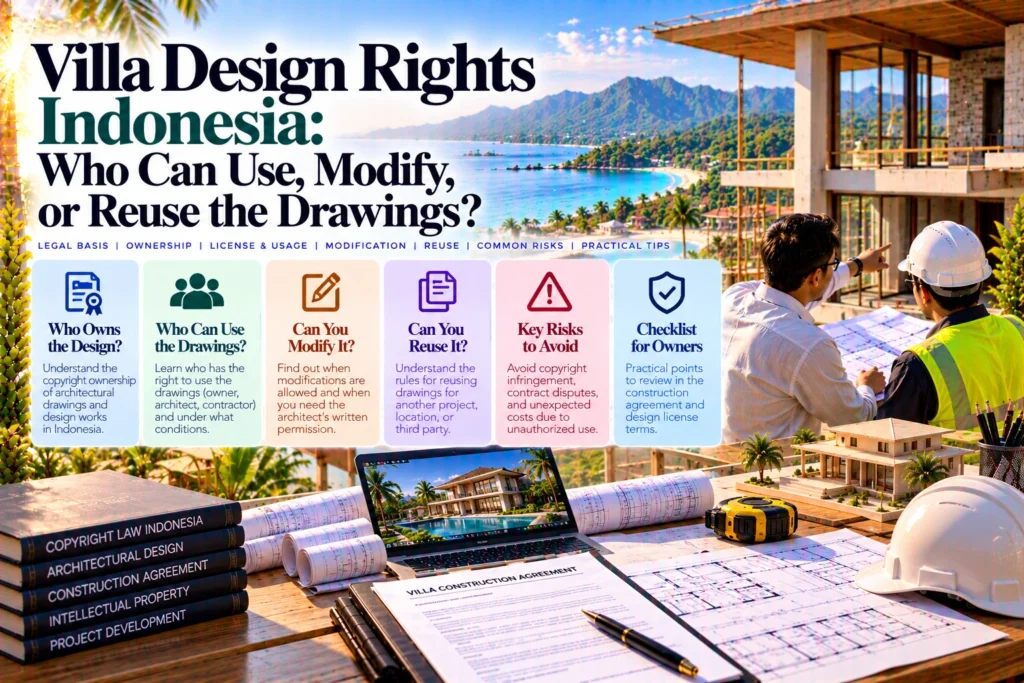
Villa Design Rights Indonesia: Payment Does Not Answer Every Rights Question
For villa design rights Indonesia, the first question is not simply who paid for the drawings. A villa owner may pay the architect or designer, receive PDF or editable files, and still need the agreement to state clearly who owns copyright and who may reproduce, modify, reuse, transfer, or continue the design with another consultant.
For construction planning services, Article 48 of Law No. 2 of 2017 on Construction Services requires the Construction Work Contract to contain provisions on intellectual property rights.
That requirement is especially relevant when the project involves architectural drawings, structural or engineering design, interior layouts, landscape plans, specifications, renderings, or other creative and technical documents that may be needed again after the original consultant’s appointment ends.
The current amendment framework is reflected in Law No. 6 of 2023, which is listed as in force and includes Law No. 2 of 2017 on Construction Services among the laws it amends.
Architectural Works Are Protected by Copyright
Article 40 of the Copyright Law expressly includes architectural works among the categories of protected works.
The official BPK regulatory database currently lists Law No. 28 of 2014 on Copyright as in force.
For a villa project, this means architectural design should not be treated only as a stack of physical or digital documents. The drawings can embody protected creative work, and the legal rights associated with that work are separate from the question of who physically possesses the files.
Article 4 of the Copyright Law states that copyright is an exclusive right consisting of moral rights and economic rights.
Economic Rights Control Reproduction and Modification
Articles 8 and 9 of the Copyright Law give the creator or copyright holder economic rights that include reproduction, adaptation or transformation, distribution, publication, communication, and other specified uses, while requiring permission for another person to exercise those economic rights.
This is why a design agreement should be more precise than saying the owner may ‘use the drawings for the project’. That phrase may be sufficient for one narrowly defined build but may not answer whether the owner can modify the design, construct another villa from the same drawings, send editable files to a successor architect, or use part of the design on another site.
The contract can deal with those questions through an assignment of rights, a license, or another clearly drafted permission structure. The appropriate structure depends on what the owner and designer actually intend.
Moral Rights Still Matter
Article 5 of the Copyright Law gives the creator moral rights including attribution-related rights and the right to defend the work against distortion, mutilation, modification, or other treatment that harms the creator’s honor or reputation.
Moral rights and economic rights should therefore not be treated as identical. Even where the commercial agreement gives the owner broad economic rights, the contract should still consider attribution, design credits, permitted modifications, and how future changes to the design will be handled.
Who Owns Commissioned Villa Drawings?
Commissioning and paying for architectural design does not automatically resolve every ownership question.
Article 36 of the Copyright Law provides that, unless otherwise agreed, the creator and copyright holder of a work made in a private employment relationship or on commission is the party who created the work.
That default rule makes the wording of the design agreement important. If the villa owner expects to own defined economic rights after paying the full design fee, the agreement should say which rights are transferred, when the transfer becomes effective, whether the transfer is complete or limited, and whether any rights remain with the designer.
Article 34 of the Copyright Law provides that where a work is designed by one person and executed by another under the designer’s direction and supervision, the person who designed the work is regarded as the creator.
This can matter when a villa is designed by an architect but physically drawn, modelled, or constructed with assistance from other personnel. The identity of the creator should not be inferred solely from who produced the final CAD file or who built the physical structure.
A Written Transfer Can Change the Default Position
Article 16 of the Copyright Law allows copyright to be transferred wholly or partly through, among other mechanisms, a written agreement.
For an owner, this means the agreement can deliberately change the default commercial position. But the transfer clause should identify what is being transferred instead of relying on broad language such as ‘all drawings belong to the client’.
Useful drafting questions include whether the owner receives rights to reproduce the drawings, modify them, appoint another architect to continue the work, use the design for later extensions, reproduce the design on another site, publish images of the design, or give drawings to contractors and consultants for project delivery.
Design Ownership Is Different From File Handover
Receiving drawing files and owning copyright are not the same issue. An owner may legitimately need final PDFs, CAD files, BIM models, schedules, specifications, calculation files, renderings, or other source materials so that the villa can be completed, maintained, altered, or repaired later.
The design agreement should therefore address both legal rights and deliverables.
A useful deliverables schedule can state:
- Which drawing packages must be handed over.
- Whether editable source files are included.
- Which file formats must be delivered.
- When files become due.
- Whether handover depends on payment of an identified invoice or milestone.
- Whether the owner may share the files with contractors, engineers, replacement designers, operators, or maintenance consultants.
- Whether the files may be modified and by whom.
- Whether the designer must provide revision histories or final as-issued documents.
These are practical contract terms. The Copyright Law does not replace the need to define the exact project deliverables.
What Happens If You Change Architect or Contractor?
A consultant change is where vague design-rights language often becomes commercially important. If the original architect stops work halfway through the project, the owner may need another professional to review, modify, complete, or coordinate the existing design.
Before that situation occurs, the contract should state whether the owner may give the drawings and source files to a replacement architect or engineer and whether the replacement consultant may modify those materials for completion of the same project.
The agreement should also distinguish between rights for the original villa and rights for future reuse. An owner may reasonably need broad rights to complete, repair, maintain, renovate, and extend the same villa while the designer may wish to retain control over reproduction of the same design on unrelated sites.
Those positions can be negotiated. The important point is to make the boundary explicit before a consultant change or dispute arises.
For broader agreement documentation in Lombok, the existing Lombok Legal ID guide to Notary Services in Lombok discusses agreement deeds, lease documentation, and other legal documents relevant to property and villa projects.
Clauses Owners Should Check Before Paying for the Design
Before signing a villa design or construction-planning agreement, review these points:
- Identify the designer, architectural practice, company, or individual contracting party.
- State who is expected to be the creator and copyright holder of each main design deliverable.
- Define whether economic rights remain with the designer, are licensed to the owner, or are transferred wholly or partly.
- State whether any transfer or license begins at signing, at a specific milestone, or after full payment.
- Define the owner’s right to reproduce drawings for construction, operation, maintenance, repair, renovation, and extension.
- State whether the owner may appoint another architect, engineer, or contractor to continue or modify the work.
- Define whether reuse on another site is permitted, prohibited, or subject to additional agreement.
- Specify whether editable CAD, BIM, source files, specifications, and schedules must be handed over.
- Define permitted sharing with contractors, engineers, lenders, operators, purchasers, tenants, and replacement consultants where relevant.
- Address design credits and attribution.
- Address the treatment of modifications that may affect the creator’s moral rights.
- Clarify ownership and permitted use of renderings, photographs, models, presentations, and marketing material.
- State what happens to unfinished design work if the appointment is terminated.
- Define any obligations to provide final or updated drawings after completion.
- Make the intellectual-property clause consistent with the construction agreement, consultant appointments, and actual project delivery structure.
The aim is not automatically to transfer every possible right to the owner. The aim is to make the commercial arrangement explicit enough that the parties know what the design may be used for after payment, completion, consultant replacement, sale, renovation, or future expansion.
Conclusion
Villa design rights are not determined by payment alone. Indonesian law protects architectural works and gives creators and copyright holders economic and moral rights, while commissioned works generally remain with the creator unless the parties agree otherwise.
For a villa owner, the most useful contract separates copyright ownership from project permission and file delivery. It should say who owns which rights, what the owner may reproduce or modify, whether another consultant may continue the work, which source files must be handed over, and whether the design can be reused beyond the original villa. Clear intellectual-property drafting at the beginning of the project is far easier to manage than negotiating those rights after the original designer has left the project.
Review Design Rights Before the Drawings Become Project-Critical
If you are preparing an architectural, design, or construction-planning agreement for a villa project in Lombok, Lombok Legal ID can assist with agreement documentation and legal review.
A pre-signing review can focus on copyright ownership, permitted project use, source-file handover, modification rights, replacement consultants, termination, and the relationship between the design agreement and the wider villa construction documents.
FAQ – Villa Design Rights Indonesia
Does paying an architect automatically give the villa owner copyright in the drawings?
Not automatically. Article 36 of the Copyright Law provides that, unless otherwise agreed, the creator and copyright holder of commissioned work is the party who created it. The agreement should state clearly if economic rights are to be transferred or licensed.
Can architectural drawings be protected by copyright in Indonesia?
Yes. Article 40 of Law No. 28 of 2014 expressly includes architectural works among protected works.
Can a villa owner give the drawings to another architect?
That should be addressed expressly in the original agreement. The owner’s ability to provide or modify the design materials through a replacement architect depends on the rights granted or transferred.
Is receiving the CAD or BIM file the same as owning copyright?
No. Physical or digital possession of a file and legal ownership of copyright are separate issues. The contract should address both source-file delivery and the rights to reproduce, modify, share, or reuse the design.
Can copyright in architectural work be transferred?
Yes. Article 16 of the Copyright Law allows copyright to be transferred wholly or partly through a written agreement, among other legally recognized mechanisms.
Should a construction-planning contract contain an intellectual-property clause?
Yes. Article 48 of Law No. 2 of 2017 requires intellectual-property provisions for construction-planning services.
References & Sources
- Copyright Law No. 28 of 2014 — peraturan.bpk.go.id
- Official Text of Copyright Law No. 28 of 2014 — peraturan.bpk.go.id
- Official Text of Law No. 2 of 2017 on Construction Services — peraturan.bpk.go.id
- Official Regulatory Status for Law No. 2 of 2017 on Construction Services — peraturan.bpk.go.id
- Law No. 6 of 2023 Establishing the Job Creation Emergency Regulation as Law — peraturan.bpk.go.id
Recommended Next Articles
- agreement and notary documentation for villa projects — lomboklegalid.com