

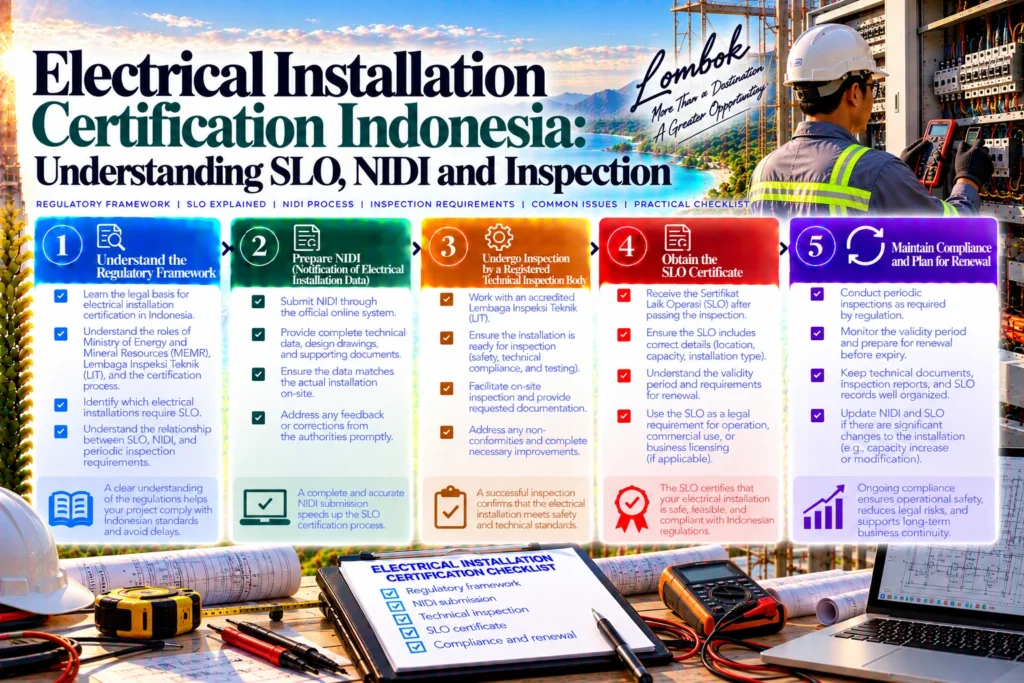
Electrical Installation Certification Indonesia: For most owners and investors searching for electrical installation certification Indonesia, the relevant installation-level document is the Sertifikat Laik Operasi, or SLO. It is the formal operating-fitness certificate for the electrical installation itself, not a competency certificate for the electrician and not a business certificate for the electrical contractor.
Article 49 of Government Regulation No. 25 of 2021 requires operating electrical installations to have a Sertifikat Laik Operasi (SLO) and states that the SLO is obtained through electrical-installation certification.
The same Article 49 framework covers power-supply installations consisting of generation, transmission, and distribution installations, as well as electricity-utilization installations at high, medium, and low voltage.
The official BPK regulatory database currently lists Minister of Energy and Mineral Resources Regulation No. 12 of 2021 as in force. That regulation provides the more detailed certification procedures used for different electrical-installation categories.
For the broader planning framework, read our Business Certification Guide in Lombok. For help with your project, see our Business Certification services.
SLO Is Different From Serkom and Electrical SBU
A major source of confusion is that several electricity-sector certificates may appear in the same project. They serve different subjects and should not be treated as substitutes for one another.
The Directorate General of Electricity’s current SIMATRIK guidance separates these obligations: electrical installations require an SLO, supporting electricity businesses require a business-entity certificate, and technical personnel require a competency certificate.
SLO Certifies the Installation
SLO concerns whether the actual electrical installation has been inspected and tested against the applicable technical requirements and can be declared fit for operation. The certificate therefore follows the installation rather than proving that an individual technician or contractor is generally competent for every electrical activity.
Under Article 49 of Government Regulation No. 25 of 2021, an SLO may be issued by the Minister or governor according to their authority, or by a technical inspection institution accredited by the Minister, and the certificate must receive a registration number from the Minister.
Serkom or SKTTK Certifies the Technical Worker
Technical-worker competency certification addresses the competence of the individual performing electricity-sector work. It does not replace the inspection and operating-fitness certification of the completed installation.
This distinction is especially important where a project file contains both certified personnel and a newly completed installation. Having qualified personnel does not by itself establish that the finished installation has obtained its SLO.
Electrical SBU Certifies the Supporting Business Entity
Electrical SBU or JBTL certification concerns the business entity performing supporting electricity services. It is therefore a company-level certification layer, while SLO remains installation-specific.
Businesses that also need to review their company-level certification can consult Lombok Legal ID’s verified Electrical SBU (JBTL) service page, but that business certificate should not be confused with the SLO required for the physical installation.
How the SLO Process Works
At a practical level, the SLO process starts after the relevant installation information has been prepared and the installation is ready for certification. The inspection institution then checks the application, performs the required inspection and testing, records the results, and proceeds with SLO issuance when the installation meets the applicable requirements.
For low-voltage utilization installations, Minister of Energy and Mineral Resources Regulation No. 12 of 2021 assigns inspection and testing to the Lembaga Inspeksi Teknik Tegangan Rendah (LIT-TR), which issues the SLO after the installation satisfies the applicable examination and testing requirements.
For low-voltage utilization installations, Article 43 of Regulation No. 12 of 2021 provides that inspection, testing, and SLO issuance are completed no later than three working days after a complete and correct application has been received.
That regulatory period should not be read as a guarantee that an incomplete, technically non-compliant, or correction-dependent installation will receive an SLO within three days. Document readiness and the installation’s inspection results still matter.
NIDI Comes Before the SLO Review
The Nomor Identitas Instalasi Tenaga Listrik, or NIDI, identifies the completed electrical installation and links its installation records to the certification process.
The Ministry of Energy and Mineral Resources explains that NIDI is used as a prerequisite for an SLO application after the completed installation work has been reported through the electricity-services system.
For an owner, this means the certification file should not be assembled as if the SLO were an isolated inspection certificate. Installation drawings, relevant installation information, the licensed installer or business involved in the work, and the NIDI record should reconcile with the installation that will actually be inspected.
The Inspection Institution Depends on the Installation
The certification route differs according to the type and voltage of the installation. Low-voltage utilization installations use the LIT-TR framework, while other categories use the technical-inspection framework applicable to generation, transmission, distribution, and higher-voltage utilization installations.
Owners should therefore identify the installation category before selecting an inspection institution. Choosing an institution only because it is nearby or familiar is not enough if its accredited scope does not match the installation requiring certification.
How Long Is an SLO Valid?
SLO validity is not the same for every electrical installation. The current regulation uses different periods according to the installation category.
The following table helps owners identify the normal validity period that applies to the main installation categories.
| Installation category | SLO validity |
|---|---|
| Power-generation installation | 5 years |
| Transmission installation | 10 years |
| Distribution installation | 10 years |
| High-voltage utilization installation | 10 years |
| Medium-voltage utilization installation | 10 years |
| Low-voltage utilization installation | Up to 15 years |
Under Regulation No. 12 of 2021, SLO validity is five years for generation installations, ten years for transmission, distribution, high-voltage utilization, and medium-voltage utilization installations, and up to fifteen years for low-voltage utilization installations.
The expiry date is therefore only one part of the compliance review. The condition and configuration of the installation must also be considered.
When an Existing SLO May No Longer Be Enough
An investor acquiring a building or business should not assume that an unexpired SLO automatically covers the installation in its current configuration. Renovation, equipment additions, increased capacity, relocation, or reconstruction can change the certification position.
An SLO should not be treated as valid solely by checking its expiry date because Regulation No. 12 of 2021 provides that specified changes such as capacity changes, installation changes, reconstruction or reconditioning, and certain relocations can cause the existing SLO to cease to apply.
For low-voltage utilization installations specifically, the regulation provides that the SLO ceases to apply where there is a capacity change, installation change, or reconditioning. The exact treatment should therefore be checked before energizing a materially modified installation.
This is particularly relevant in property or business due diligence. A certificate issued years earlier may relate to a different installed capacity or configuration from what is physically present today.
Pre-Operation Electrical Certification Checklist
Before operating, acquiring, or materially modifying an electrical installation, use the following review sequence:
- Identify whether the installation is generation, transmission, distribution, or a utilization installation.
- For a utilization installation, identify whether it is high, medium, or low voltage.
- Confirm that the installation work and technical records correspond with the physical installation.
- Check that the required NIDI information has been generated and can be matched to the installation.
- Select a technical inspection institution with the appropriate scope for the installation category.
- Prepare the application information and supporting technical documents required for inspection.
- Allow the authorized inspection personnel to perform the applicable examination and testing.
- Confirm that the issued SLO relates to the correct owner, installation, location, capacity, and technical scope.
- Check the SLO registration information and applicable validity period.
- If capacity, configuration, equipment, or location later changes materially, reassess whether the existing SLO remains applicable before relying on its original expiry date.
This checklist also helps separate installation compliance from company and personnel compliance. A project may need competent technical workers, an appropriately certified electrical-services business, and an SLO for the installation itself; satisfying one of those layers does not automatically satisfy the others.
For companies reviewing the wider certification structure, Lombok Legal ID’s Business Certification page provides the active site’s broader business-certification service context.
Conclusion
Electrical installation certification in Indonesia is primarily an SLO question. The certificate confirms the operating fitness of the installation after the applicable inspection and testing process, while Serkom or SKTTK addresses technical-personnel competence and Electrical SBU addresses the supporting business entity.
For owners and investors, the most useful compliance sequence is to identify the installation category, reconcile the NIDI and technical records, use the appropriate inspection institution, confirm the resulting SLO and its validity, and reassess certification whenever the installation is materially changed. That distinction prevents a personnel or company certificate from being mistakenly relied on as proof that the electrical installation itself is certified for operation.
Review the Electrical Certification Structure Before Your Project Proceeds
If your business is reviewing electrical-company certification, project documentation, or related business compliance in Indonesia, Lombok Legal ID can assist with business certification preparation and regulatory-document review.
For installation-level SLO matters, the installation type, NIDI record, inspection route, and current technical configuration should be checked separately from the company’s business-certification documents.
FAQ – Electrical Installation Certification Indonesia
What is electrical installation certification called in Indonesia?
The installation-level operating certificate is the Sertifikat Laik Operasi, or SLO. It is obtained through certification of the electrical installation.
Is SLO the same as Serkom or SKTTK?
No. SLO certifies the electrical installation, while Serkom or SKTTK concerns the competency of technical personnel working in the electricity sector.
Is Electrical SBU the same as SLO?
No. Electrical SBU concerns the supporting electricity business entity. SLO concerns whether a particular electrical installation has been inspected, tested, and declared fit for operation.
Is NIDI required before applying for SLO?
Current Ministry of Energy and Mineral Resources guidance identifies NIDI as a prerequisite for an SLO application and uses it to record the completed installation and related installation information.
How long is an SLO valid?
The period depends on the installation. Regulation No. 12 of 2021 provides five years for generation, ten years for transmission, distribution, and high- or medium-voltage utilization installations, and up to fifteen years for low-voltage utilization installations.
Can an SLO become unusable before its expiry date?
Yes. Depending on the installation category, specified changes such as capacity changes, installation changes, reconditioning, reconstruction, or certain relocations can affect whether the existing SLO remains applicable.
References & Sources
- Government Regulation No. 25 of 2021 on the Administration of the Energy and Mineral Resources Sector — peraturan.bpk.go.id
- Official Regulatory Status for Government Regulation No. 25 of 2021 — peraturan.bpk.go.id
- Minister of Energy and Mineral Resources Regulation No. 12 of 2021 on Classification, Qualification, Accreditation and Certification of Electricity Supporting Services — gatrik.esdm.go.id
- Official Regulatory Status for Minister of Energy and Mineral Resources Regulation No. 12 of 2021 — peraturan.bpk.go.id
- New Electrical Installations Must Be Reported and Have an Installation Identification Number — esdm.go.id
- SIMATRIK Electrical Safety and Certification Guidance — gatrik.esdm.go.id