

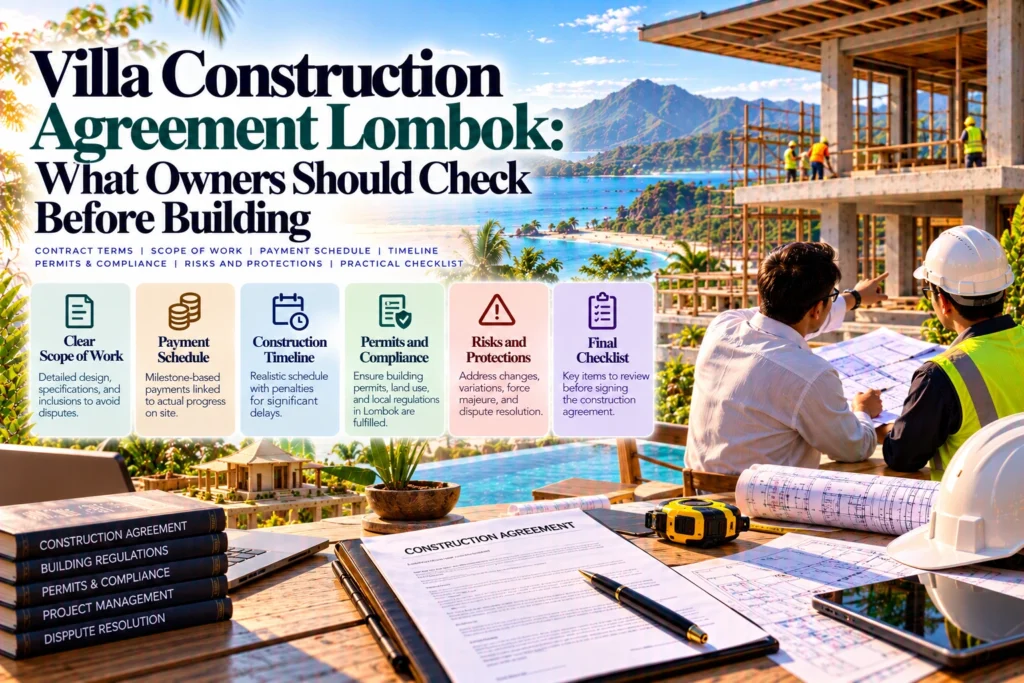
Villa Construction Agreement Lombok: Start With the Legal Minimum
A villa construction agreement Lombok owners can manage effectively should do more than state the contractor, total price, and completion date. It should function as the project’s operating rulebook: identifying exactly what will be built, which documents control the work, when money becomes payable, how changes are approved, what counts as completion, and what happens when the project deviates from plan.
Article 46 of Law No. 2 of 2017 on Construction Services requires the working relationship between a construction service user and provider to be set out in a Construction Work Contract.
Article 47 of Law No. 2 of 2017 requires the contract to identify the parties clearly and describe the work in detail, including scope, work value, unit price or lump-sum basis, and the implementation time limit.
The same Article 47 also requires provisions on the implementation and maintenance responsibility period, balanced rights and obligations, use of certified construction workers, and the payment method including payment security.
Article 47 further requires the contract to address default, dispute procedures, termination, force majeure, building failure, worker protection, third-party protection, environmental obligations, guarantees for project risks and legal liability, and the chosen construction-dispute mechanism under Law No. 2 of 2017.
The official BPK regulatory database lists Law No. 2 of 2017 as in force and records that it has been amended, including by Law No. 6 of 2023. The current amendment context is also confirmed by Law No. 6 of 2023, which is listed as in force and forms part of the current amendment framework affecting Law No. 2 of 2017 on Construction Services. The current implementing framework also includes Government Regulation No. 14 of 2021, which the BPK database lists as in force and as amending Government Regulation No. 22 of 2020 on implementation of the Construction Services Law.
At the general contract level, Article 1320 of the Indonesian Civil Code requires consent, capacity, a specific subject matter, and a lawful cause for a valid agreement. Article 1338 of the Indonesian Civil Code further provides that lawfully made agreements bind the parties and must be performed in good faith.
Define the Scope Before You Define the Price
The most common commercial problem in a private construction project is not necessarily the headline contract price. It is uncertainty about what that price includes.
For a villa project, the scope schedule should identify the building areas, structural work, architectural finishes, mechanical and electrical work, plumbing, pool work where applicable, external works, landscaping responsibility, utility connections, temporary works, testing, cleanup, and handover documents. It should also identify exclusions.
If the contract says ‘turnkey’ or ‘complete villa’ but the annexes do not define materials, specifications, quantities, and exclusions, the parties may still disagree about what completion means.
Attach the Drawings and Specifications
Do not rely on drawings exchanged informally through messaging applications. List each controlled drawing, specification, bill of quantities where used, material schedule, and revision number in the contract or an attachment incorporated into it.
Where the contract includes construction planning services, Article 48 of Law No. 2 of 2017 additionally requires provisions dealing with intellectual property rights.
For a villa project, the practical drafting question is therefore not only who creates the design, but also who may use, revise, reproduce, hand over, or continue using the drawings if the architect, designer, or contractor changes during the project.
Create a Written Variation Procedure
Construction changes are normal; undocumented changes are the risk. The agreement should define who is authorized to request a variation, what information the contractor must provide, and when the owner becomes committed to additional cost or time.
A useful variation record identifies the requested change, drawing or specification affected, price increase or decrease, time impact, and approval date. The contract should also state whether the contractor may proceed with a non-emergency variation before written approval.
This is a practical project-control mechanism rather than a separate statutory formula. Its purpose is to keep scope, price, and completion date synchronized throughout construction.
Tie Payments to Verifiable Progress
A payment schedule should explain more than percentages and dates. It should show what work must exist before each payment becomes due.
Because Article 47 expressly requires the construction contract to address payment, owners should align payment milestones with measurable construction progress. Examples may include mobilization, foundation completion, structural completion, roof completion, MEP rough-in, finishes, practical completion, and final handover, depending on the actual project.
Avoid copying milestone percentages from another villa project without checking whether its scope, procurement method, and material-purchase schedule are comparable.
Define What Evidence Releases Each Payment
For each milestone, specify the evidence needed for approval. That may include site inspection, progress photographs, measurement records, invoices for agreed materials, consultant certification, or an owner-approved progress report.
The agreement should also address advance payments, retention where negotiated, deductions, disputed invoices, tax documentation where applicable, and the final-payment conditions. These are commercial drafting choices and should match the project’s actual payment structure.
A payment certificate should not silently approve defective work or unauthorized variations unless the contract expressly says so. Keep acceptance of progress, valuation of work, and final quality acceptance conceptually separate.
Completion, Defects and Maintenance Need Separate Definitions
‘Finished’ is too vague for a construction agreement. The contract should define practical completion or the equivalent project milestone by objective conditions.
For a villa, that may require completion of the agreed work, testing of relevant systems, removal of temporary works and waste, correction of material defects preventing normal use, delivery of keys and agreed documents, and preparation of a remaining punch list.
The maintenance-responsibility period required in the construction-contract framework should also be translated into an operational process: how defects are reported, how quickly the contractor must inspect them, which defects remain the contractor’s responsibility, and what happens if correction is not completed.
Final handover can then be distinguished from practical completion. That allows the parties to manage minor outstanding work without pretending the entire project is either completely unfinished or completely accepted.
Allocate Delay, Force Majeure and Site Risks
The agreement should distinguish contractor-caused delay from owner-caused delay and events outside both parties’ control. Each category can have different consequences for time and cost.
For contractor delay, define notice, cure rights, revised schedules, and any agreed consequences. For owner-caused delay, address late access, late information, late decisions, or owner-initiated changes. Avoid using an automatic penalty figure copied from another contract without checking whether it is appropriate and enforceable for this transaction.
For force majeure, define the notification period, supporting evidence, duty to mitigate, effect on the construction schedule, treatment of additional costs, and when prolonged disruption may permit termination. Article 47 requires force-majeure provisions but leaves substantial risk allocation to the parties’ contract structure.
Site risks should also be addressed expressly. If the owner is responsible for land access, survey data, utilities, or approvals, say so. If the contractor must investigate particular site conditions, define the expected investigation and the consequences of discovering materially different conditions.
Check Contractor and Design Documentation
A well-written agreement does not replace contractor due diligence. Before signing, verify the identity and authority of the party that will actually perform the construction work and compare that entity with the invoices, bank account, certification records, and signatory shown in the contract.
For broader contractor-certification review, Lombok Legal ID’s verified Business Certification page covers Construction SBU within the active site’s certification services. This certification review is separate from deciding whether the commercial terms of a particular villa contract protect the owner adequately.
For agreements, deeds, and property-related documentation, the existing Notary Services in Lombok guide provides a separate first-party overview of agreement deeds, land documentation, and contract-related support.
If the villa is being built on leased land, the construction agreement should also be checked against the land lease. A construction contract cannot create broader rights to build, access, alter, or retain improvements than the project party actually holds under the relevant property arrangement.
Termination and Dispute Clauses Should Be Usable
A termination clause should not stop at saying either party may terminate for breach. Define the trigger, notice procedure, cure period where applicable, date termination becomes effective, site-security responsibility, valuation of completed work, treatment of unused materials, return of owner documents, and handover of drawings and project records.
The dispute clause should also be operational. State the first escalation step, the people authorized to negotiate, whether mediation or another agreed process comes next, and the selected final dispute mechanism.
The objective is not to make the contract longer for its own sake. It is to avoid discovering during a dispute that the agreement names a process without explaining how the parties are supposed to use it.
Pre-Signing Villa Construction Agreement Checklist
Before committing substantial funds, review these points:
- Verify the legal identity and signing authority of the owner and construction provider.
- Confirm the contractor entity matches the entity that will invoice and receive payment.
- Attach the final agreed drawings, specifications, material schedule, and pricing documents.
- State the contract price and whether it is lump sum, unit-rate based, or another agreed structure.
- Define exclusions and owner-supplied items.
- Set the start date, construction period, milestone dates, and completion test.
- Create a written variation procedure covering both price and time effects.
- Link payment milestones to measurable progress and required evidence.
- Define practical completion, punch-list work, final handover, and the maintenance or defects process.
- Address certified construction personnel and contractor compliance appropriate to the work.
- Allocate responsibility for site access, utilities, approvals, owner information, and design coordination.
- Define delay notices, extensions of time, force majeure, and prolonged disruption.
- Address worker safety, third-party loss, environmental obligations, insurance or other agreed risk protection.
- Clarify ownership and permitted use of architectural, engineering, and other design documents.
- Define default, cure, suspension where relevant, and termination consequences.
- Set a usable dispute-escalation and final resolution procedure.
- Check that the construction contract is consistent with the land title, lease, corporate structure, and project approvals relevant to the actual villa site.
This checklist should be adapted to the project’s delivery model. A simple labor-only contract, a full material-and-labor build, and a design-build arrangement do not allocate the same risks even when they concern the same villa.
Conclusion
A villa construction agreement is most useful when every important commercial promise can be measured later. Scope should connect to controlled drawings and specifications, payments should connect to evidence of progress, variations should connect to written approval, and completion should connect to defined handover criteria.
Indonesia’s construction-services framework already identifies the core subjects that a Construction Work Contract must address. The owner’s additional task is to make those subjects specific enough for the actual Lombok villa project so that price, time, quality, design responsibility, defects, risk, termination, and disputes can be managed from the document rather than reconstructed after a disagreement occurs.
Review the Contract Before Construction Payments Begin
If you are preparing or reviewing a villa construction agreement in Lombok, Lombok Legal ID can assist with contract documentation, notary services, construction-business compliance review, and related legal due diligence.
A pre-signing review can focus on the parties, project scope, drawings, variations, payment milestones, completion criteria, contractor documentation, risk allocation, termination, and dispute provisions before substantial construction funds are committed.
FAQ – Villa Construction Agreement Lombok
Does a villa construction project in Indonesia need a written construction contract?
Law No. 2 of 2017 requires the working relationship between a construction service user and provider to be set out in a Construction Work Contract. The agreement should address the statutory minimum subjects and the specific commercial details of the project.
What should be attached to a villa construction agreement?
Useful attachments commonly include controlled drawings, specifications, material schedules, bills of quantities where applicable, milestone schedules, payment schedules, and other documents the parties intend to form part of the agreed scope.
How should construction variations be handled?
The contract should establish a written process identifying the changed work, price effect, schedule effect, and required approval. The process should make clear who can authorize the change and whether work may proceed before approval.
Should the owner pay according to dates or construction progress?
The payment structure is a negotiated term, but for project control it is generally useful to connect payments to clearly defined milestones and evidence rather than relying only on calendar dates.
What should happen when the villa is substantially complete but minor defects remain?
The agreement can distinguish practical completion from final handover and define a punch-list and maintenance or defects process. This allows minor outstanding items to be documented without treating them as if no completion milestone has occurred.
Does the construction agreement replace contractor licensing or land due diligence?
No. Contract drafting, contractor business and personnel compliance, land or lease authority, and project approvals are separate review layers. They should be checked together for the actual villa project.
References & Sources
- Law No. 2 of 2017 on Construction Services — peraturan.bpk.go.id
- Official Text of Law No. 2 of 2017 on Construction Services — peraturan.bpk.go.id
- Law No. 6 of 2023 Establishing the Job Creation Emergency Regulation as Law — peraturan.bpk.go.id
- Government Regulation No. 14 of 2021 Amending the Construction Services Implementing Regulation — peraturan.bpk.go.id
- Indonesian Civil Code — jdih.mahkamahagung.go.id
- Official JDIH Record for the Indonesian Civil Code — jdih.mahkamahagung.go.id
Recommended Next Articles
- notary and agreement documentation in Lombok — lomboklegalid.com