
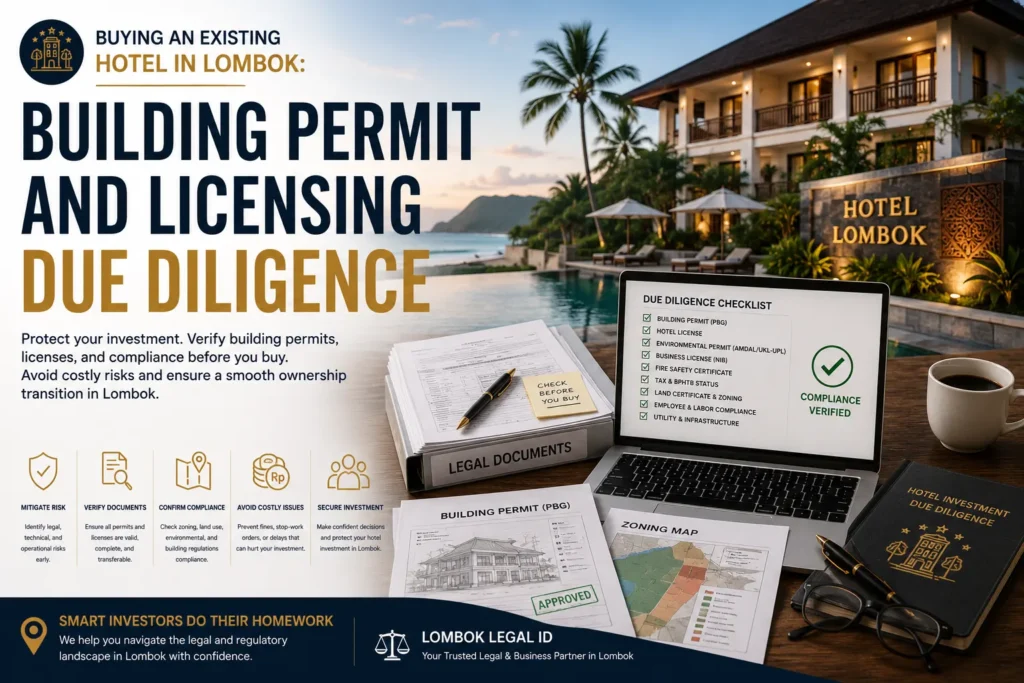
An operating hotel can look considerably safer than an undeveloped property. The buildings exist, guests may already be staying there, staff are working and the business may have been operating for years. None of those facts, however, proves that the land, buildings and business licenses are fully aligned with the property that an investor intends to acquire.
For this reason, Buying an Existing Hotel in Lombok should be treated as a multi-layer review rather than a simple check of the sale agreement and land certificate.
A practical acquisition review normally separates at least five questions: who controls the property, whether the physical hotel matches its approved building documentation, whether the building has the relevant functionality certification, whether the location supports the existing use, and whether the operating business has the appropriate OSS licensing for what it actually does.
For the broader planning framework, read our Company Setup Guide in Lombok. For help with your project, see our Business Setup services.
Buying an Existing Hotel in Lombok
The most important principle is that an operating business and a compliant property are not necessarily the same thing.
An investor should verify the legal position independently rather than assume that historical operation proves compliance.
Start by Defining What You Are Actually Acquiring
Before requesting documents, clarify the transaction structure.
The investor may be considering:
- Acquisition of the land and buildings
- Acquisition of shares in the company operating the hotel
- Acquisition of selected hotel assets
- Assignment or takeover of a long-term property lease
- A combination of property and corporate transactions
The diligence scope changes depending on the transaction. A share acquisition, for example, requires examination of the existing company’s legal and regulatory position, while a property acquisition places greater emphasis on the land, buildings and transfer documentation.
The transaction documents should be structured only after the investor understands what legal rights and regulatory liabilities are actually being acquired.
Check the Land and Property Position First
Building and business licenses do not replace land due diligence.
Indonesia’s land-rights and registration framework is addressed under Government Regulation No. 18 of 2021. Before relying on a hotel property as a transaction asset, investors should verify the relevant land rights, registration information and the seller’s or contracting party’s legal authority over the property.
Review the Certificate and Supporting Property Records
Depending on the structure of the transaction, the review may include:
- Registered land-right holder
- Certificate information
- Property boundaries
- Existing security or encumbrance information
- Transaction authority
- Supporting acquisition or lease documents
- Relationship between the land and the hotel buildings
Lombok Legal ID’s existing land certificate checking guide provides a separate overview of property certificate due diligence.
Review the Existing IMB or PBG
The next layer is the building itself.
Indonesia currently administers building approvals through the official SIMBG system under Government Regulation No. 16 of 2021.
Older hotels may still have an IMB issued under the previous building-permit framework. SIMBG states that an IMB issued before Government Regulation No. 16 of 2021 remains valid where the building was already constructed and has not undergone changes.
That qualification is particularly important in a hotel acquisition.
Do the Approved Plans Match the Existing Hotel?
An investor should compare the available IMB or PBG, approved drawings and recorded building information with what exists physically on the site.
Look for later changes such as:
- Additional rooms or villas
- Additional floors
- Expanded lobby or restaurant areas
- New pools or supporting structures
- Conference or event facilities
- Structural alterations
- Changed building function
- Extensions outside the original footprint
The objective is not merely to confirm that a document titled IMB or PBG exists. The review should establish whether that approval still corresponds to the hotel being acquired.
Existing Alterations Can Change the Risk Profile
If the physical hotel materially differs from its approved documentation, the investor should determine what regulatory action may be required before pricing the acquisition risk or finalizing the transaction.
This issue becomes even more important where further renovation or expansion is planned immediately after acquisition.
Verify the SLF and Functional Suitability
SLF, or *Sertifikat Laik Fungsi*, concerns whether a completed building is suitable for its intended function under the building framework.
The official OSS guidance for existing-building SLF applications specifically provides a process for buildings that already have an IMB or PBG.
For hotel acquisition due diligence, investors should therefore identify:
- Whether an SLF exists
- Which buildings it covers
- Whether the documented building matches the existing property
- Whether substantial later alterations occurred
- Whether further action may be needed for the current or proposed building configuration
An operating hotel should not automatically be assumed to have a complete SLF position solely because guests are already using the property.
Check Zoning and Spatial-Use Compliance
Land ownership and building approval should also be separated from zoning.
Indonesia’s national spatial-planning framework is governed by Government Regulation No. 21 of 2021, while detailed requirements depend on the spatial plans and zoning instruments applicable to the exact location.
Verify the Existing Use and Future Plan
The diligence question is not only whether hospitality use has historically occurred on the site. Investors should also determine whether the existing use and any proposed expansion are compatible with the current spatial-planning framework.
This becomes especially important if the acquisition strategy includes:
- Adding more rooms
- Developing additional villas
- Adding restaurants or event areas
- Increasing the development footprint
- Changing part of the site to another commercial use
The existing zoning check guide for Lombok can be used as a companion review for this part of the transaction.
Audit NIB, KBLI and OSS Business Licensing
A legally acceptable building does not automatically mean that the hotel business itself has the correct operating licenses.
Indonesia’s current overarching risk-based business licensing framework is Government Regulation No. 28 of 2025.
The acquisition review should compare what the business actually does with the company’s registered activities and OSS records.
Compare the Real Operation With the Registered KBLI
An existing hotel can have several revenue-generating activities beyond accommodation.
Depending on the actual operation, these may include food and beverage services, event activities, wellness services or other supporting businesses.
The review should therefore identify:
- What activities are actually performed
- Which entity performs each activity
- Which KBLI classifications appear in OSS
- What NIB and business-license records exist
- Whether additional certifications or supporting permissions apply to those activities
The correct licensing package must be determined from the actual business model and current OSS data rather than from the fact that the property is generally described as a hotel.
Review Environmental and Other Project-Specific Requirements
PBG, SLF and NIB should not be treated as the complete regulatory file.
Depending on the property, location, scale and operating activities, additional issues may need review, including environmental documentation, spatial requirements, water or infrastructure matters, building systems and other sector-specific approvals.
The diligence scope should therefore be adjusted to the particular hotel instead of applying one universal checklist to every acquisition.
Build a Pre-Acquisition Red-Flag Matrix
A useful due-diligence report should not simply list documents. It should show what each issue means for the transaction.
A practical matrix can classify findings as:
| Finding | Transaction Question |
|---|---|
| Documentation verified | Can the transaction proceed on the current basis? |
| Information incomplete | What must the seller provide before closing? |
| Physical building differs from approval | What regulatory or technical review is required? |
| License does not match actual activity | What correction or update is required? |
| Approval depends on future action | Should completion become a condition of the transaction? |
| Material unresolved issue | Does it affect price, structure, or whether the acquisition should proceed? |
This approach converts due diligence from a document-collection exercise into an investment decision tool.
Hotel Acquisition Due Diligence Checklist
Before completing an existing hotel acquisition in Lombok, investors should consider reviewing:
- Transaction structure
- Land certificate and property rights
- Encumbrances and transaction authority
- Existing IMB or PBG
- Approved plans and actual building configuration
- SLF status
- Zoning and spatial compatibility
- Environmental documentation where applicable
- NIB
- KBLI classifications
- OSS business licensing
- Supporting operational permissions
- Planned post-acquisition renovations or expansion
- Regulatory updates required after completion
Material issues should ideally be identified before the purchase price becomes unconditional or significant acquisition funds are committed.
Conclusion
Buying an Existing Hotel in Lombok: Building Permit and Licensing Due Diligence should examine the property, building and operating business as connected but legally distinct layers.
A stronger review sequence is:
transaction structure → land rights → zoning → IMB/PBG → physical-building comparison → SLF → NIB and KBLI → OSS licensing → additional project requirements → post-acquisition actions.
An operating hotel may have substantial commercial value, but the investment decision is stronger when the investor knows which rights and approvals are verified, which documents require updating and which unresolved issues should be addressed before the acquisition is completed.
Review the Hotel’s Legal and Licensing Position Before Acquisition
An existing hotel acquisition can involve land rights, building approvals, SLF, zoning and operating licenses at the same time. Reviewing these layers before the transaction is finalized can help identify missing documentation, historical alterations and licensing issues that may affect the acquisition structure or post-closing plan.
For a pre-acquisition consultation based on the property’s available documents and intended transaction, discuss the project with Lombok Legal ID before committing to the final purchase, lease or company acquisition.
FAQ – Buying an Existing Hotel in Lombok
What should I check before buying an existing hotel in Lombok?
A practical review should cover the transaction structure, land rights, certificate information, zoning, existing IMB or PBG, SLF, physical-building conformity, NIB, KBLI, OSS licensing and any additional approvals relevant to the hotel’s actual operation.
Is an old IMB still valid for an existing hotel?
SIMBG states that an IMB issued before Government Regulation No. 16 of 2021 remains valid for a completed building that has not undergone changes. If the hotel has been materially altered or expanded, the existing approval position should be reviewed against the current physical building.
Why should the physical hotel be compared with the PBG or IMB?
A building approval may relate to an earlier configuration. Additional rooms, floors, pools, restaurants or other later alterations can create differences between the approved documentation and the property an investor is actually acquiring.
Does an operating hotel need an SLF?
SLF concerns the functional suitability of a completed building. Investors should verify the SLF position of an existing hotel and determine whether the documentation corresponds to the current building configuration.
Does a PBG prove that the hotel has the correct business licenses?
No. PBG relates to building approval. Business licensing is reviewed separately through the company’s NIB, KBLI, OSS records and other activity-specific requirements.
Should zoning still be checked if the hotel has operated for years?
Yes. Historical operation does not replace current spatial due diligence, particularly when an investor plans expansion, additional villas, restaurants, event areas or another change in land use.
Why should I check the hotel’s KBLI before acquisition?
KBLI identifies registered business activities and affects the OSS licensing pathway. Investors should compare the hotel’s actual revenue-generating activities with the classifications and licenses recorded for the operating entity.
Is an NIB enough to prove that the hotel is fully licensed?
Not necessarily. Indonesia uses risk-based business licensing, and additional licensing, certification or supporting permissions can apply depending on the activities, risk classification and project circumstances.
What if the hotel has undocumented extensions or additional rooms?
The differences should be identified before acquisition and reviewed against the existing building approvals, technical records and applicable regulatory process. The finding can affect transaction conditions, renovation plans and post-acquisition compliance work.
Should due diligence be completed before paying the full purchase price?
From a transaction-risk perspective, material land, building and licensing issues are better identified before the acquisition becomes unconditional. The specific contractual treatment of findings should be determined for the actual transaction.
References & Sources
- Government Regulation No. 16 of 2021 on Building Implementation – JDIH Ministry of Public Works
- Official Building Management Information System – SIMBG
- OSS Guide for SLF Applications for Existing Buildings With IMB or PBG
- Government Regulation No. 28 of 2025 on Risk-Based Business Licensing
- Government Regulation No. 18 of 2021 on Land Rights and Land Registration – JDIH ATR/BPN