For most applicants, JBTL certification requirements fall into three main groups: the business must fit the correct electricity-support service classification and qualification, it must provide the required corporate and financial evidence, and it must have appropriately certified technical personnel for every subfield being requested.
The core certification framework is Minister of Energy and Mineral Resources Regulation No. 12 of 2021, which regulates classification, qualification, accreditation and certification of electricity-support service businesses. JBTL certification also sits within Indonesia’s wider business-licensing environment, whose current overarching framework is Government Regulation No. 28 of 2025.
JBTL Certification Requirements: What Businesses Need
A useful way to prepare is to separate company eligibility from technical personnel eligibility.
| Requirement area | What should be checked |
|---|---|
| Business activity | The actual electricity-support service and requested field/subfield |
| Business qualification | Small, medium or large qualification based on the applicable criteria |
| Corporate evidence | Establishment documents, legal-entity evidence, NPWP and declarations |
| Financial evidence | Financial statements appropriate to the business qualification |
| Technical personnel | Certified Penanggung Jawab Teknik and Tenaga Teknik for each requested subfield |
| Appointment evidence | Signed appointment letters and required work declarations |
This distinction matters because obtaining the corporate documents alone does not establish technical eligibility, while having qualified personnel does not replace the business entity’s certification and licensing requirements.
What Is JBTL Business Entity Certification?
Business Entity Certification for electricity-support services is a formal assessment of the classification and qualification of an electricity-support business.
Under Minister of Energy and Mineral Resources Regulation No. 12 of 2021, *Sertifikasi Badan Usaha* is the process used to obtain formal recognition of the classification and qualification of an electricity-support service business’s capability.
That is different from an individual competency certificate. The company is being certified as the business entity, while the technical personnel used to support the application need their own applicable competency certification.
Which Electricity-Support Activities Require a Business Entity Certificate?
Under Article 58 of Minister of Energy and Mineral Resources Regulation No. 12 of 2021, specified electricity-support service businesses—including consultancy, construction and installation, inspection and testing, operation, maintenance and technical-competency certification activities—must hold a Business Entity Certificate.
The higher-level basis is also found in Government Regulation No. 25 of 2021, which provides that electricity-support Business Entity Certificates are obtained through Business Entity Certification.
Start With the Correct Field and Subfield
Applicants should not begin with a generic request for an ‘Electrical SBU’ and only determine the scope later.
The intended service should be mapped to the relevant classification and subfield first because the technical personnel, competency certificates and certificate scope must correspond to what is being requested.
A company performing electrical installation work may therefore have a different certification scope from a consultancy, testing business, operator or maintenance provider.
Administrative Requirements for JBTL Certification
For the business entities covered by Article 58, the administrative requirements in the regulation include qualifying financial statements, the establishment deed and amendments where applicable, legal-entity approval or equivalent legality evidence, NPWP and a declaration confirming the accuracy of the submitted information.
Financial Statements Depend on Qualification
The financial-document requirement is not identical for every applicant.
For qualification purposes, the regulation distinguishes the supporting financial evidence: small businesses use the business entity’s financial statement, while medium and large qualifications use financial statements audited by a licensed public accounting firm for the relevant net-worth assessment.
This is an important preparation issue. An applicant should determine the intended qualification before assuming that an ordinary internal financial statement will be sufficient.
Technical Requirements: PJT and Certified Technical Personnel
The personnel layer is central to JBTL certification.
The technical requirements under Article 58 include a Penanggung Jawab Teknik (PJT) and Tenaga Teknik with competency certificates for each requested subfield, supported by appointment letters and statements confirming their work relationship with the applicant business.
Match Personnel to Every Requested Subfield
The regulation ties the technical requirement to each subfield being applied for. That means applicants should map personnel before submitting a broad certification scope.
A practical review should ask:
- Which fields and subfields will the business request?
- Who will serve as Penanggung Jawab Teknik for each relevant subfield?
- Which Tenaga Teknik will support that scope?
- Do their competency certificates correspond to the requested activity?
- Are the appointment and work declarations prepared correctly?
This personnel mapping can reveal a certification gap before the formal application begins.
How JBTL Business Qualification Is Determined
The same regulation classifies relevant electricity-support businesses as large, medium or small and bases qualification on technical-personnel competence and business capability, with business capability determined from net worth or annual sales.
Qualification is important because it affects the recognised level of business capability and is used to determine matters including the ability to perform work simultaneously and the limit applicable to one job under the regulatory framework.
Do Not Choose Qualification Only for Commercial Reasons
A company may prefer a larger qualification because it expects larger projects, but the certification application still has to satisfy the regulatory criteria for that qualification.
The better sequence is to review the company’s financial capability and certified personnel first, then determine which qualification the evidence can support.
Special Requirements for Foreign Representative Offices
Foreign investors should distinguish an Indonesian incorporated business from a foreign electricity-support company opening a representative office.
A foreign electricity-support company using a representative-office structure follows a separate requirement set under Article 59, including parent-company documents and Indonesian translation, NPWP, an embassy recommendation, appointment of the representative head, identification documents, audited parent-company financial statements and an NIB.
Its technical requirements also include appropriately certified or recognised Penanggung Jawab Teknik and Tenaga Teknik for every requested subfield, together with the corresponding appointment and work documentation.
The exact corporate route should therefore be established before a foreign investor builds the certification file around the domestic-company checklist.
Personnel Conflicts to Check Before Filing
Having certified personnel is not enough if the proposed roles conflict with regulatory restrictions.
Applicants should check personnel conflicts before filing because Article 61 restricts several overlapping roles, including the same Penanggung Jawab Teknik or Tenaga Teknik holding equivalent roles for the same type, field and subfield at another business.
The regulation also contains restrictions affecting commissioners, directors and officers of certification-related institutions in certain circumstances.
This makes personnel due diligence a useful pre-application step rather than a final document check.
Application Review, Timing and Certificate Validity
After submission, the certification authority evaluates the application and conformity of the requested classification and/or qualification; Article 63 states that approval or rejection is made no later than 14 working days after the application has been received completely and correctly.
That 14-working-day provision should not be presented as a guaranteed total project timeline. Time spent preparing corporate documents, correcting qualification evidence, securing appropriate technical personnel or completing other licensing steps occurs before or around the formal evaluation stage and depends on the applicant’s circumstances.
Under Article 64, a Business Entity Certificate generally remains valid for up to five years, while a certificate for a foreign electricity-support business operating through a foreign representative office is valid for up to three years.
Changes in classification or qualification data can require a certificate amendment, so certification should be treated as an ongoing compliance record rather than a one-time filing.
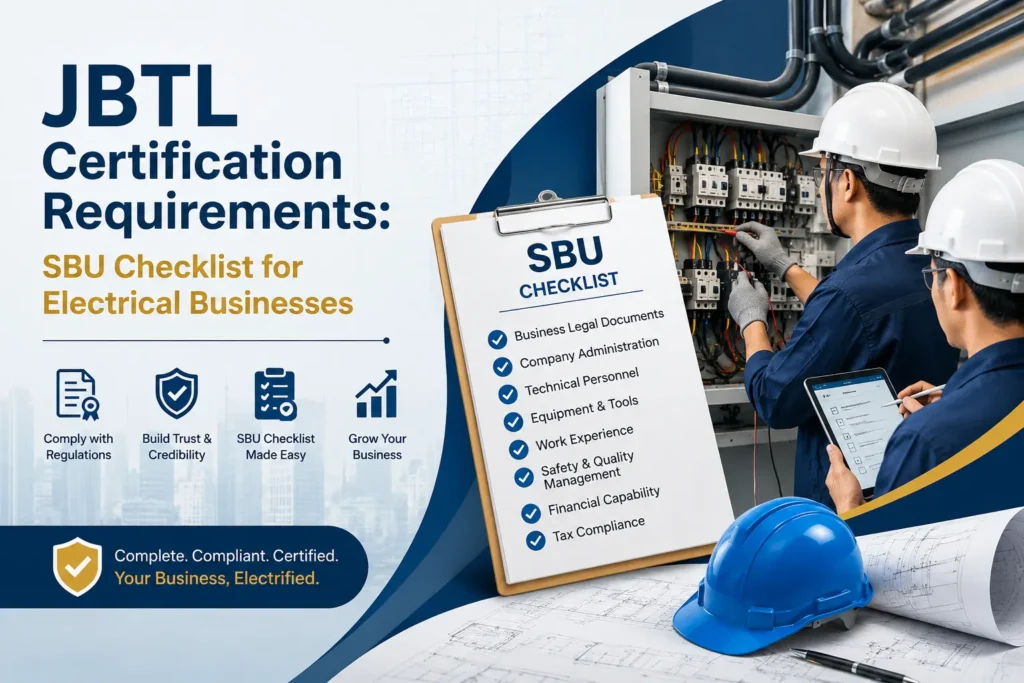
Practical Pre-Application Checklist
Before submitting a JBTL certification application, verify:
- The exact electricity-support service the company will perform
- The field and subfield being requested
- The appropriate small, medium or large qualification
- The financial evidence supporting that qualification
- Establishment and amendment deeds where applicable
- Legal-entity approval or equivalent legality evidence
- NPWP and required applicant declarations
- The Penanggung Jawab Teknik for each requested subfield
- The Tenaga Teknik and their applicable competency certificates
- Signed appointment and work declarations
- Whether any proposed personnel have prohibited overlapping roles
- Whether the business is an Indonesian entity or a foreign representative office subject to the separate Article 59 requirements
If the business still needs alignment between its corporate and OSS records and the certification activity, the existing NIB OSS RBA registration guide for Lombok provides useful background on the wider licensing layer.
Conclusion
JBTL certification requirements are not limited to submitting company documents. The application combines the correct electricity-support classification and qualification, appropriate financial evidence and certified technical personnel mapped to every requested subfield.
For foreign investors, the legal structure should also be confirmed early because foreign representative offices follow a separate requirement set. Reviewing the business scope, qualification, PJT, Tenaga Teknik, financial evidence and role conflicts before filing can make the certification assessment substantially clearer.
Check Your JBTL Scope and Requirements Before Filing
The correct JBTL certification file depends on the electricity-support activity, requested field and subfield, business qualification, financial evidence and certified technical personnel. Identifying those elements before submission helps separate missing documents from more fundamental eligibility or personnel issues.
For a consultation on Electrical SBU requirements and preparation in Lombok, discuss the proposed scope with Lombok Legal ID or review its verified Electrical SBU (JBTL) service as the next step.
FAQ – JBTL Certification Requirements: SBU Checklist for Electrical Businesses
What are the main JBTL certification requirements?
The main requirements are the correct electricity-support classification and qualification, appropriate corporate and financial evidence, and certified Penanggung Jawab Teknik and Tenaga Teknik for each requested subfield, together with the required appointment and work declarations.
Does JBTL certification require certified technical personnel?
Yes. Minister of Energy and Mineral Resources Regulation No. 12 of 2021 requires a Penanggung Jawab Teknik and Tenaga Teknik holding competency certificates for each requested subfield for the Article 58 business-entity certification route.
What financial documents are required for JBTL certification?
The requirement depends on qualification. The regulation uses the business entity’s financial statement for small-business qualification, while medium and large qualification uses audited financial statements for the relevant net-worth assessment.
Is NIB alone enough for an electricity-support business?
No. NIB belongs to the wider business-licensing framework. Electricity-support activities that fall under the Business Entity Certification obligation must separately satisfy the applicable JBTL certification requirements.
Can the same technical person be registered at more than one JBTL company?
The regulation restricts a Penanggung Jawab Teknik or Tenaga Teknik from holding the same role for the same business type, field and subfield at another business. The proposed personnel structure should therefore be checked before application.
How long does JBTL certification take?
Article 63 provides a maximum 14-working-day period for the certification authority to approve or reject issuance after the application has been received completely and correctly. This is not the same as a guaranteed total preparation timeline because document, qualification and personnel preparation may occur beforehand.
How long is a JBTL Business Entity Certificate valid?
Under Article 64, a Business Entity Certificate generally has a maximum validity of five years and can be extended. For a foreign electricity-support business opening a foreign representative office, the maximum validity is three years.
Do foreign representative offices have the same JBTL requirements as Indonesian companies?
No. Article 59 provides a distinct set of administrative requirements for foreign electricity-support businesses opening representative offices, including parent-company documentation, Indonesian translation, embassy recommendation, audited parent-company financial statements, NIB and representative-office documentation.
References & Sources
- Minister of Energy and Mineral Resources Regulation No. 12 of 2021 on Classification, Qualification, Accreditation and Certification of Electricity-Support Service Businesses
- Official Text of Minister of Energy and Mineral Resources Regulation No. 12 of 2021
- Government Regulation No. 25 of 2021 on Implementation of the Energy and Mineral Resources Sector
- Government Regulation No. 28 of 2025 on Risk-Based Business Licensing
- SIMATRIK – Directorate General of Electricity