

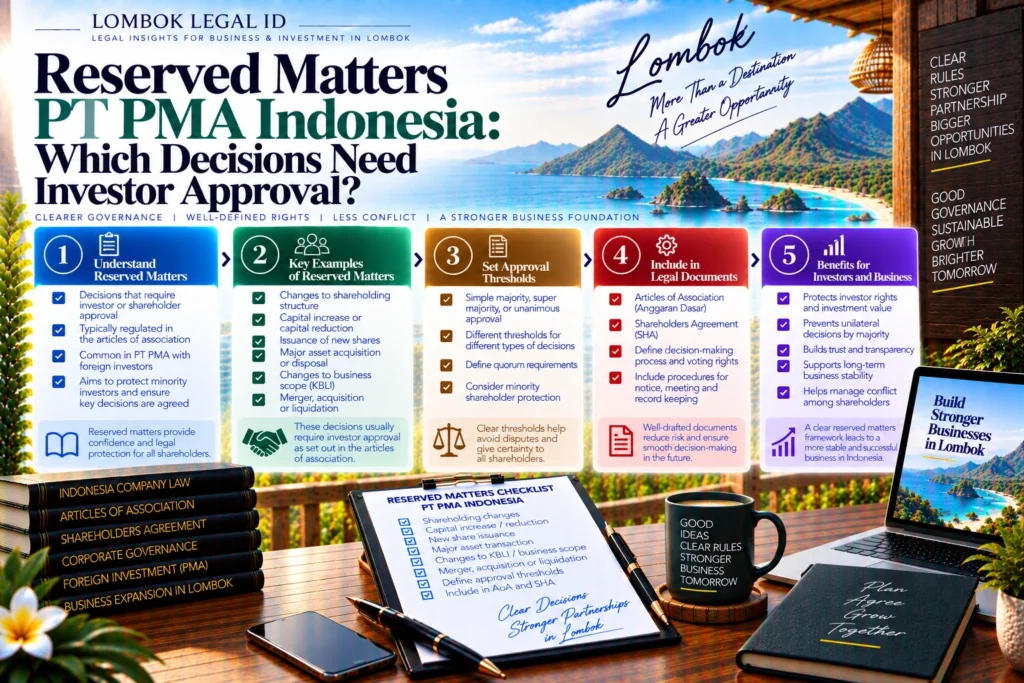
Reserved matters are decisions that shareholders agree should not be taken through ordinary management authority alone. For a PT PMA, however, the correct starting point is not a generic veto list: first identify which corporate organ Indonesian company law already authorizes to make the decision, then decide whether investors need an additional contractual approval right.
Indonesia’s central company-law framework remains Law No. 40 of 2007 on Limited Liability Companies, which the official BPK database lists as in force and amended, including through Law No. 6 of 2023.
Reserved Matters PT PMA Indonesia: Start With the Legal Decision-Maker
A shareholders agreement can allocate negotiated protections among investors, but it should not assume that every commercial decision legally belongs to the shareholders.
Article 75 provides that RUPS has authority not granted to the Board of Directors or Board of Commissioners within the limits established by the Company Law and the Articles of Association under the official Company Law text.
That creates the first drafting rule: identify the statutory or Articles of Association decision-maker before writing the reserved-matters clause. A contractual approval right can then be designed around that formal structure rather than contradicting it.
Three Layers of Corporate Decisions
Matters already requiring formal shareholder approval
Some matters already sit within an RUPS approval framework. These should not be drafted as though the shareholders agreement itself creates the requirement.
Article 88 generally requires at least two-thirds of all voting shares to be present or represented for an RUPS amending the Articles of Association and at least two-thirds of the votes cast to approve the amendment, unless the Articles of Association set a higher threshold under the Company Law.
Article 89 applies a higher RUPS threshold to merger, consolidation, acquisition, separation, an application for the company to be declared bankrupt, extension of the company’s duration, and dissolution under the official Company Law text. For the first meeting, Article 89 generally requires at least three-quarters of all voting shares to be present or represented and at least three-quarters of the votes cast to approve, unless the Articles of Association imposes a higher requirement under the official text.
Article 127 confirms that RUPS decisions on merger, consolidation, acquisition, or separation must be taken in accordance with Article 87 paragraph (1) and Article 89 under the official Company Law text.
Major asset transactions have a separate statutory trigger. Article 102 requires the Board of Directors to obtain RUPS approval to transfer company assets or encumber company assets as debt security when the transaction or transactions represent more than 50 percent of the company’s net assets, subject to the statutory exception for actions carried out in the ordinary course of the company’s business under its Articles of Association under the Company Law.
These statutory rules form a floor for the governance analysis. The commercial reserved-matters list can be broader, but it should not obscure which approvals are already required by the corporate-law framework.
Matters investors may reserve contractually
Investors often want approval rights before a decision becomes large enough to trigger a statutory RUPS threshold. These are commercial protections rather than a universal statutory list.
Common candidates include adopting or materially changing the annual budget, borrowing above an agreed amount, issuing new equity, entering significant related-party transactions, changing the principal business plan, acquiring or selling major assets below a statutory threshold, appointing specified senior executives, settling material litigation, granting security, or entering long-term commitments above agreed limits.
The reason to reserve a matter should be materiality, not habit. A useful test is whether the decision could materially change ownership, dilution, leverage, asset exposure, strategic direction, related-party risk, regulatory position, or the investor’s realistic exit options.
Matters that should normally stay with management
A reserved-matters schedule can become counterproductive if shareholders must approve routine purchases, normal hiring, ordinary customer contracts, or minor operational changes.
The Board of Directors remains the company’s management organ, while the governance documents can create defined approval boundaries. One useful alternative to shareholder approval for some legal acts is commissioner oversight: Article 117 allows the Articles of Association to authorize the Board of Commissioners to give approval or assistance to the Board of Directors for specified legal acts under the Company Law.
That distinction allows a PT PMA to protect investors without turning every management decision into an RUPS event.
How Approval Thresholds Differ
Not every matter should automatically use the same voting threshold.
Article 87 provides that if consensus cannot be reached, an ordinary RUPS decision is generally valid when approved by more than one-half of the votes cast, unless the Company Law or Articles of Association requires a larger approval threshold under the official text.
By contrast, Articles of Association amendments and the fundamental actions listed in Article 89 use higher statutory thresholds. A negotiated reserved-matters clause can also require stronger investor consent for specified commercial matters, but the drafter should distinguish that contractual protection from the statutory RUPS threshold.
For a joint venture, this distinction is especially important. A requirement for unanimous investor approval may provide strong minority protection, but it can also create a practical veto over decisions the business needs to make quickly. The right threshold depends on the ownership percentages, materiality of the decision, board structure, and deadlock mechanism.
Eight Reserved-Matter Categories to Consider
A PT PMA investor can review the following categories when designing a proportionate list:
- Capital and ownership. New shares, changes to share classes, significant capital changes, options, convertible instruments, or transactions that can dilute an investor.
- Budget and business plan. Adoption of the annual plan and material deviations beyond an agreed tolerance.
- Borrowing and security. New debt, guarantees, or security above monetary thresholds agreed by the shareholders.
- Major assets and investments. Acquisitions, disposals, capital expenditure, leases, or commitments above specified values.
- Related-party transactions. Deals involving shareholders, directors, commissioners, affiliates, or connected parties where conflicts may arise.
- Management and governance. Appointment or removal of specified senior positions, material changes to board structure, or delegations outside agreed limits.
- Strategic and regulatory changes. Entering a new material business line, abandoning a core activity, moving a major project, or taking an action that materially changes the regulatory profile.
- Exit and fundamental transactions. Merger, acquisition, separation, dissolution, sale of the business, or another transaction that changes control or the investor’s exit position.
The list should then be reconciled with the Articles of Association and the statutory approval rules. A clause that says ‘investor approval required’ is incomplete if it does not also identify how the company will implement the decision through the correct corporate organ.
How to Avoid a Governance Deadlock
Reserved matters work best when the drafting defines both the protected decision and the boundary of the protection.
For financial matters, use monetary thresholds rather than vague phrases such as ‘material expenditure.’ For recurring activities, an approved annual budget can allow management to act within agreed parameters while requiring investor approval only for significant deviations.
For emergencies, consider whether directors need a narrow ability to act to protect the company, comply with law, prevent loss, or respond to an immediate operational threat. Any exception should be precisely drafted rather than becoming a general way around investor consent.
A deadlock mechanism should also distinguish between ordinary disagreement and a true governance block. Escalation to senior representatives, a defined negotiation period, mediation, or an agreed exit mechanism can be more useful than simply requiring the same failed vote to be repeated indefinitely.
Investors who are still structuring the entity can review Lombok Legal ID’s PT PMA setup guide for Lombok alongside the governance documentation.
Pre-Signing Reserved Matters Checklist
Before finalizing the clause, review each proposed reserved matter through the following sequence:
- Identify the decision. Describe the transaction or action precisely enough that management knows when approval is triggered.
- Identify the legal decision-maker. Determine whether the matter belongs to RUPS, the Board of Directors, the Board of Commissioners, or another formal process.
- Check the statutory threshold. Do not replace a mandatory RUPS rule with a lower contractual threshold.
- Choose the investor threshold. Decide whether approval requires a simple investor majority, supermajority, class consent, or unanimity.
- Add objective triggers. Use amounts, percentages, durations, deviations from budget, or transaction categories where practical.
- Align the Articles of Association. Determine whether the protection also needs to appear in the formal constitutional documents or corporate approval mechanics.
- Test the clause against daily operations. Remove approvals that would unnecessarily obstruct routine management.
- Test the deadlock outcome. Decide what happens when the required investor approval cannot be obtained.
A strong schedule therefore does not maximize the number of vetoes. It reserves the decisions that can genuinely change the investor’s economic or control position while leaving ordinary execution with management.
Conclusion
Reserved matters PT PMA Indonesia should be designed around corporate authority first and investor protection second. Indonesian company law already assigns formal approval mechanics to matters such as Articles of Association amendments, specified fundamental transactions, and certain major asset actions; shareholders can then negotiate additional protections for commercially significant decisions.
The practical objective is balance. A reserved-matters schedule should protect capital, control, strategy, and exit rights without making the PT PMA unable to operate. Matching each matter to the correct corporate organ, approval threshold, trigger, and implementation document is more useful than copying a generic veto list from another joint venture.
Align Investor Approval Rights With the PT PMA Documents
If you are structuring or revising governance arrangements for a foreign-invested company in Lombok, Lombok Legal ID can assist with reviewing shareholder arrangements, corporate documents, business setup, and related notarial requirements.
A project-specific review can help identify which approvals belong in the shareholders agreement, which need alignment with the Articles of Association, and where an approval threshold could create unintended management or deadlock risk.
For help coordinating the documents and next steps discussed above, review our notary services in Lombok.
Read More: Notarial Documents Guide in Lombok: Preparing Deeds, Leases and Agreements
FAQ Reserved Matters PT PMA Indonesia
What are reserved matters in a PT PMA?
Reserved matters are specified decisions that investors agree should require an enhanced approval process rather than being left entirely to ordinary management. They should be distinguished from decisions that Indonesian company law already assigns to RUPS or another corporate organ.
Does Indonesian company law provide one fixed reserved-matters list?
No single universal investor veto list applies to every PT PMA. The Company Law assigns formal authority and approval rules to particular corporate actions, while shareholders may negotiate additional approval protections for commercially significant matters.
Does every reserved matter need unanimous shareholder approval?
No. The appropriate threshold depends on the ownership structure, importance of the matter, statutory requirements, minority-protection objective, and deadlock risk. Some matters may justify unanimity while others can use a supermajority or another agreed threshold.
Do Articles of Association amendments require a higher shareholder threshold?
Article 88 generally applies a two-thirds attendance and approval framework for an RUPS amending the Articles of Association, subject to the detailed statutory rules and any higher threshold in the Articles of Association.
When does a major asset transaction require RUPS approval?
Article 102 requires RUPS approval when directors transfer or encumber company assets representing more than 50 percent of the company’s net assets in one or more transactions, subject to the statutory ordinary-business exception.
Can the Board of Commissioners approve some significant transactions?
Yes, where the Articles of Association gives it that authority. Article 117 allows the Articles of Association to authorize the Board of Commissioners to give approval or assistance to directors for specified legal acts.
How can investors avoid reserved-matter deadlock?
Use clear financial and operational thresholds, avoid reserving routine management, distinguish fundamental matters from ordinary deviations, and include an escalation or exit mechanism for genuine deadlocks.
References & Sources
- Limited Liability Company Law No. 40 of 2007 — peraturan.bpk.go.id
- Official Text of the Limited Liability Company Law No. 40 of 2007 — peraturan.bpk.go.id
- Job Creation Law No. 6 of 2023 — peraturan.bpk.go.id