

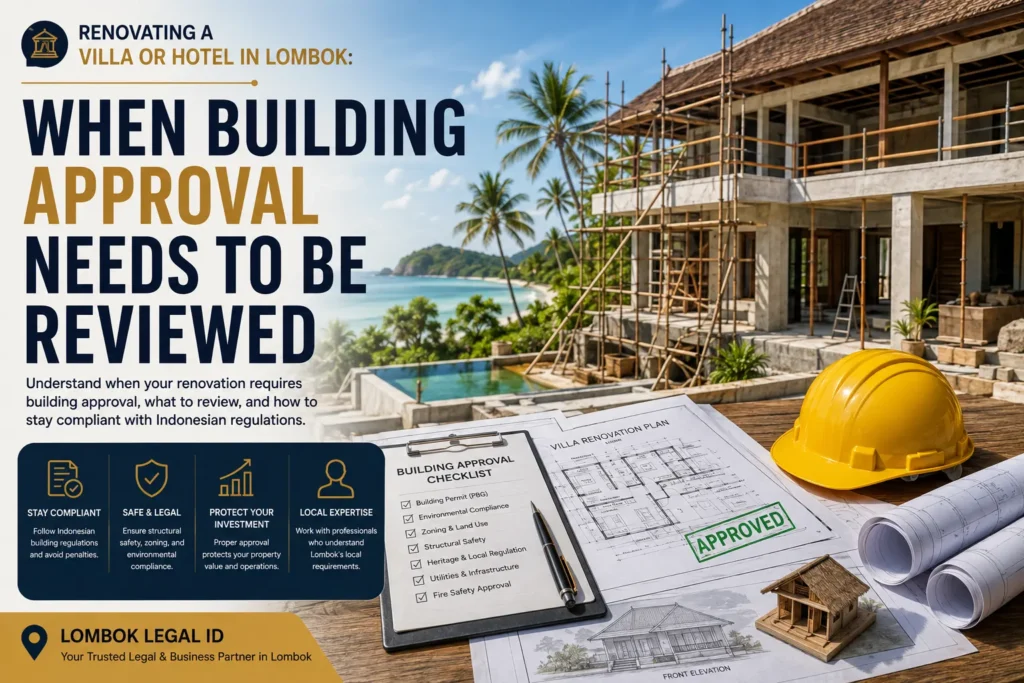
Renovating an existing hospitality property is different from constructing a completely new project. The building already has a legal and technical history, and the proposed renovation has to be assessed against that history before an owner assumes the existing approvals still cover the redesigned property.
For anyone Renovating a Villa or Hotel in Lombok, the first questions should therefore be: what building approval currently exists, does the physical building still match that approval, what exactly will change, and will the completed property retain the same function and licensing profile?
Indonesia’s building framework is governed by Government Regulation No. 16 of 2021, while PBG and SLF administration is handled electronically through the official SIMBG system.
For the broader planning framework, read our Company Setup Guide in Lombok. For help with your project, see our Business Setup services.
Renovating a Villa or Hotel in Lombok: Start With the Existing Building File
Before an architect redesigns rooms or a contractor begins demolition, collect the existing building documentation.
Relevant records may include:
- Existing IMB or PBG
- Existing SLF
- Approved architectural drawings
- Site plan
- Structural drawings where available
- Records of earlier extensions or alterations
- Land and spatial-planning documents
- Current operational and OSS information
The objective is to establish a reliable baseline showing what was previously approved and what physically exists today.
Older IMB Documents Still Matter
The SIMBG official guidance states that an IMB issued before Government Regulation No. 16 of 2021 remains valid where the building was already constructed and has not undergone changes.
That condition is important for renovation projects. If the existing property has already been extended, altered or changed in function, an investor should not assume that the historical IMB automatically describes the building as it exists today.
Compare Documents With the Actual Property
Before planning another renovation, compare the approved drawings and building information against the site.
Look for differences such as:
- Extra guest rooms
- Additional floors
- Enlarged restaurants or reception areas
- Added villas or detached structures
- New swimming pools or supporting facilities
- Structural alterations
- Changes in access or circulation
- A different building function from the original approval
Existing discrepancies should be identified before they become part of a larger renovation project.
When Renovation Can Affect PBG
PBG should not be understood only as an approval for a completely new building. Indonesia’s building framework also addresses changes to existing buildings.
A renovation should receive closer review when it changes the physical or functional characteristics reflected in the existing building approval.
Minor Maintenance and Material Alteration Are Not the Same
Repainting walls, replacing finishes or repairing equipment does not present the same regulatory issue as adding a floor, extending the building footprint or materially changing the structure.
Projects that deserve specific PBG review can include changes involving:
- Building area
- Number of floors
- Building footprint
- Structural elements
- Major additions
- Building function
- Significant configuration changes
The exact treatment should be confirmed through SIMBG and the competent technical authority for the regency or city where the property is located.
Do Not Design Around an Assumed Approval
A common investment mistake is completing the architectural design first and checking permits afterward.
A stronger sequence is to identify the existing approval, define the proposed changes, determine the regulatory implications, and then finalize the detailed design.
This reduces the risk of developing a concept that later needs material modification to align with the building-approval process.
Existing Buildings Without Complete PBG or IMB Records
Some investors acquire villas or hospitality properties where the building is already standing but the approval history is incomplete.
SIMBG specifically explains that an existing building without an earlier IMB or PBG can be handled through the existing-building SLF process, with the building-approval documentation addressed through that pathway. The detailed process should be confirmed against the project’s actual condition through SIMBG.
OSS also provides a separate SLF application pathway for existing buildings with an IMB or PBG.
This means an existing building should not automatically be treated as legally straightforward simply because it has been physically standing or commercially operated for several years.
What Happens to the SLF After Renovation?
SLF, or *Sertifikat Laik Fungsi*, concerns whether a building is suitable for its intended function in accordance with the applicable building requirements.
For a renovated hotel or villa property, the effect on the SLF should therefore be considered before the project is treated as operationally complete.
Renovation Can Change the Basis of Functional Suitability
A major renovation may change aspects relevant to how the building is ultimately assessed, particularly where the works alter the building configuration, capacity, structure or intended function.
The completed property should therefore be compared with the approved post-renovation design and the applicable SLF process before guests or commercial operations rely on the renovated areas.
Keep the PBG and SLF Review Connected
PBG and SLF represent different stages, but renovation planning should connect them.
The objective is for the regulatory record to follow the same project that is actually designed, constructed and eventually used.
Changing a Villa Into a Hotel or Commercial Accommodation
Renovation sometimes involves more than changing the building itself. An owner may convert a private villa into commercial accommodation, combine several villas into an operating resort, add a restaurant or significantly change the hospitality concept.
Building Function and Business Activity Are Separate Reviews
A change in the commercial model may require attention to both:
- Building approval and function
- KBLI and business activity
- NIB and OSS records
- Risk-based business licensing
- Supporting operational requirements
Updating the building does not automatically update the business license, and updating the OSS business activity does not automatically resolve building compliance.
For the business-licensing side, the existing NIB OSS RBA registration guide for Lombok explains how business activity and licensing are handled through OSS.
Zoning and Spatial Use Must Still Match the New Project
Renovation may also change the intensity or nature of land use.
A small existing villa and a substantially expanded hospitality operation do not necessarily present the same planning profile.
Before increasing building area or changing the project concept, check whether the proposed development remains compatible with the applicable spatial plan and land-use requirements.
Lombok Legal ID’s existing zoning check guide explains the importance of confirming the permitted land use before relying on a property for tourism development.
A Pre-Renovation Compliance Workflow
For an existing villa, boutique hotel or resort property, a practical review can follow this sequence.
Step 1: Collect the Existing Building Documents
Identify the IMB or PBG, SLF, approved drawings and available technical records.
Step 2: Inspect the Physical Property
Compare the building on site with the approved documentation and identify earlier undocumented changes.
Step 3: Define the Renovation Precisely
Separate cosmetic maintenance from structural, dimensional, functional or capacity-related changes.
Step 4: Check Spatial Compatibility
Verify that the expanded or altered concept remains compatible with applicable zoning and spatial-utilization requirements.
Step 5: Review PBG Implications
Determine whether the proposed renovation requires a new or adjusted building-approval process through SIMBG.
Step 6: Plan the SLF Stage
Identify what functionality review will be needed once construction is completed.
Step 7: Re-check Business Licensing
If the commercial activity, capacity or business model changes, review the KBLI and OSS licensing position separately.
Common Renovation Risks for Existing Hospitality Properties
Renovating Before Reviewing the Old Approval
The new design can compound an existing discrepancy between the approved plans and the physical building.
Assuming an Old IMB Covers Every Later Alteration
The SIMBG guidance expressly ties continued validity of an older IMB to a completed building that has not undergone changes. Material alterations should therefore be reviewed rather than presumed covered.
Focusing Only on Architecture
A visually successful renovation can still create regulatory issues if zoning, building approvals, environmental requirements or business licensing are addressed too late.
Buying a Property Because It Is Already Operating
Existing commercial operation does not prove that the building and licensing records accurately reflect the current property.
Treating PBG as the Only Required Review
A renovation can simultaneously affect spatial planning, building compliance, SLF and commercial licensing.
Conclusion
When Renovating a Villa or Hotel in Lombok, the safest starting point is the existing legal and technical building record, not the new design.
Compare the IMB or PBG with the actual property, identify the precise scope of renovation, review whether PBG-related action is required, plan the post-construction SLF stage, and separately check zoning and OSS licensing where the project concept or business activity changes.
This sequence gives investors a clearer view of the regulatory work before significant design and construction expenditure is committed.
Review the Existing Approvals Before Starting Your Renovation
Renovating an existing villa or hotel can expose earlier discrepancies in building approvals, approved drawings, zoning or operational licensing. Reviewing those records before design and construction decisions are finalized helps define which issues should be addressed as part of the renovation plan.
For consultation on an existing hospitality property or renovation project, provide the available IMB/PBG, SLF, building drawings, land documents and proposed renovation concept to Lombok Legal ID so the relevant legal and licensing review can be mapped before construction begins.
FAQ – Renovating a Villa or Hotel in Lombok
Do I need to review PBG before renovating a villa in Lombok?
Yes, particularly where the renovation changes the building footprint, floor area, number of floors, structure, configuration or function. The exact requirement should be checked against the existing approval and proposed works through SIMBG and the competent local authority.
Is an old IMB still valid after renovation?
SIMBG states that an IMB issued before Government Regulation No. 16 of 2021 remains valid where the building was already constructed and has not undergone changes. If the property has materially changed, the current building position should be reviewed rather than assuming the historical IMB still covers it.
Does cosmetic renovation require the same review as adding another floor?
Not necessarily. Cosmetic maintenance and material changes to the building’s area, structure, floors or function present different regulatory issues. The actual scope of work should be classified before the approval pathway is determined.
What if the existing villa was built without an IMB or PBG?
SIMBG provides a pathway for existing buildings that do not have earlier IMB/PBG documentation through the existing-building SLF process. The property’s physical and technical condition still needs to be assessed against the applicable requirements.
Should the SLF be reviewed after a major hotel renovation?
Yes. SLF relates to the building’s functional suitability, so material changes to the approved building or its intended function should be considered when determining the post-renovation SLF requirements.
Can I convert a private villa into a commercial rental villa simply by renovating it?
Physical renovation alone is not enough. The investor should separately check building function, zoning, KBLI, NIB and applicable OSS business licensing for the intended commercial activity.
Does a PBG automatically allow a hotel to operate?
No. PBG concerns building approval. Commercial operation may separately depend on NIB, risk-based business licensing, sector requirements and other applicable approvals.
Should zoning be checked again when expanding an existing hotel?
It can be important where the renovation increases development intensity, changes land use or materially changes the project concept. Spatial compatibility should be checked against the proposed development rather than only the original building.
Who processes PBG and SLF applications in Lombok?
Applications are submitted through the national SIMBG system and processed by the relevant technical and licensing authorities at regency or city level according to the location of the building.
What documents should I prepare before planning a hotel renovation?
Useful starting documents include the existing IMB or PBG, SLF, approved plans, land documents, records of previous alterations, current business licensing information and a clear description of the proposed renovation.
References & Sources
- Government Regulation No. 16 of 2021 on Building Implementation – JDIH Ministry of Public Works
- Official Building Management Information System – SIMBG
- OSS Guide for New Building Approval (PBG) Applications
- OSS Guide for SLF Applications for Existing Buildings With IMB or PBG
- Central Lombok Public Works Department 2025 Work Plan