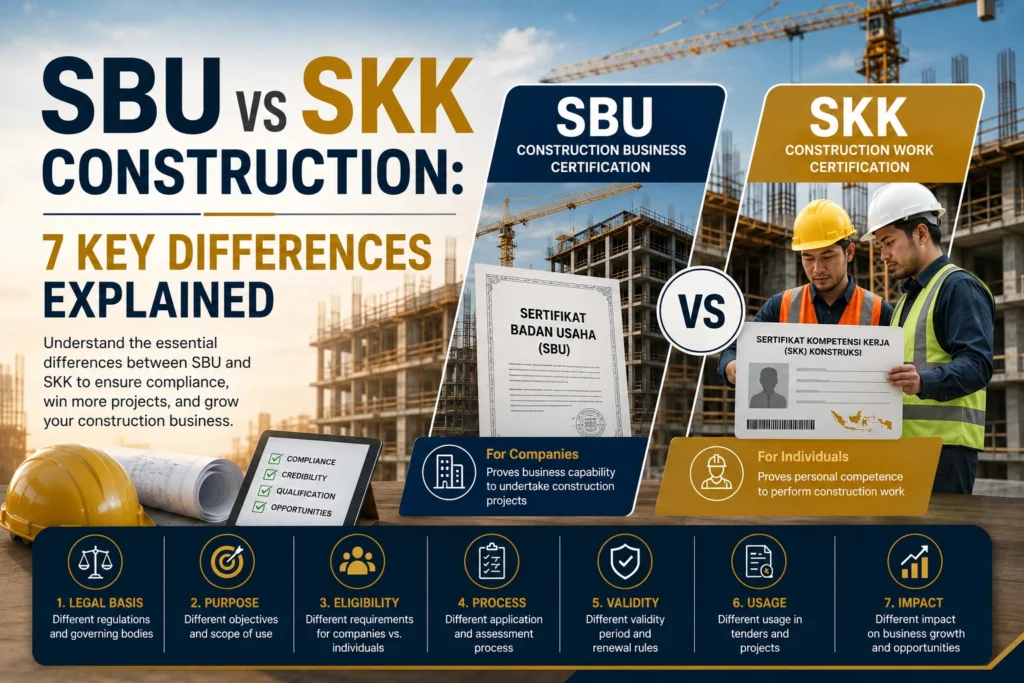
The core difference in SBU vs SKK construction is the legal subject being certified. SBU certifies the construction business entity, while SKK Construction certifies the competence of an individual construction worker. They can be connected in one company’s compliance structure, but one does not replace the other.
The legal distinction is explicit in Minister of Public Works and Housing Regulation No. 8 of 2022: SBU is proof of recognition of the classification and qualification of a construction business entity’s capability, while SKK Construction is proof of recognition of construction-worker competence.
Construction certification also operates within Indonesia’s wider business-licensing environment under the current Government Regulation No. 28 of 2025.
SBU vs SKK Construction: The Short Answer
Use SBU when the unresolved question concerns the construction company: its business classification, qualification and recognised capability.
Use SKK Construction when the unresolved question concerns an individual construction worker: the person’s recognised competency for a particular construction job and qualification.
The same PUPR regulation separates the two certification routes: a BUJK uses SBU for the relevant construction-services standard certification, while a TKK uses SKK Construction for competency certification.
The practical issue for a construction company is often not choosing one instead of the other. It is determining which SBU scope the company needs and whether the people supporting that scope have the appropriate competency certification.
Quick Company vs Individual Certification Comparison
The matrix below helps identify which compliance layer should be investigated before documents are prepared.
| Comparison | Construction SBU | SKK Construction |
|---|---|---|
| Who is certified? | Construction business entity | Individual construction worker |
| What is recognised? | Business classification, qualification and capability | Individual construction competence |
| Main assessment focus | Business capability and relevant construction scope | Job position, qualification and competency |
| Certification institution | LSBU | LSP licensed by BNSP and recorded with LPJK |
| New application route | OSS/PB-UMKU connected to the integrated construction-services system | Ministry licensing portal connected to the integrated construction-services system |
| Relationship to personnel | Personnel availability is part of business capability | Shows the individual’s recognised construction competency |
| Main planning question | Can the company support the intended SBU scope? | Does this person have the competency required for the intended role? |
The important implication is that SBU and SKK solve different problems but can become dependent on each other in a company application. A valid SKK confirms an individual’s competency; it does not automatically prove that the person is the correct personnel resource for every SBU classification, sub-classification or qualification.
What Is Construction SBU?
SBU, or *Sertifikat Badan Usaha*, is the construction business entity’s certification.
Under the current construction-services framework, it recognises the classification and qualification of the company’s capability. The PUPR certification procedure provides that SBU certification is conducted by an LSBU.
For the company route, a new SBU application is submitted through OSS using the PB-UMKU menu connected with the integrated construction-services information system.
What Does SBU Assess?
For a general construction business entity, the SBU capability assessment includes factors such as annual sales, financial capability, availability of construction workers and construction-equipment capability where applicable.
This means the certificate is not simply proof that a company has been incorporated. The company’s construction scope and supporting capability must be assessed against the classification and qualification being requested.
For company-level certification assistance, Lombok Legal ID maintains a Construction SBU service page.
What Is SKK Construction?
SKK Construction, or *Sertifikat Kompetensi Kerja Konstruksi*, is competency certification for an individual construction worker.
For the individual route, SKK Construction applications use the Ministry licensing portal connected to the integrated construction-services information system, and the applicant submits requirements corresponding to the selected job position and application type.
The Certificate Is Linked to a Defined Role
A new SKK application is not generic: the PUPR rules link it to the relevant construction job position, classification, sub-classification and qualification, with the applicable education and experience requirements taken into account.
This is why the question should not be only “Does this person have an SKK?” The more useful question is “Does this person’s SKK match the role and construction scope the company needs?”
For individual competency certification assistance, Lombok Legal ID maintains a Building Construction SKK service page.
7 Key Differences Between SBU and SKK
1. Company vs Individual
SBU certifies a construction business entity. SKK certifies an individual construction worker.
That distinction determines the purpose of each application.
2. Capability vs Competency
SBU evaluates the business entity’s capability for its requested construction scope.
SKK evaluates whether the individual satisfies the competency requirements associated with the applicable construction job and qualification.
3. LSBU vs LSP
They use different certification institutions. Under the current PUPR certification procedure, SBU certification is conducted by an LSBU, while SKK Construction certification is conducted by an LSP licensed by BNSP and recorded with LPJK.
4. Different Application Channels
New SBU filing begins through OSS/PB-UMKU and connects to the integrated construction-services information system.
SKK Construction follows the Ministry licensing portal connected to that integrated system.
The two applications should therefore not be treated as one administrative process merely because both belong to the construction-services framework.
5. Different Evidence
The SBU route looks at company-level capability information, including relevant sales, financial, personnel and equipment factors.
The SKK route is centred on the individual’s job position, certification scheme and competency requirements, including relevant education and experience.
6. Different Scope Logic
SBU is tied to the company’s construction classification, sub-classification and qualification.
SKK is tied to the individual’s construction job and competency qualification.
A practical consequence is that having any SKK is not enough by itself: because the regulation connects construction job positions, qualification and relevant sub-classifications, the company should check whether the individual’s competency actually matches the personnel role supporting the intended SBU scope.
7. They Can Be Interdependent Without Being Interchangeable
SBU and SKK remain legally distinct, but personnel can affect business certification.
Within the SBU personnel framework, construction-worker availability can involve roles such as Penanggung Jawab Badan Usaha, Penanggung Jawab Teknis Badan Usaha and/or Penanggung Jawab Subklasifikasi Badan Usaha, depending on the applicable certification requirements.
That is why an SBU application should not be treated as a company-document exercise that can be separated completely from personnel planning.
The Missing Question: Does the SKK Match the SBU Role?
A common comparison stops after saying that SBU is for the company and SKK is for the worker. That distinction is correct, but it is not enough for an actual SBU planning decision.
The next question is whether the proposed worker’s competency certificate fits the role, qualification and sub-classification the business entity needs.
For example, a company can have access to certified construction personnel and still need to verify whether those people satisfy the particular personnel configuration supporting its intended SBU.
This creates three separate checks:
- Does the company need the proposed SBU classification and sub-classification?
- Which personnel roles support that company certification scope?
- Do the proposed individuals hold competency certification suitable for those roles?
Passing one check does not automatically answer the other two.
Four Situations: Which Compliance Layer Comes First?
Scenario 1: An Individual Wants Construction Competency Recognition
The starting point is SKK Construction. The individual should identify the relevant job position and qualification and check the applicable education, experience and competency requirements.
There is no reason to treat company SBU as the individual’s first certification simply because the person works in construction.
Scenario 2: A Company Wants a New SBU
Start by mapping the company’s intended classification, sub-classification and qualification.
Then identify the personnel structure required to support that scope. If relevant personnel need suitable SKK, the competency layer should be resolved as part of the company’s SBU preparation rather than after the company has built an application around unsuitable personnel.
Scenario 3: The Company Has the Right Business Scope but a Personnel Gap
The issue may not require redesigning the entire SBU strategy. The immediate compliance gap may be identifying or qualifying the appropriate construction personnel.
In this scenario, the company should compare the SBU personnel requirement with the competency held by the proposed worker before assuming that any existing SKK will solve the problem.
Scenario 4: An Existing Company Changes Personnel or Expands Its Scope
Review both layers.
A new sub-classification or qualification can alter the personnel question, while a change in key personnel can affect whether the current company certification structure remains properly supported.
The relevant decision is therefore not automatically ‘SBU first’ or ‘SKK first’. It is which compliance dependency changed.
Five-Question SBU and SKK Readiness Audit
Before filing or changing either certificate, ask these questions:
- What is the company’s intended construction scope? Identify the classification, sub-classification and qualification rather than using only a broad description such as building contractor
- Which personnel roles support that SBU scope? Determine whether the company needs PJBU, PJTBU, PJSKBU or another applicable personnel configuration
- Does each proposed individual hold the appropriate competency certification? Check the actual job and qualification rather than only the existence of an SKK
- Which layer is currently incomplete? Distinguish a company capability problem from an individual competency problem
- Has the business or personnel structure changed? A new business scope, new sub-classification or personnel replacement may require the two certification layers to be reviewed together
This audit gives a more useful answer than asking generically whether SBU or SKK is ‘more important’. The two certificates perform different functions, and the correct next action depends on where the compliance gap sits.
For a broader view of the two commercial service pathways, the Business Certification page lists both Construction SBU and Building Construction SKK.
Conclusion
SBU is company-level construction certification, while SKK Construction is individual competency certification. They have different legal subjects, assessment logic, certifying institutions and application routes.
The more important operational question is how the two layers interact. A company preparing or changing an SBU should identify the intended construction scope first and then verify that the personnel supporting that scope have suitable competency certification. An individual professional, by contrast, should begin with the SKK job and qualification relevant to the work they perform.
Neither certificate is a universal substitute for the other, and neither should be selected only from its name. The correct sequence depends on whether the unresolved compliance issue belongs to the company, the individual or the relationship between the two.
Identify the Company or Personnel Gap Before Filing
Construction SBU and SKK address different compliance layers. Before filing, identify the company’s intended construction scope, the personnel roles supporting that scope and whether the proposed individuals hold competency certification that actually matches those roles.
For a certification review in Lombok, discuss the construction scope with Lombok Legal ID and determine whether the appropriate next step is Construction SBU, Building Construction SKK or coordinated review of both.
FAQ – SBU vs SKK construction
What is the main difference between SBU and SKK Construction?
SBU certifies the construction business entity’s classification, qualification and capability, while SKK Construction certifies the competence of an individual construction worker.
Does a construction company need SBU or SKK?
The company-level certificate is SBU, but the company can also depend on construction personnel with appropriate competency certification. The practical question is whether the people supporting the intended SBU scope hold SKK suitable for their roles.
Does any SKK qualify a person for an SBU personnel role?
No. The existence of an SKK alone should not be treated as proof that the holder fits every SBU role. The person’s construction job, competency qualification and alignment with the relevant company scope must be checked.
Can SKK replace Construction SBU?
No. SKK certifies an individual’s competency and does not certify the construction business entity.
Can SBU replace an individual’s SKK?
No. SBU recognises the construction business entity and does not replace competency certification applicable to individual construction personnel.
Who certifies SBU and SKK Construction?
Under Minister of Public Works and Housing Regulation No. 8 of 2022, SBU certification is conducted by an LSBU, while SKK Construction certification is conducted by an LSP licensed by BNSP and recorded with LPJK.
Should SKK always be obtained before SBU?
No. There is no universal sequence. An individual professional can pursue SKK independently. A company preparing SBU should first identify the intended business certification scope and then ensure that the personnel supporting that scope have suitable competency certification.