

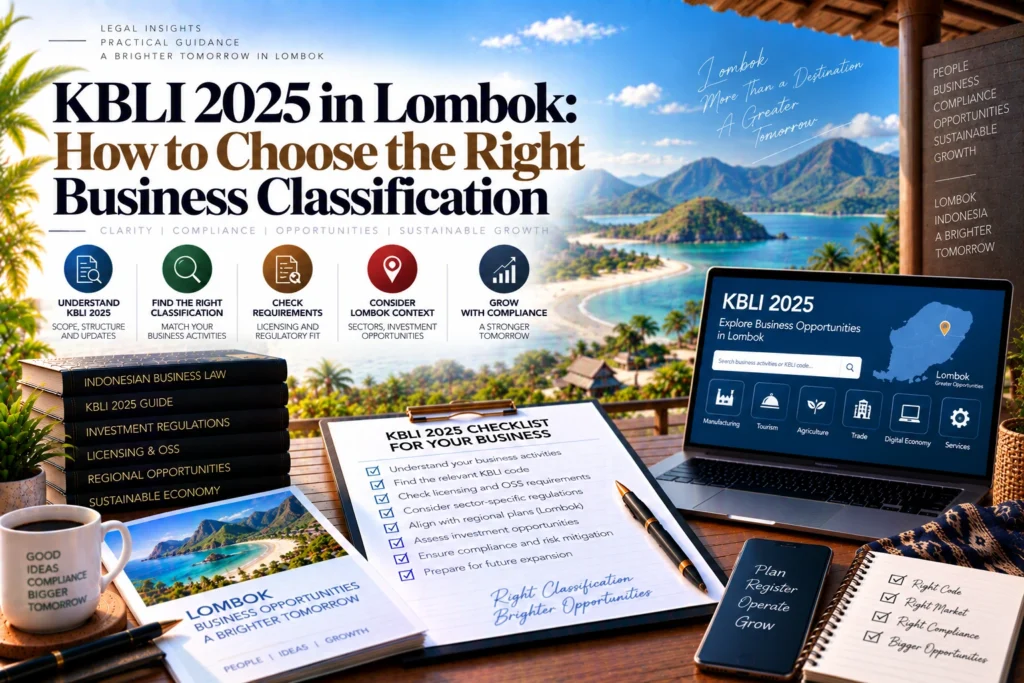
KBLI 2025 is now the classification framework businesses in Lombok should use when mapping their economic activities for company and licensing purposes. The important point is that there is no separate ‘Lombok KBLI’: the classification is national, while the correct code depends on what the business actually does.
The legal starting point is BPS Regulation No. 7 of 2025, which established KBLI 2025 as Indonesia’s official classification of economic activities and revoked the previous KBLI 2020 framework.
For the broader planning framework, read our Company Setup Guide in Lombok. For help with your project, see our Business Setup services.
KBLI 2025 Lombok: What Business Owners Need to Know
For an owner or investor researching KBLI 2025 Lombok, the practical job is not simply to find a code that sounds similar to the project name. The code should describe the real revenue-generating activity, and the licensing path should then be checked against that activity in OSS.
This matters particularly in Lombok’s hospitality and tourism market, where a hotel operator, accommodation-booking platform, restaurant, villa-related service and tourism intermediary may all use different classifications even if they serve the same visitor economy.
The first useful question is therefore: what does the company itself provide to the customer?
KBLI Is Based on Activity, Not Location
KBLI classifies economic activity at the national level. Lombok affects the project location and may affect downstream operational requirements, but it does not create a separate classification code simply because the business operates in NTB.
A company should begin with its actual activity and commercial role. Does it operate accommodation? Does it intermediate bookings? Does it operate a restaurant? Does it provide travel services? Does it lease property, manage property for somebody else or provide another tourism-related service?
That distinction should be made before incorporation or OSS amendment because a company name such as ‘resort’, ‘villa’, ‘hospitality’ or ‘tourism’ does not by itself determine the correct KBLI.
What Changed in September 2026?
KBLI 2025 was then amended by BPS Regulation No. 6 of 2026, which took effect on 10 September 2026.
Its official abstract identifies the principal September 2026 changes as KBLI 27201, 27203 and 68122, rather than a wholesale rewrite of every tourism, hospitality or service classification.
For most accommodation businesses, this means the correct task is still to verify the current OSS description of the relevant KBLI rather than assuming that every hospitality code changed again in September.
Do Existing Lombok Businesses Need New Permits?
A change from KBLI 2020 to KBLI 2025 does not automatically mean that every existing company must obtain a new business permit.
BPS has also explained that implementation of KBLI 2025 does not by itself require businesses to obtain new permits where there is no substantive change to the business activity.
The same BPS implementation guidance states that automatic OSS and AHU conversion applies where the business substance has not changed, while substantive changes to company purpose or activity scope require adjustment.
That distinction is important for existing Lombok businesses. A code conversion caused by the new classification is different from a company that has added a restaurant, booking platform, property-management service or another new activity that changes what the company actually does.
If the project has changed commercially, review the corporate objects, actual operations and OSS activity together rather than treating conversion as a purely administrative code update.
Hospitality Examples Under KBLI 2025
Hospitality demonstrates why classification should follow the business model.
For accommodation businesses, the current KBLI 2025 category 55 structure in OSS covers short-term accommodation and separates hotel activities, other short-term accommodation, camping or caravan activities, accommodation intermediation and other accommodation into different branches.
Non-Star Hotel — KBLI 55106
A commercial non-star hotel should examine KBLI 55106, which OSS identifies as the current non-star hotel activity and as the one-to-one conversion destination for former code 55120.
This classification focuses on operating accommodation that meets the relevant non-star hotel description. It should not be selected merely because a property is rented to tourists if the actual model fits a different short-term accommodation class.
One-Star Hotel — KBLI 55105
A one-star hotel instead falls under KBLI 55105, which OSS shows as the KBLI 2025 conversion destination for former code 55110.
The distinction between hotel classes matters because OSS may display different scopes and supporting licensing requirements depending on the selected activity and scale.
Apartment Hotel or Condotel — KBLI 55204
An apartment-hotel or condotel model should be checked against KBLI 55204, which covers short-term accommodation using apartments as hotels and converts former code 55194 on a one-to-one basis.
This is a useful example of why an investor should not automatically reuse a general hotel code for every accommodation project. The physical property format and the operating model both matter.
Accommodation Booking and Intermediation — KBLI 55400
A business that intermediates accommodation rather than operating the accommodation itself should examine KBLI 55400, which covers accommodation booking and intermediation through digital or non-digital channels and shows a one-to-one conversion from former code 63122 for this activity.
A booking platform can therefore be economically connected to hotels while still requiring a fundamentally different KBLI from the hotels listed on its platform.
How to Select the Right KBLI Before OSS Filing
A practical classification review can be reduced to several questions.
First, describe each revenue-generating activity without using a brand name. Second, identify whether the company operates the service itself or only connects customers with another provider. Third, check whether different parts of the business are separate activities—for example accommodation plus restaurant operations, hotel operations plus booking intermediation, or property ownership plus management services. Fourth, compare each material activity with the current KBLI 2025 description and conversion information in OSS.
Existing companies should add one more step: compare the current business with the purpose and activity already recorded in the company documents and OSS profile. A new KBLI number caused by official conversion is not the same thing as a genuinely new business activity.
Avoid choosing extra codes merely as a precaution. The better objective is to represent the activities the company genuinely conducts or is preparing to conduct and then evaluate the licensing consequences of each one.
Check OSS Licensing After the Classification Is Chosen
KBLI selection is not the end of the licensing analysis. OSS uses the selected activity as part of the risk-based licensing process and can display activity-specific scope, risk level and supporting requirements.
Once the activity is mapped, businesses should review the current OSS licensing output because Minister of Investment and Hilirisasi/BKPM Regulation No. 5 of 2025 remains the current procedural framework for risk-based business licensing and investment-facility administration through OSS.
This is especially important for a Lombok hospitality project that combines multiple functions. The accommodation operation may have one classification, a restaurant another, and a booking or intermediation activity another. Each should be reviewed on its own facts rather than assuming that one hotel-related KBLI covers the entire commercial model.
Where a company is still at the planning stage, classification should ideally be reviewed before finalizing its company purposes and OSS activities. For an existing operation, review the actual business model before changing corporate or licensing records.
Conclusion
KBLI 2025 does not create a special classification system for Lombok. It provides a national framework that Lombok businesses use according to their actual economic activities.
For owners and investors, the most reliable sequence is to identify the real business activity, verify the current KBLI 2025 description, distinguish automatic conversion from a substantive business change, and then review the OSS licensing requirements connected to the selected code.
Hospitality businesses illustrate the importance of that process clearly: a non-star hotel, one-star hotel, apartment hotel and accommodation-booking platform may operate in the same tourism market while requiring different KBLI classifications.
Confirm Your KBLI Before Finalizing a Lombok Business Setup
If you are establishing or restructuring a business in Lombok and need to align the operating model with company activities and OSS registration, Lombok Legal ID can be consulted to review the classification and licensing pathway.
Business setup, notary and licensing support can also be considered where the selected KBLI needs to be reflected consistently across company and OSS records.
FAQ – KBLI 2025 in Lombok
Is there a separate KBLI specifically for Lombok?
No. KBLI is Indonesia’s national classification of economic activities. A business in Lombok selects its classification according to the activity it conducts, while location becomes relevant to the project and downstream licensing context.
Did every KBLI change again in September 2026?
No. BPS Regulation No. 6 of 2026 amended KBLI 2025, but its official abstract identifies the principal changes as codes 27201, 27203 and 68122.
Does an existing Lombok business need a new permit because of KBLI 2025?
BPS has stated that businesses do not generally need new permits merely because of the KBLI 2025 conversion where the substance of the activity has not changed. Substantive changes to company purpose or activity scope should be reviewed separately.
What KBLI applies to a non-star hotel?
The current OSS classification for non-star hotel activities is KBLI 55106, subject to verifying that the project’s actual activity fits that description.
What KBLI applies to an accommodation booking platform?
KBLI 55400 covers accommodation intermediation, including booking services conducted through digital and non-digital channels.
Should a hotel use one KBLI for accommodation, restaurant and booking activities?
Not automatically. Different commercial activities may fall under separate classifications. Each material activity should be mapped to its current KBLI description and then checked in OSS.
References & Sources
- BPS Regulation No. 7 of 2025 — Indonesian Standard Industrial Classification 2025 — jdih.bps.go.id
- BPS Regulation No. 6 of 2026 — Amendment to KBLI 2025 — jdih.bps.go.id
- BPS Guidance — KBLI 2025 Does Not Automatically Require New Business Permits — bps.go.id
- KBLI 2025 Accommodation Category — oss.go.id
- KBLI 55106 — Non-Star Hotel Activities — oss.go.id
- KBLI 55105 — One-Star Hotel Activities — oss.go.id
- KBLI 55204 — Apartment Hotel Activities — oss.go.id
- KBLI 55400 — Accommodation Intermediation Services — oss.go.id
- Minister of Investment/BKPM Regulation No. 5 of 2025 — OSS Risk-Based Licensing Procedure — peraturan.bpk.go.id