

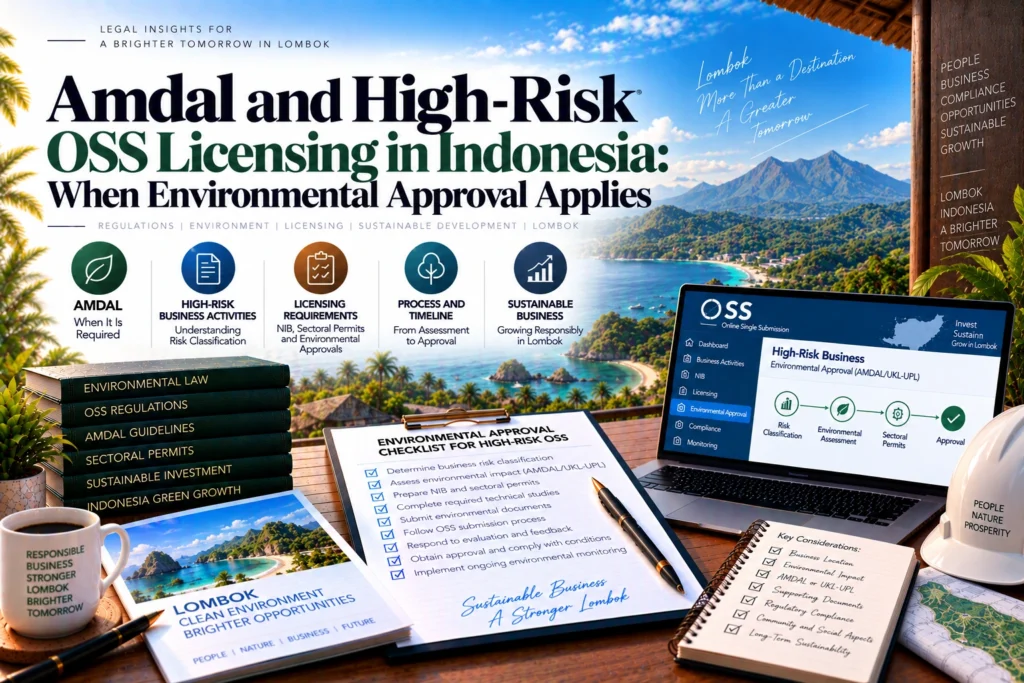
A high-risk OSS classification does not automatically mean that every project requires Amdal. The correct analysis has two connected parts: first determine the environmental document required for the activity, and then determine how that environmental requirement enters the high-risk OSS Permit process.
The current overarching licensing framework is Government Regulation No. 28 of 2025, which took effect on 5 June 2025 and revoked Government Regulation No. 5 of 2021.
For the broader planning framework, read our Company Setup Guide in Lombok. For help with your project, see our Business Setup services.
Amdal High Risk OSS Indonesia: Is Amdal Always Required?
No. PP 28/2025 does not say that every high-risk activity automatically requires Amdal.
For a high-risk activity, Article 133 of PP 28/2025 provides that principal Business Licensing consists of an NIB and a Permit.
After the NIB is obtained, Article 227 requires the applicable Permit requirements to be fulfilled before the high-risk activity begins operational or commercial activities.
Most importantly for environmental readiness, Article 227 states that the Permit requirements include Amdal for business activities that are required to have Amdal.
Because Article 227 uses the conditional formulation for activities that are required to have Amdal, high-risk status should not by itself be treated as proof that every high-risk project automatically requires an Amdal document.
High-Risk Classification and Environmental Screening Are Different Tests
The OSS risk category determines the principal form of Business Licensing. Environmental screening determines which environmental-document pathway applies to the proposed activity.
Those questions interact, but they are not interchangeable.
The environmental framework must therefore also be read with Government Regulation No. 22 of 2021, which remains in force as the government regulation governing environmental protection and management.
The current Minister of Environment and Forestry Regulation No. 4 of 2021 remains in force and sets out the lists of businesses and activities required to have Amdal, UKL-UPL or SPPL.
For an investor, the practical consequence is clear: do not determine the environmental document merely by reading the word “high” in the OSS risk result. Review the actual activity, project characteristics and applicable environmental classification.
How Article 227 Connects Amdal to the High-Risk Permit
Article 227 turns an applicable Amdal obligation into part of the high-risk Permit-readiness analysis.
First Confirm the High-Risk Activity
Start with the exact activity shown in OSS. Confirm the KBLI, scope, location and project configuration that produced the high-risk classification.
This matters because a corporate entity may operate several activities. One activity may be high risk while another has a different risk level or environmental-document requirement.
The environmental and licensing files should therefore be matched to the same project activity rather than reviewed as unrelated company documents.
Then Determine the Environmental Document
The next step is environmental screening.
The current OSS environmental-screening guide for medium-high and high-risk activities shows an environmental-screening workflow in which the result can identify Amdal as the required environmental document for a high-risk activity.
Amdal should therefore be treated as applicable when the project falls within the legal criteria requiring Amdal, not merely because the OSS activity has been categorized as high risk.
Where the screening and applicable environmental rules instead lead to another environmental-document pathway, the business should follow that result rather than manufacturing an Amdal requirement that does not apply.
Complete the Permit Verification Path
Once the applicable Permit requirements have been identified, the business moves through the verification process.
For high-risk licensing generally, Article 227 requires Permit requirements to be submitted through OSS and forwarded to the competent authority for verification.
When the verification result confirms that the requirements are fulfilled, Article 228 provides that OSS issues the Permit to the business actor.
If the requirements are not fulfilled, Article 229 requires OSS to notify the business actor to complete the outstanding Permit requirements.
For a project that requires Amdal, environmental readiness should therefore be checked before management treats the high-risk Permit file as complete.
What Determines Whether Amdal Applies?
The answer comes from the environmental rules and project facts, not from the risk label alone.
A due-diligence review should identify the exact activity and compare the project against the current environmental screening and regulatory list. Scale, project characteristics and the specific type of business or activity can affect which environmental document is required.
Permen LHK 4/2021 is particularly important because it organizes activities according to whether they are subject to Amdal, UKL-UPL or SPPL requirements.
For a new Lombok project, the environmental review should therefore use the actual planned location, development scale and activity configuration. For an acquisition, the reviewer should compare the existing environmental documents with the operation currently carried out on site.
A historic environmental document should not automatically be assumed to cover a later expansion, materially different activity or changed project configuration without checking the applicable rules and approval records.
Amdal Is Not the Same as the OSS Permit
Amdal and the high-risk Permit perform different legal functions.
Amdal belongs to the environmental assessment and approval framework. The high-risk OSS Permit is the principal Business Licensing instrument required under PP 28/2025 for a high-risk activity.
Article 227 connects them where Amdal applies by making Amdal part of the Permit requirements. That connection does not merge the two concepts into one document.
This distinction helps explain why an investor should not stop after seeing either an NIB or an environmental document. The complete readiness review should confirm how the environmental requirement has been integrated into the OSS Permit process for the relevant activity.
Businesses that need practical filing support after the environmental and risk pathway has been identified can use the verified NIB OSS RBA Registration service for the OSS implementation stage.
Investor Environmental Readiness Checks
For a high-risk project, begin by confirming that the OSS activity, KBLI and location match the project being reviewed.
Next, determine the required environmental-document pathway under the current environmental rules. If Amdal applies, verify the current status of the Amdal and related environmental approval rather than relying on a statement that environmental processing has merely started.
Then reconcile the environmental record with the high-risk Permit file. Confirm whether the applicable Amdal requirement has been submitted through the licensing process and whether the competent authority’s verification has been completed.
Check the Permit status itself. An NIB, an environmental application and a Permit application are different milestones from an issued Permit.
For an existing operation, compare the approved project description with the actual business on the ground. Look for expansions, additional facilities, increased capacity, new activities or changed locations that may require the environmental position to be reassessed.
Finally, review supporting PB UMKU and sector requirements separately. Environmental approval can be essential without being the only remaining requirement before operation.
Common Amdal and High-Risk OSS Mistakes
The first mistake is assuming that high-risk status automatically equals Amdal. Article 227 is conditional: Amdal is included when the activity is required to have Amdal.
The second mistake is reviewing the environmental document separately from the Permit file. For an Amdal-required high-risk activity, environmental readiness is part of the Permit-requirement analysis.
The third mistake is treating an NIB as evidence that environmental and Permit requirements are complete. A high-risk activity requires more than the NIB before commercial operation.
The fourth mistake is relying only on an old environmental document without checking whether the project has expanded or changed.
The fifth mistake is copying the environmental requirement from another project. Two projects in the same broad sector may have different scales, configurations or screening results.
Readers who need the broader NIB-plus-Permit framework can also review Lombok Legal ID’s existing High Risk OSS Licensing Indonesia guide alongside this environmental analysis.
Conclusion
Amdal and high-risk OSS licensing are connected, but they are not the same determination. PP 28/2025 requires NIB plus Permit for high-risk activities and expressly includes Amdal within the Permit requirements where the activity is legally required to have Amdal.
For investors, the reliable sequence is to confirm the high-risk activity, complete the environmental screening, determine whether Amdal applies, reconcile the environmental result with the Permit requirements and verify that the Permit has reached the stage required for operational or commercial activity.
That approach is more accurate than assuming that every high-risk project needs Amdal—or that an NIB alone proves environmental and commercial readiness.
Review Environmental and OSS Readiness Before Operations Begin
If you are developing, acquiring or expanding a regulated business in Lombok, Lombok Legal ID can be consulted to review how the project’s environmental requirements fit into its wider OSS licensing pathway.
For practical OSS filing support after the applicable environmental and risk route has been identified, the verified NIB OSS RBA Registration service can support the registration and licensing process.
FAQ – Amdal High Risk OSS Indonesia
Does every high-risk OSS activity require Amdal?
No. Article 227 of PP 28/2025 includes Amdal in the Permit requirements for activities that are legally required to have Amdal. The environmental requirement must therefore be determined separately under the applicable environmental rules.
What is the relationship between Amdal and a high-risk OSS Permit?
Where Amdal is required, Article 227 makes it part of the Permit-requirement process for the high-risk activity. Amdal remains an environmental requirement, while the Permit remains the principal Business Licensing instrument.
How is it determined whether a project needs Amdal?
The project must be reviewed against the current environmental framework and the applicable activity lists and thresholds, including Permen LHK 4/2021, rather than using the OSS risk label alone.
Can a high-risk business operate after receiving only an NIB?
No for the principal high-risk licensing pathway. The NIB can support preparation, but the relevant Permit requirements must be fulfilled and the Permit issued for operational or commercial activity.
What happens if an Amdal-required Permit file is incomplete?
Under Article 229 of PP 28/2025, OSS notifies the business actor to complete outstanding Permit requirements when verification finds that the requirements have not been fulfilled.
Should environmental approval be checked during an acquisition?
Yes. Investors should compare the project’s actual activity, scale and location with its environmental documents and current OSS Permit status, especially where the operation has expanded or changed.
References & Sources
- Government Regulation No. 28 of 2025 — Risk-Based Business Licensing — peraturan.bpk.go.id
- Government Regulation No. 28 of 2025 — BKPM-Hosted Unofficial English Translation — jdih-storage.bkpm.go.id
- Government Regulation No. 22 of 2021 — Environmental Protection and Management — peraturan.bpk.go.id
- Minister of Environment and Forestry Regulation No. 4 of 2021 — Activities Requiring Amdal, UKL-UPL or SPPL — peraturan.bpk.go.id
- OSS Environmental Screening Guide for Medium-High and High-Risk Activities — s3.oss.go.id
Recommended Next Articles
- high-risk OSS NIB and Permit readiness checks — lomboklegalid.com