

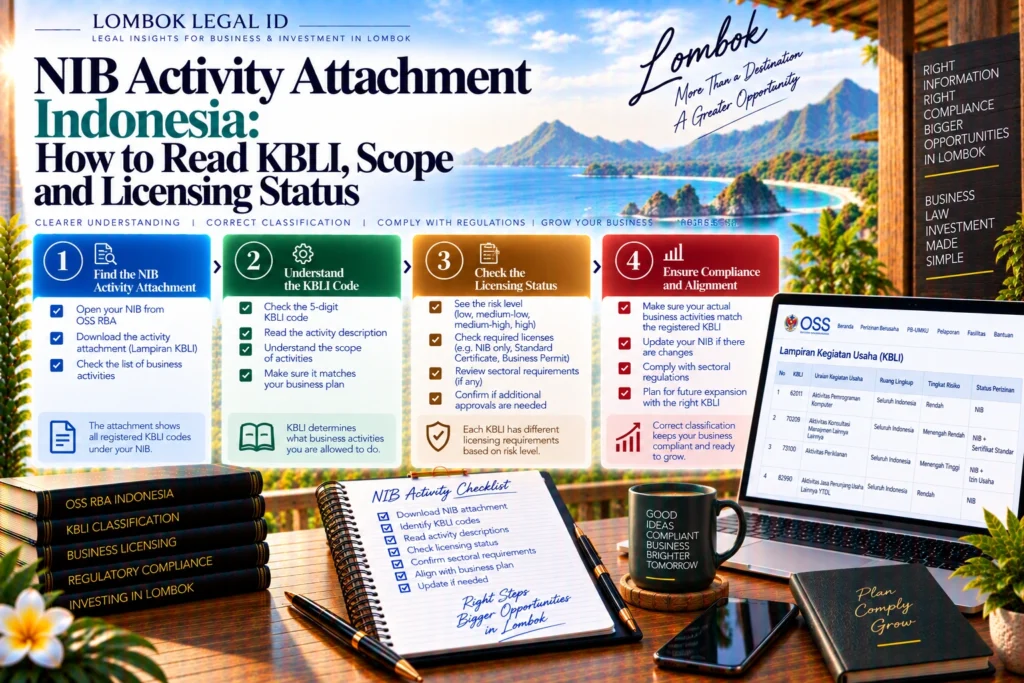
An NIB number identifies the business operator, but the activity attachment tells you much more about the business activity recorded in OSS. For an owner or investor reviewing a licence file, the attachment is where KBLI, activity scope, location, risk classification, licensing type, status, and notes can be checked against what the business actually does.
Indonesia’s current umbrella framework is Government Regulation No. 28 of 2025, which has been in force since 5 June 2025 and revoked Government Regulation No. 5 of 2021. The detailed OSS procedure is governed by Minister of Investment and Downstreaming/Head of BKPM Regulation No. 5 of 2025, which the official JDIH BKPM database lists as in force.
For the broader planning framework, read our Company Setup Guide in Lombok. For help with your project, see our Business Setup services.
NIB Activity Attachment Indonesia: What the Document Tells You
The regulation defines NIB as proof of registration of a business operator and as the operator’s identity when carrying out its business activities in Article 1 of Regulation No. 5 of 2025.
The activity attachment serves a different practical purpose. Instead of simply identifying the operator, it shows how particular activities have been recorded in the risk-based licensing system.
The prescribed low-risk NIB activity attachment displays the KBLI code, KBLI title, activity scope, business location, risk classification, Business Licensing type, status, and notes in the official NIB format.
The format expressly states that the activity attachment is an inseparable part of the NIB document under Regulation No. 5 of 2025. For document review, it should therefore be read with the NIB rather than treated as optional background information.
Readers trying to decide whether NIB itself is sufficient for a low-risk activity can use the separate Lombok Legal ID guide on low-risk OSS licensing and NIB. The purpose here is narrower: reading the fields correctly.
How to Read the Main Fields
KBLI code and KBLI title
Start with the KBLI code, then read the KBLI title beside it. The code identifies the classification recorded for the activity, while the title gives its label.
Article 34 requires OSS business data related to spatial and location conformity to include at least the KBLI, activity scope, business-location address, land-area needs, land-control information, coordinates, and planned building information under the current implementing regulation.
This matters because a company name or general commercial description is not enough to determine what activity has actually been entered in OSS. Review the recorded KBLI against the real revenue-generating or operational activity.
Activity scope
The scope field is one of the most important fields to read after the KBLI title. Two activities may appear related at a general level but have different recorded scopes or licensing consequences.
The same prescribed attachment states that the NIB applies only to the listed KBLI code, title, and activity scope shown in the official format.
That makes scope a boundary, not decorative text. If the business performs an activity outside the recorded scope, further review is appropriate rather than assuming the NIB automatically covers the expanded operation.
Business location
Location should be checked against the site where the activity is actually conducted. Article 35 states that this business data is entered for each five-digit KBLI code and per location through the OSS data structure.
For a company with several activities or sites, this is especially useful. Do not assume that one correctly recorded location proves that every business site is represented by the same activity record.
If the document review identifies a location or spatial issue, the existing guide on spatial conformity in OSS Indonesia addresses that narrower question.
Risk classification, licensing type and status
Read these fields together rather than independently. The risk classification tells you which risk tier OSS has assigned to the activity; the licensing-type field shows the Business Licensing document associated with the record; and the status field shows the state displayed for that licensing item.
Risk classification must be read carefully because Article 186 provides that low-risk Business Licensing consists of NIB, medium-low uses NIB plus a Standard Certificate without verification, medium-high uses NIB plus a verified Standard Certificate, and high risk uses NIB plus an Izin under Regulation No. 5 of 2025.
If an investor expects a pure low-risk NIB record but sees another licensing document or risk level, that difference should be investigated instead of being dismissed as formatting.
Notes, business-activity number and authority
The official low-risk format also provides space for notes, a business-activity number, and the relevant authority. These fields provide context for the specific activity row and should be retained when reviewing or comparing OSS documents.
The prescribed attachment also says that the business operator must fulfill the relevant requirements and obligations and that the fulfillment list can be accessed through the QR Code on the official NIB attachment.
The practical implication is that an activity row should not be reviewed only by asking whether its status says ‘issued.’ The attachment also directs the operator to the associated requirements and obligations.
Five Mismatches That Deserve Investigation
1. The KBLI does not describe the real activity
A business may hold a valid NIB while its actual operation has evolved beyond the activity originally recorded. When the real activity and recorded KBLI differ materially, confirm whether an OSS update is required rather than relying on the old attachment.
The existing Lombok Legal ID guide on changing business activity in OSS Indonesia is the more relevant next read when this mismatch appears.
2. The KBLI title looks right, but the scope does not
Do not stop at the title. Compare the scope field with the actual service, product, facility, or commercial activity being carried out. A broadly similar title does not remove the need to check the recorded scope.
3. The location does not match the operating site
Because the OSS data structure is activity- and location-sensitive, a mismatch between the recorded site and the actual operating location deserves further review. This is particularly important when a business expands to another property or operates similar activities at multiple sites.
4. The licensing type does not match the expected risk tier
If the attachment or related OSS record shows a Standard Certificate or Izin where the reviewer expected an NIB-only structure, first verify the risk classification. The licensing documents change according to the risk tier.
5. The attachment and the real business tell different stories
A useful due-diligence test is consistency. The KBLI, title, scope, location, risk classification, licensing type, status, and notes should collectively describe the business being reviewed. Where several fields conflict with the commercial reality, investigate the OSS record before relying on the document for a transaction or operational decision.
A Seven-Step Review Before You Rely on the Attachment
Use this sequence when reviewing an NIB activity attachment for a Lombok business:
- Identify the exact business activity being conducted. Start from commercial reality, not from the document label.
- Match the five-digit KBLI. Confirm that the classification corresponds to that activity.
- Read the scope beside the KBLI. Check whether it covers the actual service, product, or operation.
- Verify the activity location. Compare the recorded site with the location actually being used.
- Read risk classification and licensing type together. Confirm that the documents shown are consistent with the risk tier.
- Check status, notes, and linked obligations. Do not reduce the review to whether an NIB exists.
- Compare the entire activity row with current operations. If the business has changed, expanded, moved, or added activities, investigate whether the OSS data remains accurate.
For current system navigation, OSS also maintains an official application guide for low and medium-low risk Business Licensing.
This review does not replace activity-specific legal analysis. Its purpose is to identify whether the document is internally coherent and whether the recorded activity matches the project being evaluated.
Conclusion
The NIB activity attachment Indonesia review should focus on the activity record, not merely the NIB number. KBLI code, title, scope, location, risk classification, licensing type, status, notes, and linked obligations collectively show what OSS records for the business activity.
For an owner or investor, the most useful question is simple: does the attachment accurately describe the business operating at that location today? If the answer is uncertain, investigate the mismatch before treating the NIB file as conclusive evidence of the project’s licensing position.
Review the Activity Record Before You Rely on the NIB
If an NIB attachment does not clearly match the business activity, scope, location, or licensing status you are reviewing in Lombok, Lombok Legal ID can assist with business setup and licensing review based on the actual OSS record.
A focused consultation can help identify which activity details require further checking before an operational, investment, or transaction decision is made.
FAQ – NIB Activity Attachment Indonesia
What is the NIB activity attachment?
It is the activity-level attachment that forms part of the NIB document and records information about the business activities included in the OSS record, such as KBLI, activity scope, location, risk classification, licensing type, status, and notes.
Why should I check the KBLI title and scope together?
The KBLI title identifies the classified activity, but the scope provides additional boundaries for what is recorded. The prescribed NIB format states that the NIB applies to the listed KBLI code, title, and scope.
Can one company have several activity rows?
Yes. The current OSS procedure requires relevant business data to be entered for each five-digit KBLI code and per location, so a company with multiple activities or locations may have several activity records.
What does the risk classification field tell me?
It identifies the risk tier assigned to that activity. This matters because the Business Licensing document structure differs between low, medium-low, medium-high, and high-risk activities.
What should I do if the actual activity does not match the NIB attachment?
Treat the mismatch as a reason for further OSS and licensing review. Determine whether the recorded KBLI, scope, location, or other activity data needs to be corrected or updated before relying on the document.
References & Sources
- Government Regulation No. 28 of 2025 on Risk-Based Business Licensing — peraturan.bpk.go.id
- Minister of Investment and Downstreaming/Head of BKPM Regulation No. 5 of 2025 on OSS Risk-Based Licensing Procedures — jdih.bkpm.go.id
- Official Text of Minister of Investment and Downstreaming/Head of BKPM Regulation No. 5 of 2025 — jdih-storage.bkpm.go.id
- Business Licensing Application Guide for Low and Medium-Low Risk — oss.go.id
Recommended Next Articles
- low-risk OSS licensing and NIB — lomboklegalid.com
- changing business activity in OSS Indonesia — lomboklegalid.com
- spatial conformity in OSS Indonesia — lomboklegalid.com