

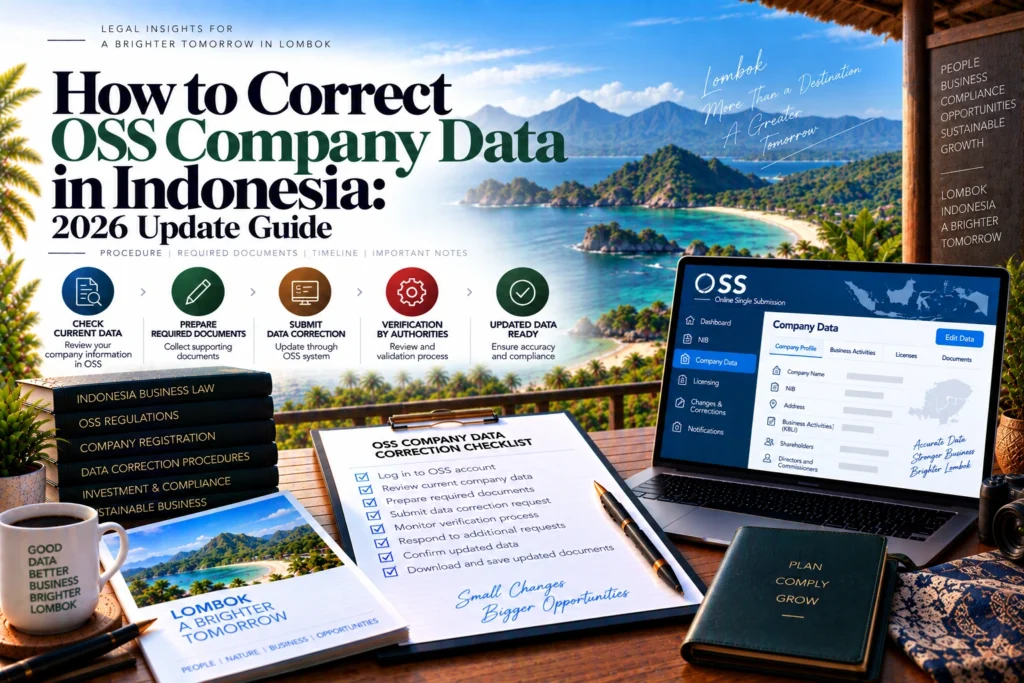
Incorrect OSS data should not be corrected by simply editing whichever field looks wrong. The right correction route depends on whether the mismatch belongs to the legal company profile, contact information, business location, activity-level data or a technical licensing attachment.
The current overarching framework is Government Regulation No. 28 of 2025, which has been in force since 5 June 2025 and replaced Government Regulation No. 5 of 2021.
The detailed data-change rules are now contained in Minister of Investment and Hilirisasi/BKPM Regulation No. 5 of 2025.
For the broader planning framework, read our Company Setup Guide in Lombok. For help with your project, see our Business Setup services.
Correct OSS Company Data: First Identify What Is Wrong
Before changing anything, compare the OSS record with the source document that should control the information.
If the mismatch concerns the company’s legal identity, management, shareholders, corporate purposes or capital, review the current corporate records first. If it concerns the operating location, compare the location recorded in OSS with the actual project. If it concerns investment, products, employees or operational timing, treat it as business-activity data rather than a general company-profile correction.
This distinction matters because the regulation does not treat every field in the same way.
Company Data and Business-Activity Data Are Different
Under Article 225 of Minister of Investment and Hilirisasi/BKPM Regulation No. 5 of 2025, changes are divided into business-actor data and/or business-activity data, and responsibility for those changes rests with the business actor.
The same Article 225 requires a business actor to adjust the corresponding information in OSS when the underlying change was made outside the OSS system.
That creates a useful correction rule: first identify where the underlying legal or commercial change actually occurred, then make sure OSS reflects it through the correct process.
A new deed, shareholder change or corporate-purpose amendment should not be treated in the same way as changing a telephone number. Likewise, correcting the registered company profile is different from changing project-level investment or product information.
Which Company Details Can Be Corrected?
The important point is that the regulation lists these items together but does not make them all editable through the same mechanism.
Data Validated Against Other Government Systems
Some information must agree with another government database before OSS updates it.
For NPWP changes, Article 226 requires OSS validation against the system administered by the ministry responsible for government affairs in the financial sector.
For company name, deed data, responsible-person data, company duration, capital, management or shareholders, shareholder origin, corporate purposes and the KBLI list, Article 226 requires OSS validation against the government system administered for legal affairs.
If one of these records is wrong, the practical review should therefore start with the underlying legal or tax record instead of repeatedly attempting to overwrite the value inside OSS.
For company-name corrections, OSS has a dedicated company-name change and business-entity change-history guide.
Data You Can Update Directly in OSS
Some company-profile fields have a simpler route.
The current OSS portal maintains a dedicated guide for changing business-actor data for business entities, separate from other correction routes.
Even for a self-service field, check the replacement value before saving it. Contact information can affect where system notices and account communications are received, while correspondence addresses should remain consistent with the company’s current administrative records.
Correcting the Business Location
A company address and a project location are not always the same data point.
If the problem concerns the address of a particular business activity, identify the relevant activity and project location first.
For a land-based business location that remains at the same coordinates, Article 229 allows specified address-detail changes such as the floor, building name, building number or address, street name and certain administrative-area changes.
A qualifying address-detail correction requires the documents specified in Article 229, and the OSS Institution verifies the requested change within a maximum of five days after receiving the application.
If the project has genuinely moved to a different location rather than simply correcting details at the same coordinates, do not assume the Article 229 detail-correction route is sufficient. Review the new location as a licensing issue because location can interact with spatial, environmental and sector requirements.
Correcting Business-Activity Data
OSS also provides a separate guide for changing business-activity data.
For business-activity data, Article 230 allows changes to the business name, planned investment value, financing source, planned workforce, products produced and estimated start of operational or commercial activity.
These fields describe the activity or project rather than the company’s core legal identity.
For an operating business, this means a discrepancy cannot always be solved by simply reopening the original planning fields. Review whether the issue should instead be addressed through the applicable reporting, expansion or licensing mechanism.
Technical License Attachments Use a Different Route
A mismatch may also sit inside the technical attachment to an existing Business License or PB UMKU rather than in the general company or activity profile.
If the correction concerns data in a technical attachment to PB or PB UMKU, Article 231 requires the business actor to submit the change through OSS for verification by the competent authority.
That means a technical-license correction should not be handled as though it were merely an account-profile edit. Identify the specific license, its technical attachment and the authority responsible for verifying the change.
A Practical OSS Data-Correction Checklist
Start by downloading or reviewing the current OSS records for the company and each active business activity. Compare those records with the latest corporate deed, legal-entity approval or notification, tax data and operating documents.
Then classify every mismatch into one of five groups: legal company profile, direct OSS contact or administrative data, business location, business-activity data, or technical-license data.
For corporate records that require external validation, correct or confirm the authoritative record first and then update or synchronize OSS. For direct OSS fields, use the applicable change menu. For project data, check whether the business is still in the pre-operational stage before assuming the original field remains amendable.
After the correction, review the resulting NIB, licensing documents and activity list rather than checking only the screen where the change was entered. Confirm that the company name, relevant KBLI, project address and licensing status now tell the same story.
Businesses using several KBLIs should repeat the check activity by activity. Correct company-level data does not automatically prove that every project-level record is accurate.
Common OSS Data-Correction Mistakes
The first mistake is trying to edit a field in OSS when the controlling record must first be corrected in another government system.
The second is confusing the registered company address with the address of a business activity. They can require different amendment routes.
The third is treating every mismatch as a company-profile issue when the error actually concerns investment, employees, products or another activity-level field.
The fourth is waiting until long after commercial operations have started before checking planning data. Article 230 places timing limits on several activity-data amendments.
The fifth is changing a technical license attachment as though it were ordinary profile information. Technical changes can require authority verification under Article 231.
For broader registration and implementation support after identifying the correct amendment route, the verified NIB OSS RBA Registration service is the relevant first-party next step.
Conclusion
Correct OSS company data starts with diagnosis, not data entry. Determine whether the mismatch belongs to the legal company profile, a direct OSS field, the project location, business-activity data or a technical licensing attachment.
Then use the route that applies to that data type. Some fields can be changed directly, some are validated against other government systems, and some project-level changes are restricted by the stage of the business.
For owners and investors, the safest final check is consistency: the corporate records, OSS company profile, activity data, location and licensing documents should reflect the same current business structure.
Review OSS Data Before It Affects the Next Licensing Step
If your company records, OSS profile or business-activity data no longer match, Lombok Legal ID can be consulted to review which record should be corrected and how it fits into the wider licensing structure.
For practical OSS registration and amendment support, the verified NIB OSS RBA Registration service can support the filing process after the correct data-change route has been identified.
FAQ – How to Correct OSS Company Data in Indonesia
Who is responsible for keeping OSS company data updated?
Article 225 of Minister of Investment and Hilirisasi/BKPM Regulation No. 5 of 2025 places responsibility for changes to business-actor and business-activity data on the business actor.
Can every company field be edited directly in OSS?
No. Some fields can be updated directly, while company name, corporate deed data, management, shareholders, capital, corporate purposes and the KBLI list are among the fields subject to validation against the relevant government legal system.
Can I change my company email or telephone number in OSS?
Yes. Article 226 allows company email, telephone number, correspondence address, customs access and importer identification to be updated directly by the business actor through OSS.
What if the company’s NPWP is wrong in OSS?
Article 226 provides for NPWP changes to be validated against the government system administered for financial affairs, so the underlying tax record should be checked as part of the correction.
Can business investment or workforce data always be changed later?
Not always. Article 230 limits amendments to planned investment value, planned workforce, products and estimated operational or commercial start to the pre-operational or pre-commercial stage.
What if the wrong information is inside a technical business-license attachment?
Article 231 provides a separate OSS amendment process for technical attachments to PB or PB UMKU, with verification by the competent authority.
References & Sources
- Government Regulation No. 28 of 2025 — Risk-Based Business Licensing — peraturan.bpk.go.id
- Minister of Investment/BKPM Regulation No. 5 of 2025 — OSS Risk-Based Licensing Procedures — jdih-storage.bkpm.go.id
- OSS Guide — Change Business-Actor Data for Business Entities — oss.go.id
- OSS Guide — Change Business-Activity Data — oss.go.id
- OSS Guide — Company Name Change and Business-Entity Change History — oss.go.id