

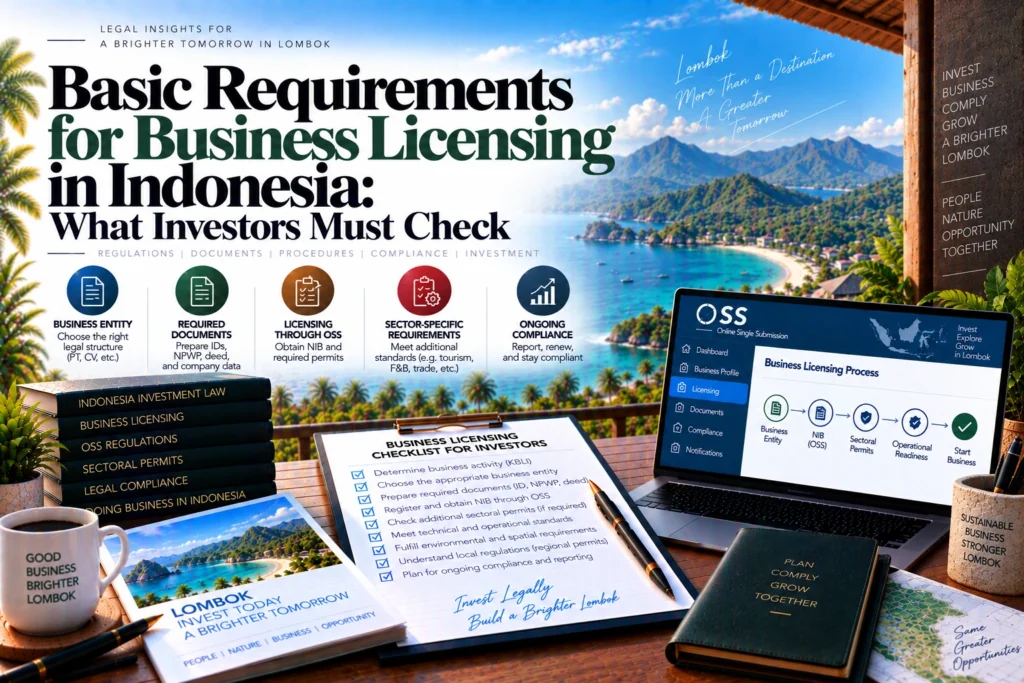
Indonesia’s business licensing process does not begin and end with an NIB. Owners and investors also need to identify the Basic Requirements connected to the project’s location and physical operation before treating the licensing file as complete.
The current overarching framework is Government Regulation No. 28 of 2025, which has been in force since 5 June 2025 and revoked Government Regulation No. 5 of 2021.
The official regulation summary confirms that the PP 28/2025 framework covers Basic Requirements, Business Licensing and Business Licensing to Support Business Activities, or PB UMKU.
For the broader planning framework, read our Company Setup Guide in Lombok. For help with your project, see our Business Setup services.
Basic Requirements Business Licensing Indonesia: What Does It Mean?
For basic requirements business licensing indonesia, the key distinction is that Basic Requirements are not simply another name for the NIB or the final risk-based Business License.
They address fundamental project conditions that can involve the proposed location, environmental position and physical premises. The exact combination should be checked against the real project rather than copied from another company.
BKPM’s current PP 28/2025 implementation material describes the licensing stages as Basic Requirements, Business Licensing and PB UMKU.
That sequence is useful for investors because it prevents three different questions from being mixed together: whether the site is ready, what principal Business Licensing the activity requires, and what supporting permissions may apply during operation.
The Four Basic Requirement Categories Shown in OSS
The current OSS Basic Requirements page presents four categories: Kesesuaian Kegiatan Pemanfaatan Ruang, Kesesuaian Kegiatan Pemanfaatan Ruang Laut, Persetujuan Lingkungan, and Bangunan Gedung.
The presence of four categories does not mean every business automatically needs the same four processes. The correct review starts with where the project is located and what the business will actually build and operate.
Spatial Conformity
Spatial conformity is the first location question to investigate for a land-based project. Before focusing only on the company’s NIB, verify that the proposed business activity and the site are being reviewed within the current spatial-licensing route shown by OSS.
For an investor acquiring an existing hotel, restaurant, warehouse, factory or another location-dependent business, compare the physical operation with the address and project data recorded in OSS. A correct corporate entity does not by itself resolve whether the site is suitable for the activity being licensed.
Sea-Space Conformity
OSS separately lists sea-space conformity within Basic Requirements. This category should therefore be reviewed for projects whose activities involve the relevant marine-space context rather than automatically added to every licensing checklist.
For Lombok projects, this distinction is particularly useful when comparing an ordinary land-based business with a project whose activities extend into marine areas. The project facts should drive the licensing analysis.
Environmental Approval
Environmental readiness is another separate layer.
OSS maintains a dedicated Environmental Approval section within Basic Requirements, so environmental readiness should be checked as its own licensing layer rather than assumed from the NIB.
The applicable environmental pathway depends on the project, and a detailed environmental assessment should be based on the actual business activity, scale and location. Readers dealing specifically with high-risk activities can use Lombok Legal ID’s Amdal and High-Risk OSS guide for that narrower issue.
Building Requirements
OSS also places Bangunan Gedung within the Basic Requirements area.
That means investors should treat the physical premises as a separate readiness question from company registration. When the project depends on a building, compare the premises being used or developed with the relevant current building and project records before assuming the business is operationally ready.
This is especially important in acquisitions: buying shares in a company or taking over a lease does not automatically demonstrate that the building-related licensing position is complete for the activity being conducted there.
Basic Requirements Are Not the Same as the NIB
OSS currently describes the NIB as the official identity for starting or running a business in Indonesia.
That identity function should not be confused with proof that every location, environmental or building requirement has been resolved.
A useful internal companion is Lombok Legal ID’s NIB OSS RBA Registration in Lombok guide, which explains the wider registration and risk-based licensing process. The Basic Requirements review goes deeper into the project conditions that sit alongside that registration process.
For investors, this distinction prevents a common due-diligence error: checking that the company has an NIB and then assuming the entire physical project has passed every required readiness step.
How Basic Requirements Connect to Risk-Based Licensing
After the project-level Basic Requirements are identified, the activity still has to be read through Indonesia’s risk-based licensing framework.
This means two analyses should be kept separate but connected. First, check the project’s Basic Requirements. Second, determine the Business Licensing output attached to the relevant activity and risk level. Supporting PB UMKU may then add another operational layer where applicable.
Do not use one layer as a substitute for another. A spatial or environmental approval does not replace the principal Business Licensing, and an NIB does not by itself answer every site-readiness question.
Investor Readiness Checklist Before Filing
Start with the business model. List every material activity and the location where it will operate.
Then review the site itself. Confirm whether the project is land-based, whether any marine-space issue is relevant, what environmental pathway needs investigation and whether a building is part of the operation.
Next, compare those facts with the current OSS Basic Requirements interface instead of relying on a historic permit checklist. Record which Basic Requirement categories are relevant and which are not applicable to the specific project.
After that, review the activity’s current OSS risk classification and principal Business Licensing. Do not assume that an NIB is the only required output simply because the company has already been registered.
For an acquisition, compare the documents with the real site. Check whether the business has expanded, changed its activity, changed buildings or added facilities since the original licensing process.
Finally, review supporting PB UMKU and sector requirements separately. The goal is one coherent licensing position in which the company identity, activity, location, environmental position, premises and operational permissions match the business that actually exists.
Common Basic Requirement Mistakes
The first mistake is treating the NIB as proof that every project requirement is complete.
The second is copying another company’s licensing package. Two businesses with similar names can operate at different sites, at different scales and under different project conditions.
The third is reviewing the legal entity but not the physical location. Investors should reconcile the company records with the site that is actually being acquired or developed.
The fourth is treating environmental approval as an isolated document without checking whether it corresponds to the current project scope.
The fifth is assuming that every one of the four OSS Basic Requirement categories applies to every business. The correct approach is applicability testing, not automatic accumulation of permits.
Conclusion
Basic Requirements are a distinct part of Indonesia’s current risk-based licensing framework. OSS currently separates spatial conformity, sea-space conformity, environmental approval and buildings within its Basic Requirements area, while Business Licensing and PB UMKU remain separate licensing layers.
For owners and investors, the practical approach is to start with the actual project: activity, location, environment and premises. Then connect those facts to the current OSS Basic Requirements, determine the relevant risk-based Business Licensing and review supporting permissions before treating the project as licensing-ready.
Review Project Requirements Before Treating the OSS File as Complete
If you are establishing, acquiring or expanding a business in Lombok, Lombok Legal ID can be consulted to review how the project’s Basic Requirements, OSS Business Licensing and supporting permissions fit together.
For construction-related projects that separately require construction competency or certification support, the verified Business Certification s
ervice can be reviewed as a separate project-specific compliance step.
FAQ – basic requirements business licensing indonesia
What are the Basic Requirements shown in OSS?
The current OSS Basic Requirements area presents spatial conformity, sea-space conformity, environmental approval and buildings as separate categories.
Does every business need all four Basic Requirements?
No automatic conclusion should be made from the category list alone. Applicability should be checked against the activity, location, environmental context and physical project.
Is an NIB the same as completing the Basic Requirements?
No. OSS describes the NIB as the official business identity, while Basic Requirements address separate project conditions such as spatial, environmental and building matters.
How do Basic Requirements relate to risk-based licensing?
Basic Requirements form one layer of the current framework. OSS separately determines the principal licensing obligations according to the business activity’s risk level, with PB UMKU potentially adding supporting permissions.
Should investors review Basic Requirements when buying an existing business?
Yes as a due-diligence step. The project documents should be compared with the activity, location, premises and environmental position that actually exist at the time of acquisition.
Can the Basic Requirements change when a project expands?
A material change in location, project scope, physical premises or environmental profile can justify a fresh review of the current applicable requirements rather than relying only on the original licensing file.
References & Sources
- Government Regulation No. 28 of 2025 — Risk-Based Business Licensing — peraturan.bpk.go.id
- OSS Basic Requirements — oss.go.id
- OSS Basic Requirements — Environmental Approval — oss.go.id
- OSS Risk-Based Business Licensing Portal — oss.go.id
- BKPM — Implementation of Government Regulation No. 28 of 2025 — bkpm.go.id
Recommended Next Articles
- NIB OSS RBA registration process in Lombok — lomboklegalid.com
- Amdal and high-risk OSS environmental readiness — lomboklegalid.com