

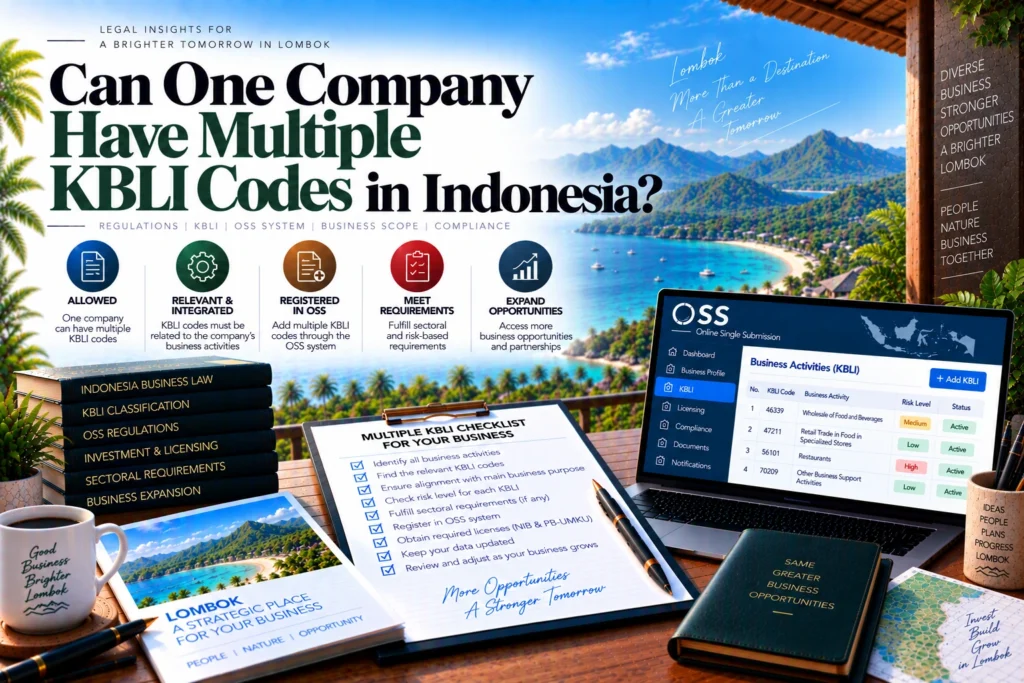
Yes. Indonesia’s current OSS framework allows one business entity to have more than one business activity, so a company does not need to establish a new legal entity merely because it wants to operate an additional KBLI activity. The important limitation is that each activity still needs to be checked against its own licensing, location and sector requirements.
The current overarching framework is Government Regulation No. 28 of 2025, which has been in force since 5 June 2025 and governs Indonesia’s current risk-based Business Licensing system.
The current implementing regulation is Minister of Investment and Hilirisasi/BKPM Regulation No. 5 of 2025, which the issuing authority currently lists as in force.
Multiple KBLI Codes in One Company: Is It Allowed?
For multiple KBLI codes in one company, the practical answer is yes: one business entity can hold more than one business activity in the OSS framework.
The current regulation expressly contemplates this situation: Article 361 provides that when Business Licensing for one activity is cancelled and the business actor has more than one business activity, OSS updates the NIB rather than automatically cancelling it.
That provision is important because it shows the regulatory distinction between the business entity and the individual activities it operates. Removing one activity does not necessarily eliminate the identity of an entity that still has other activities.
The current OSS Business Activity Management interface includes a ‘Tambah Kegiatan Usaha’ function and allows a business activity to be added to an existing business location.
OSS currently publishes a dedicated guide for adding a business field and using the location-map feature, confirming that adding another activity is a supported OSS workflow rather than requiring a separate NIB for every activity.
One Company Still Has One NIB
Multiple activities do not mean multiple NIBs for the same entity.
Under Article 16 of the current implementing regulation, every business entity has only one NIB.
This is the useful structural model for owners: one legal entity, one NIB, potentially several business activities. What changes between the activities is not the company’s basic identity but the licensing analysis attached to each activity.
For readers who need the broader NIB and risk-based registration process first, Lombok Legal ID’s NIB OSS RBA Registration in Lombok guide is a useful same-domain companion.
Multiple KBLI Does Not Mean One License Covers Everything
Adding a second or third KBLI should not be interpreted as extending every existing permit to the new activity.
Risk-based licensing is built around the business activity. A restaurant activity, accommodation activity, consulting activity, warehouse activity or industrial activity can therefore create different licensing consequences even when the same company owns all of them.
The practical review should separate three questions: what activity is being added, where it will operate, and what licensing outputs apply to that activity.
Check the Risk Level of Each Activity
The first check is the current KBLI and licensing profile of the new activity.
Do not assume that because one existing activity is low risk, another activity under the same company will have the same risk level or the same licensing output. Each planned activity should be checked in the current OSS system before commercial launch.
That distinction becomes especially important when a company expands from a relatively simple service activity into hospitality, manufacturing, warehousing, construction or another regulated activity.
Check the Location of Each Activity
A second KBLI may operate at the same place or at a different project location.
This means the licensing review should not stop at the company address. An additional activity may create a new project-level location record with its own spatial, environmental, building or other applicability questions.
If the issue is only correcting an existing location record, Lombok Legal ID’s Change Business Address OSS Indonesia guide covers that different amendment question.
Check Basic Requirements and Sector Permissions
For an additional activity, owners should therefore check whether the existing project’s Basic Requirements actually correspond to the new activity and location rather than assuming the previous approvals automatically extend to it.
The same logic applies to sector-specific licensing and PB UMKU. One company’s existing operational documents may support one activity without answering every requirement created by another KBLI.
Review Corporate Scope Before Adding Another KBLI
OSS is only one side of the review. Before adding another activity, compare the planned business with the company’s current corporate purpose and existing legal documents.
If the proposed activity is outside the company’s recorded corporate scope, obtain company-law and notarial review before assuming that an OSS addition alone resolves the corporate side. The required corporate action can depend on the entity, existing deed and proposed change, so it should be checked from the actual documents rather than handled through a generic amendment assumption.
This step is particularly important when the new activity is materially different from the company’s original business. A company incorporated for consulting, for example, should not automatically assume that a later hospitality, industrial or property-related activity requires no corporate-document review simply because OSS technically provides an activity-addition function.
KBLI 2020 vs KBLI 2025
Existing companies should also check which KBLI version their historic activities were mapped under.
Because OSS now provides a KBLI 2020-to-KBLI 2025 conversion tool, an existing company’s older activity codes should also be checked against the current classification before a new activity is added or compared.
A conversion may leave a code unchanged, change it, split it, combine it or reorganize the classification. The practical objective is to describe what the company actually does under the current OSS classification rather than copying an old KBLI solely because it appears in historic documents.
Practical Checklist Before Combining Several Activities
Start with the real business model. List every material activity the company intends to earn revenue from or operate commercially.
Next, identify the current KBLI for each activity. Do not select a broad or convenient code simply because it appears easier to license.
Then compare each activity with the company’s existing corporate purpose and legal documents. Flag anything that may require corporate or notarial review before the OSS change.
After that, identify where each activity will operate. Determine whether it uses the existing business location or requires a new location record.
Review the Basic Requirements for each relevant project location. A new activity can introduce different spatial, environmental, building or technical questions.
Next, check the risk-based Business Licensing output for every activity. One KBLI may rely on an NIB, while another may require a Standard Certificate or another licensing pathway depending on its current risk profile and sector rules.
Finally, inspect any supporting PB UMKU or sector-specific permissions linked to the new activity before treating the expansion as operationally complete.
The goal is not to accumulate as many KBLI codes as possible. It is to make sure the company’s registered activities accurately match the business it actually operates and that each material activity has the licensing position it needs.
Common Multiple-KBLI Mistakes
The first mistake is assuming every additional KBLI requires a new company and new NIB. The current framework expressly accommodates more than one business activity under a business actor.
The second is making the opposite mistake: assuming that because the company already has an NIB, every new activity is automatically licensed.
The third is adding a KBLI without checking whether the activity will operate at an existing or new project location.
The fourth is ignoring the company’s corporate purpose and focusing only on the OSS screen.
The fifth is copying an old KBLI without checking the current KBLI classification.
The sixth is assuming that an existing Standard Certificate, permit or PB UMKU automatically covers another activity merely because both activities belong to the same company.
Conclusion
One Indonesian business entity can operate more than one business activity within the OSS framework while retaining one NIB. The regulations expressly recognize business actors with multiple activities, and OSS provides functionality for adding another business activity.
The compliance question begins after that structural answer. Each added KBLI should be checked against the actual business model, current classification, corporate scope, project location, Basic Requirements, risk-based licensing and applicable sector permissions. Multiple activities can sit inside one company, but their licensing consequences should still be reviewed activity by activity.
Review the Company Structure Before Adding Another Activity
If your company in Lombok plans to expand into additional business activities, Lombok Legal ID can be consulted to review the existing company documents, KBLI structure, OSS data and licensing position before the new activity is launched.
Business setup, company amendment and OSS licensing support can be considered where the additional activity changes the company’s corporate scope, project location or licensing requirements.
For help coordinating the documents and next steps discussed above, review our business setup in Lombok.
Read More: Company Setup Guide in Lombok: Entity Choice, OSS and Launch Planning
FAQ Multiple KBLI Codes
Can one company have more than one KBLI in Indonesia?
Yes. The current OSS framework expressly contemplates business actors having more than one business activity, while each business entity continues to have one NIB.
Does each KBLI require a separate NIB?
No. Article 16 of the current OSS implementing regulation states that each business entity has only one NIB.
Does an existing NIB automatically license every new KBLI?
No. The added activity should still be reviewed for its current risk classification, Basic Requirements, location, Business Licensing and applicable sector permissions.
Can another KBLI be added at the same business location?
The current OSS activity-management interface allows a business activity to be added to an existing business location. Applicability of licensing and Basic Requirements still needs to be checked for the additional activity.
What if the new KBLI will operate at another location?
OSS currently instructs users to add the new business location first before applying for a business activity at that location.
Should the company deed be checked before adding another KBLI?
Yes as a corporate due-diligence step. Compare the intended activity with the company’s existing corporate purpose and legal documents, and obtain notarial or company-law review where the new activity may fall outside the recorded scope.
References & Sources
- Government Regulation No. 28 of 2025 — Risk-Based Business Licensing — peraturan.bpk.go.id
- Minister of Investment/BKPM Regulation No. 5 of 2025 — Official Legal Record — jdih.bkpm.go.id
- Minister of Investment/BKPM Regulation No. 5 of 2025 — Official Regulation PDF — jdih-storage.bkpm.go.id
- OSS Business Activity Management — beranda.oss.go.id
- OSS Guide — Adding a Business Field and Using the Location Map — oss.go.id
- OSS KBLI 2020 to KBLI 2025 Conversion — oss.go.id