

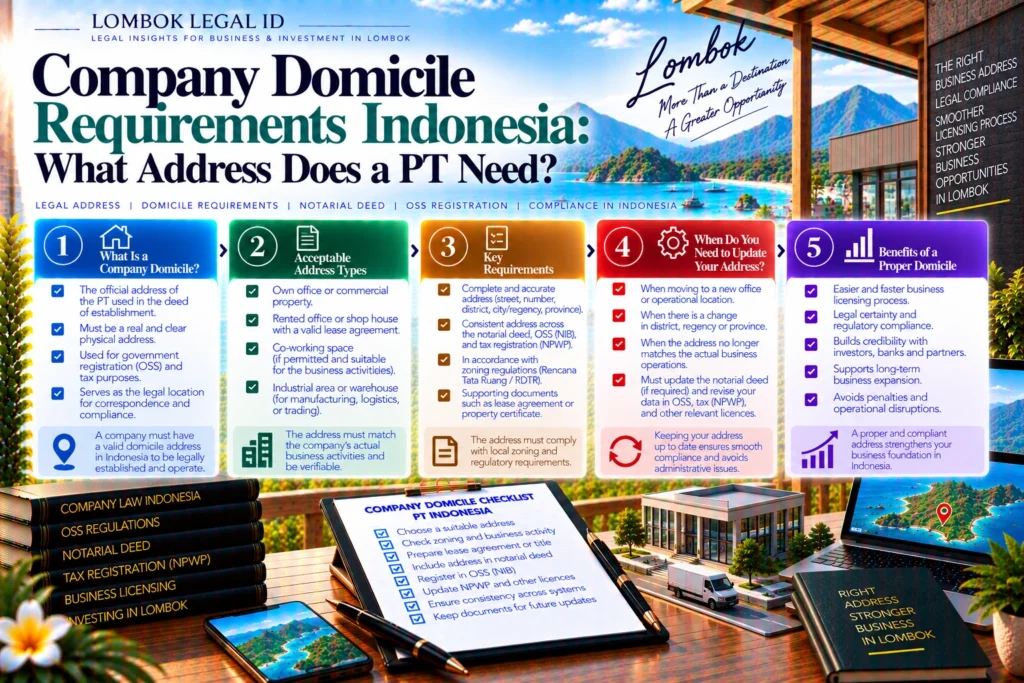
Every Indonesian PT needs a legally identifiable place of domicile and a corresponding full company address. The two concepts are connected but not identical: the place of domicile is the city or regency stated in the Articles of Association, while the full address identifies the company’s detailed address within that domicile.
Indonesia’s core limited-liability-company framework remains Law No. 40 of 2007 on Limited Liability Companies, which the official BPK database lists as in force and amended, with Law No. 6 of 2023 listed as the current amending instrument relevant to the Job Creation framework.
For readers still planning the entity itself, Lombok Legal ID’s Business Setup Lombok guide provides the broader incorporation context. This article focuses specifically on domicile and address requirements.
Company Domicile Requirements Indonesia: The Short Answer
Article 5 requires a company to have a name and place of domicile within Indonesia as determined in its Articles of Association and to have a full address corresponding to that domicile under the official Company Law text.
Article 17 specifies that the company’s place of domicile is in a city or regency within Indonesia as stated in the Articles of Association, and that this place of domicile also constitutes the company’s head office under the official text.
The practical starting point is therefore not simply to choose a street address. The company documents should identify the correct city or regency as the statutory domicile and then maintain a detailed address that corresponds to it.
Domicile and Full Address Are Not the Same Thing
This distinction matters during both incorporation and later relocation.
The domicile belongs in the Articles of Association
The statutory domicile is part of the company’s constitutional information. For example, a company may have its place of domicile in a particular regency while its complete address identifies the village, street, building or unit inside that regency.
The legal test is geographic rather than a branding choice. A company cannot describe itself informally as being ‘in Lombok’ and ignore the city-or-regency domicile stated in its Articles of Association.
The company also needs a full address
The detailed address performs a different function. It identifies where the company is registered within its statutory domicile.
Article 5 also requires the company’s name and full address to be stated in its correspondence, published announcements, printed materials and deeds where the company is a party under the Company Law.
This is one reason address consistency matters. The full address should not be treated as an incidental field that can differ casually among the deed, corporate records and formal company documents.
What Address Evidence Is Required When Establishing a PT?
The current administrative procedure is Minister of Law Regulation No. 49 of 2025, which the official BPK database lists as in force from 17 December 2025 and as revoking Minister of Law and Human Rights Regulation No. 21 of 2021.
For incorporation, Article 6 includes a certificate concerning the company’s full address from the building manager or competent authority, or an original address statement signed by the specified founders and company organs, among the supporting documents under the current Ministry procedure.
The exact evidence used should match the actual premises and filing circumstances. The address should not be selected merely because it is convenient to type into an incorporation form; the company needs documentation capable of supporting the address submitted through the corporate-registration process.
A separate question is whether the location is suitable for the company’s actual business activity. Corporate address registration by itself should not be treated as proof that every KBLI activity, facility or operational use is permitted at that location. Location-sensitive licensing should be checked separately where relevant.
What Happens When the Company Moves?
A move must first be classified correctly. Changing the statutory domicile and changing only the detailed address are not the same corporate event.
Article 8 of the current Ministry regulation classifies a change of place of domicile as an Articles of Association change requiring approval, while a change of the company’s full address is separately listed as a change of company data.
Changing the city or regency stated as domicile
Article 21 includes a change of company name and/or place of domicile among the specified Articles of Association amendments that require Ministerial approval under the Company Law.
For those specified amendments, Article 21 requires the change to be contained or stated in an Indonesian-language notarial deed and requires the approval application to be submitted to the Minister no later than 30 days from the deed containing the amendment under the Company Law.
A move that changes the city or regency named in the Articles should therefore be treated as a corporate amendment rather than merely editing the street address in another system.
Changing only the detailed address
A street, building or unit change may be different when the statutory city or regency remains unchanged. The current Ministry regulation places a change of the company’s full address in the company-data category rather than the list of Articles amendments requiring Ministerial approval.
Article 10 provides that applications for Articles of Association changes and company-data changes are submitted by the applicant through a notary electronically through SABH under the current procedure.
For a full-address data change, Article 12 includes a copy of the address certificate from the building manager or competent authority, or an original statement concerning the company’s full address signed by the directors, among the documents retained by the notary under the current regulation.
A company should therefore check the wording of its current Articles and corporate profile before assuming that every office move requires the same deed and approval process.
Corporate Domicile Is Not Automatically the Same as Every Operating Location
A company can have a statutory corporate domicile while its business model raises additional location questions. A warehouse, hotel, restaurant, factory, mining operation or other premises-dependent activity may involve spatial, environmental, building or sector requirements that go beyond the corporate domicile itself.
Treat these as separate compliance layers. First confirm that the company domicile and full corporate address are correctly documented. Then verify whether the actual operational location is properly reflected in OSS and whether the relevant business activity can lawfully operate there.
This distinction prevents two opposite mistakes: assuming that a valid corporate address automatically authorizes every activity at the premises, or assuming that an operational-site update automatically changes the company’s statutory domicile.
Seven Checks Before Filing a Company Address
Use this sequence when establishing or moving an Indonesian PT:
- Identify the city or regency. Confirm the legal place of domicile that will appear, or already appears, in the Articles of Association.
- Record the complete address. Make sure the street, building, village or other detailed information corresponds to that domicile.
- Prepare address evidence. Obtain the address certificate or statement applicable to the filing under the current Ministry procedure.
- Check the current Articles before moving. Determine whether the new location changes the statutory city or regency or only the detailed address.
- Use the correct corporate procedure. A domicile amendment and a full-address company-data change should not be treated as interchangeable.
- Synchronize dependent records. After the corporate record is correct, review OSS, tax, banking, contracts and other systems that use the company address.
- Review operational suitability separately. If the company operates from the premises, check any location-specific licensing requirements for the actual business activity.
The goal is one coherent record: the Articles identify the statutory domicile, the full address fits that domicile, and downstream records do not contradict the company’s current corporate data.
Conclusion
Company domicile requirements Indonesia are clearer once the place of domicile and full address are separated. The statutory domicile is the city or regency stated in the Articles of Association and is also the company’s head office, while the company maintains a corresponding detailed address.
That distinction also determines how a move is handled. Changing the statutory domicile is an Articles of Association amendment requiring the applicable notarial and Ministerial approval process, while changing only the full address is treated separately as company data under the current Ministry procedure.
For owners and investors, the safest approach is to establish the correct domicile first, document the full address properly and then keep SABH, licensing and operational records aligned with the actual company structure.
Check the Domicile Before Signing or Filing
If you are establishing a PT in Lombok or moving an existing company, Lombok Legal ID can assist with notarial documentation, company amendments and business-setup review based on the actual domicile and address structure.
A pre-filing review can help determine whether the transaction requires an Articles of Association amendment or a company-data update and which downstream business records should be synchronized.
For help coordinating the documents and next steps discussed above, review our business setup in Lombok.
Read More: Company Setup Guide in Lombok: Entity Choice, OSS and Launch Planning
FAQ Company Domicile Requirements Indonesia
Does an Indonesian PT need a registered domicile?
Yes. The Company Law requires a PT to have a place of domicile within Indonesia stated in its Articles of Association, together with a full address corresponding to that domicile.
At what geographic level is the company domicile stated?
Article 17 of the Company Law states that the place of domicile is in a city or regency within Indonesia. The company then maintains a more detailed full address corresponding to that domicile.
Is the company domicile the same as its full street address?
No. The statutory place of domicile and the full address are related but distinct concepts. Current Ministry of Law rules also treat a change of domicile and a change of full address differently.
What proof of address is needed when establishing a PT?
Under Minister of Law Regulation No. 49 of 2025, supporting documents can include a certificate concerning the full company address from the building manager or competent authority, or the specified original address statement.
Does moving offices always require changing the Articles of Association?
Not necessarily. If the statutory place of domicile changes, the Articles of Association must be amended through the applicable approval process. A change only to the full address is separately categorized as a company-data change under the current Ministry regulation.
Is corporate domicile approval enough to operate any business from that address?
No. Corporate domicile and operational licensing are separate compliance questions. Premises-dependent activities may require separate spatial, environmental, building or sector checks for the actual operating location.
References & Sources
- Limited Liability Company Law No. 40 of 2007 — peraturan.bpk.go.id
- Law No. 6 of 2023 Establishing the Job Creation Government Regulation in Lieu of Law as Law — peraturan.bpk.go.id
- Official Text of Limited Liability Company Law No. 40 of 2007 — peraturan.bpk.go.id
- Minister of Law Regulation No. 49 of 2025 on Establishment, Changes and Dissolution of Limited Liability Companies — peraturan.bpk.go.id
- Official Text of Minister of Law Regulation No. 49 of 2025 — peraturan.bpk.go.id