

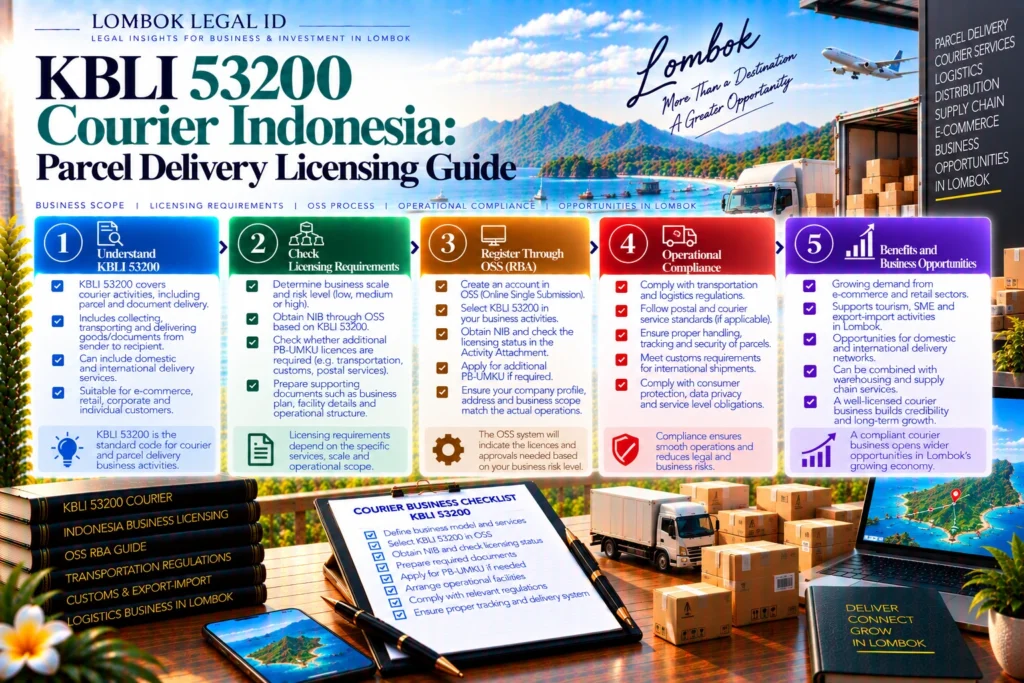
KBLI 53200 is the current Indonesian classification for courier activity. It is relevant when a business collects, sorts, transports and delivers letters, documents, parcels, goods or packages as a courier service rather than merely operating freight transport or another non-postal logistics service.
Current OSS classifies the business under KBLI 53200 Aktivitas Kurir.
The current classification framework comes from BPS Regulation No. 7 of 2025 on KBLI 2025, which BPS lists as in force. KBLI 2025 was subsequently amended by BPS Regulation No. 6 of 2026, effective from 10 September 2026.
KBLI 53200 Courier Indonesia: What Activity Does It Cover?
The classification should be selected from the actual operating model, not simply because a business uses words such as delivery, logistics or transport in its branding.
Its current OSS description covers the collection or pickup, sorting or processing, transportation and delivery of letters, documents, parcels, goods and packages, domestically or internationally, outside universal postal-service obligations under the KBLI 53200 description.
Included courier activities
The current scope also includes door-to-door delivery and certain food-delivery activity where the goods fall within the stated parcel-service description. Courier operations may use the operator’s own transport or public transport as part of the delivery process.
The defining feature is therefore the courier service chain: receiving or collecting the shipment, processing or sorting it and arranging its delivery to the recipient.
Activities that are not KBLI 53200
The same OSS description expressly excludes ordinary freight transport under the relevant transport classifications and logistics services other than postal services from KBLI 53200.
This distinction matters for businesses that own trucks. A company does not become a courier merely because it transports somebody else’s goods. If the commercial service is primarily road freight rather than parcel collection, sorting and delivery, a freight-transport classification may be more appropriate.
Likewise, a company whose principal activity is freight forwarding, warehousing or another non-postal logistics service should classify that activity according to its own operational scope instead of using KBLI 53200 as a catch-all logistics code.
Why Older Regulations Still Show KBLI 53201
Businesses researching courier licensing may find two code numbers in official sources. This is a classification transition rather than evidence that courier licensing has disappeared.
OSS records a one-to-one conversion in which legacy KBLI 53201 became KBLI 53200 in KBLI 2025 on the current courier classification page.
The current sector standard is Minister of Communication and Digital Regulation No. 15 of 2025, which the ministry’s JDIH lists as in force.
However, that regulation was issued in October 2025, before KBLI 2025 took effect in December 2025. Its courier annex therefore still prints the legacy code 53201.
For a 2026 application, the practical approach is to use the current OSS classification and verify how the live OSS and ministry systems map KBLI 53200 to the courier licensing standard rather than manually substituting an old code into an application.
Courier Business Licensing Is More Than an NIB
An NIB identifies the registered business activity, but courier operations also sit within Indonesia’s postal-sector regulatory framework.
The Postal Law provides that postal operations are conducted by Indonesian legal entities and that the business entity must obtain a postal operation licence from the Minister under Law No. 38 of 2009.
Indonesia’s current general risk-based licensing framework is Government Regulation No. 28 of 2025, which is in force and revoked Government Regulation No. 5 of 2021.
Commercial courier operations also sit under Minister of Communication and Digital Regulation No. 8 of 2025, which remains in force and requires postal operators to provide services according to their postal business licensing and applicable commercial postal-service standards.
The key point is that selecting KBLI 53200 is the classification step, not the entire licensing process.
Current Courier Licensing Requirements
The current courier-sector standard remains Minister of Communication and Digital Regulation No. 15 of 2025.
Its courier annex still labels the activity as legacy KBLI 53201 and requires minimum capital of Rp500 million together with a five-year business plan and specified administrative commitments under the current sector standard.
The five-year plan includes business-profile and capital-structure information, management information, technical aspects such as technology and operational infrastructure, business aspects and financial planning. The annex also requires statements concerning compliance with postal-operation rules and the validity of submitted information.
The same licensing standard describes an electronic workflow involving OSS and the ministry’s postal licensing system. Because its annex still uses the legacy code, a business applying under current KBLI 53200 should follow the live system mapping rather than assume that every procedural screen will reproduce the old regulation word-for-word.
Courier vs Freight vs Logistics: Which Classification Fits?
Compare the broader activity map in our Logistics Company KBLI Licensing guide when your business also operates freight, forwarding or warehousing.
Use the revenue-generating service as the starting point.
A business is more likely to fit KBLI 53200 when its service includes a courier chain such as pickup, sorting or processing and delivery of parcels or documents to recipients.
A business that simply carries cargo by truck may instead belong to a freight-transport classification. A company arranging shipment on behalf of clients may fall within freight-forwarding or transportation-management activity. A commercial warehouse has another distinct classification.
One company can perform more than one of those activities. If courier delivery is only one independent part of a broader logistics business, the company’s company documents and OSS profile should be checked to determine whether additional KBLI activities are needed.
If the courier activity is being added to an existing company, Lombok Legal ID’s business-activity change guide provides the adjacent OSS amendment workflow after the correct classification has been confirmed.
Seven Checks Before Applying
Before filing or adding KBLI 53200, review these points:
- Confirm the operating model. Document whether the business actually collects, sorts or processes and delivers parcels, documents or packages.
- Separate courier from freight and forwarding. Do not use the courier code merely because the company transports goods.
- Use current KBLI 53200 in classification work. Treat references to KBLI 53201 in the current 2025 sector regulation as the legacy classification and confirm the live system mapping.
- Check the legal entity. Postal operations are subject to the Indonesian legal-entity framework under the Postal Law.
- Prepare the capital and business-plan requirements. The current courier standard includes minimum capital of Rp500 million and a five-year business plan.
- Identify the postal services to be provided. The licensing process should reflect the actual service types rather than a broader business description that the company does not perform.
- Verify the live OSS and ministry workflow before operation. Confirm the current licence status and any commitments generated for the business rather than relying only on an NIB printout.
This sequence avoids two common classification problems: using an old KBLI number without checking the conversion, and treating courier activity as identical to every other form of goods transport.
Conclusion
KBLI 53200 courier Indonesia licensing starts with a clear operational test. The classification fits businesses performing the courier chain of collection, sorting or processing, transportation and delivery of parcels, documents or similar shipments.
Current OSS uses KBLI 53200 and records a one-to-one conversion from former KBLI 53201. The current courier-sector licensing standard remains Minister of Communication and Digital Regulation No. 15 of 2025, even though its annex still displays the former code because it predates KBLI 2025.
For a new or expanding courier business, the safest approach is therefore to use the current OSS classification, confirm the live licensing mapping, prepare the verified postal-sector requirements and keep courier activity separate from freight, forwarding and other logistics functions.
Check the Courier Classification Before Filing
If your company in Lombok plans to start parcel delivery or add courier operations, Lombok Legal ID can assist with business setup, company amendments and business-certification review based on the actual operating model.
A pre-filing review can help confirm whether KBLI 53200 fits the activity and identify which company and OSS records should be prepared before the courier operation begins.
For help coordinating the documents and next steps discussed above, review our business setup in Lombok.
Read More: Company Setup Guide in Lombok: Entity Choice, OSS and Launch Planning
FAQ KBLI 53200 Courier Indonesia
What is KBLI 53200 in Indonesia?
KBLI 53200 is the current KBLI 2025 classification for courier activity. Its OSS description covers collection, sorting or processing, transportation and delivery of letters, documents, parcels, goods and packages outside universal postal-service obligations.
Is KBLI 53200 the replacement for KBLI 53201?
Yes. Current OSS records a one-to-one conversion from KBLI 53201 under the previous classification to KBLI 53200 under KBLI 2025.
Why does the current courier licensing regulation still say KBLI 53201?
Minister of Communication and Digital Regulation No. 15 of 2025 was issued before KBLI 2025 took effect. The regulation remains in force, but its courier annex still prints the legacy KBLI 53201 code. Current OSS identifies the activity as KBLI 53200.
Is KBLI 53200 the same as trucking or freight transport?
No. The current OSS description expressly excludes ordinary freight transport. Courier activity focuses on the courier chain of collection, sorting or processing and delivery of parcels, documents or packages.
What capital is required under the current courier-sector standard?
The courier annex to Minister of Communication and Digital Regulation No. 15 of 2025 states a minimum capital requirement of Rp500 million.
Is an NIB enough to operate a courier business?
No. KBLI registration and the NIB are only part of the regulatory framework. Courier operations are also subject to postal business licensing and the current postal-sector business standards.
Can a logistics company use KBLI 53200 together with other KBLI codes?
Potentially, yes. If the company genuinely carries out separate activities such as courier delivery, freight forwarding, trucking or warehousing, each activity should be mapped to the appropriate classification and licensing requirements.
References & Sources
- OSS KBLI 53200 — Courier Activities — oss.go.id
- BPS Regulation No. 7 of 2025 on the Indonesian Standard Industrial Classification — jdih.bps.go.id
- BPS Regulation No. 6 of 2026 Amending KBLI 2025 — jdih.bps.go.id
- Postal Law No. 38 of 2009 — jdih.komdigi.go.id
- Government Regulation No. 28 of 2025 on Risk-Based Business Licensing — peraturan.bpk.go.id
- Minister of Communication and Digital Regulation No. 15 of 2025 on Risk-Based Business Standards — jdih.komdigi.go.id
- Official Text of Minister of Communication and Digital Regulation No. 15 of 2025 — jdih.komdigi.go.id
- Minister of Communication and Digital Regulation No. 8 of 2025 on Commercial Postal Services — jdih.komdigi.go.id