

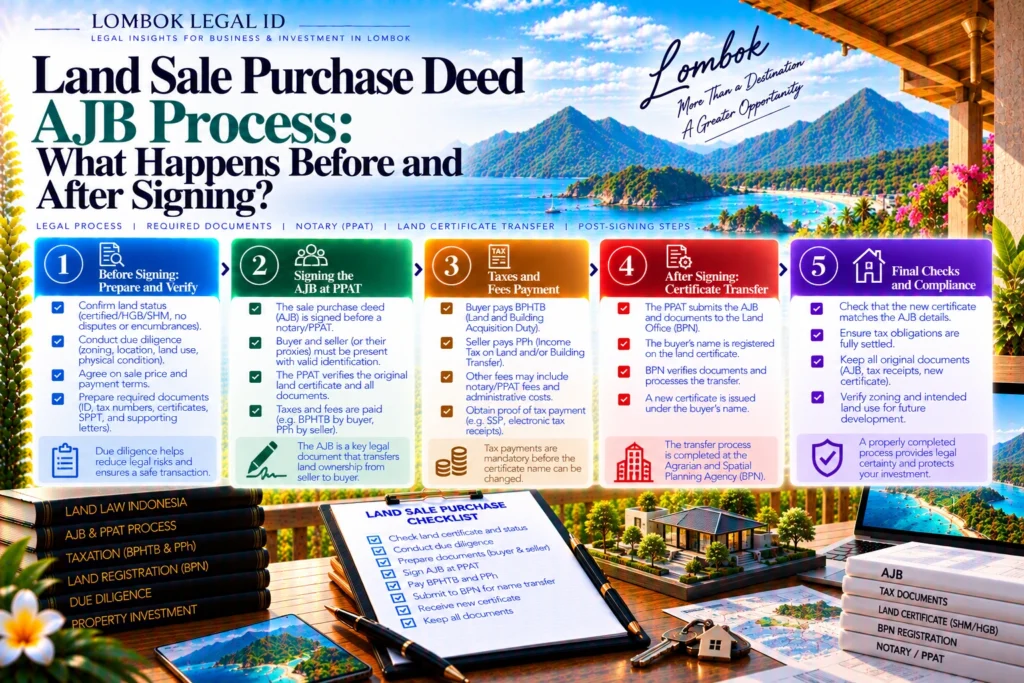
An Indonesian land Sale and Purchase Deed, commonly called an AJB (Akta Jual Beli), is not simply a receipt showing that a buyer paid a seller. For a registered land sale, the PPAT deed is the formal evidence used for registration of the transfer, and the transaction should reach signing only after the title, parties, required approvals and relevant tax obligations have been checked.
The core land-registration framework remains Government Regulation No. 24 of 1997 on Land Registration, which the official BPK database lists as in force in amended form. Its current status record identifies Government Regulation No. 18 of 2021 as the amending regulation.
For the document definition, see our AJB introduction. This guide focuses on the steps before and after execution.
Land Sale Purchase Deed AJB Process: The Short Answer
Article 37 provides that a transfer of land rights through sale and purchase is generally registrable when evidenced by a deed made by the authorized PPAT under the Land Registration regulation.
Article 2 of the PPAT office regulation states that a PPAT performs specified land-registration work by making deeds evidencing legal acts, expressly including sale and purchase under Government Regulation No. 37 of 1998. The underlying PPAT office regulation remains in force in amended form. The official status record shows that it was amended by Government Regulation No. 24 of 2016, which remains in force.
The practical sequence is therefore: verify the land and seller, resolve any inheritance or title issues, complete the relevant tax and approval checks, sign the AJB before the competent PPAT, and then register the transfer with the Land Office.
Step 1 — Confirm the Seller and the Land Record
The PPAT stage should begin with the current land record, not with signatures.
The original certificate must match the Land Office record
For registered land, Article 39 requires the PPAT to refuse to make the deed if the original certificate is not produced or if the certificate does not correspond with the Land Office records under the official regulation.
That makes the certificate check a transaction-control point. Names, title type, parcel identity and recorded status should be reconciled before the parties schedule the final execution.
A buyer should also distinguish title verification from commercial due diligence. The AJB process does not by itself answer every question about physical access, boundaries, occupation, zoning, unpaid contractual obligations or the condition of buildings. Those issues should be investigated according to the property and intended use.
Disputes and missing approvals can stop the deed
Article 39 also requires refusal in specified circumstances including where a required approval has not been obtained, the object is disputed as to physical or juridical data, or another statutory condition is not satisfied under the regulation.
A useful pre-signing review therefore asks more than whether a certificate exists. It asks whether the current seller can legally perform the sale, whether required consents or approvals have been obtained and whether the land record is sufficiently clear for the PPAT to proceed.
Step 2 — Check Inheritance Readiness Where Relevant
Where the registered holder has died, ask the PPAT to confirm the heirship and inheritance-registration steps required before the intended sale. An AJB should not be used to bypass unresolved heirs or inconsistent title records. This article focuses on the signing and registration workflow; the inheritance file needs its own review.
Step 3 — Check Seller PPh and Buyer BPHTB
Tax preparation should occur before the signing appointment because the PPAT process intersects directly with transfer-tax compliance.
The official BPK database lists Government Regulation No. 34 of 2016 as still in force. For an ordinary land or building transfer, Article 2 generally sets the seller-side final income tax at 2.5 percent of the gross transfer value, subject to the regulation’s special categories and exceptions under Government Regulation No. 34 of 2016.
Article 3 generally requires the person or entity receiving the transfer income to pay the applicable final income tax before the deed, decision, agreement or auction minutes are signed by the authorized official under the current tax regulation.
The buyer has a separate BPHTB issue. For the buyer, Article 44 of Law No. 1 of 2022 makes acquisition of land or building rights an object of BPHTB and expressly includes acquisition through sale and purchase. Article 45 identifies the person or entity acquiring the right as the BPHTB taxpayer under the same law.
Article 47 caps the BPHTB rate at 5 percent and requires the applicable rate to be set by regional regulation, so the exact buyer-side amount must be checked for the specific Lombok regency or city where the property is located under Law No. 1 of 2022. The official BPK database lists Law No. 1 of 2022 as in force.
This local element matters in Lombok because there is no sound basis for quoting one buyer-side BPHTB figure for every property across different local-government jurisdictions without checking the applicable regional rule.
Step 4 — Sign the AJB Before the PPAT
Once the legal and tax prerequisites are ready, the transaction reaches execution.
Article 38 requires the parties to the legal act to attend the making of the deed and requires at least two qualified witnesses under the same Land Registration regulation.
Before signing, the parties should ensure that the AJB accurately identifies the seller, buyer, land right, certificate and transaction being performed. Commercial promises that are separate from the land-transfer deed should not be assumed to disappear merely because the AJB is signed; transaction-specific contractual arrangements may require separate documentation.
The important distinction is that the AJB is the PPAT deed evidencing the sale-and-purchase legal act for registration purposes. It is not the same thing as the Land Office’s later completion of the registration change.
Step 5 — Register the Transfer After the AJB
Signing creates an immediate follow-up obligation for the PPAT.
After signing, Article 40 requires the PPAT to submit the deed and related documents to the Land Office for registration no later than seven working days from the date of the deed under the Land Registration regulation.
That seven-working-day rule concerns submission by the PPAT. It should not be presented as a promise that the Land Office will finish the name change or issue the updated land document within seven working days.
The parties should retain evidence of the executed transaction and track the registration until the land record reflects the buyer correctly. If the Land Office identifies missing documents, inconsistent data or another registration obstacle, additional action may be needed after the AJB has already been executed.
Seven Checks Before You Schedule AJB Signing
Before fixing the execution date, work through these checks:
- Confirm the registered owner. Compare the seller with the current land certificate and Land Office data.
- Check the land-right status. Review the title type, parcel data and any recorded issue relevant to transfer.
- Resolve inheritance first where necessary. Identify the heirs and ensure the inheritance-registration position supports the intended sale.
- Identify required approvals or consents. Do not assume every property can be transferred solely because the seller holds a certificate.
- Prepare seller-side tax compliance. Check the applicable final income-tax treatment before AJB execution.
- Calculate buyer-side BPHTB under the correct local rule. Use the regional regulation applicable where the land is located rather than a generic nationwide figure.
- Plan post-signing registration. Treat Land Office registration as a distinct transaction stage and monitor it until the ownership data is updated.
The most avoidable AJB problems usually arise when parties try to solve a title, inheritance, approval or tax issue at the signing table rather than before the appointment.
Conclusion
The land sale purchase deed AJB process is best understood as a sequence. The PPAT first needs a legally transferable object and parties who can perform the transaction; the seller and buyer then address the applicable tax and documentary requirements before the AJB is executed.
Signing the AJB is a central legal step, but it is not the administrative endpoint. The PPAT must submit the deed and supporting documents for registration, and the parties should continue tracking the transaction until the Land Office record reflects the transfer correctly.
For inherited land, the sequence begins even earlier: heir status and inheritance registration should be resolved before the property is treated like an ordinary seller-to-buyer transfer.
Check the Land File Before Scheduling the AJB
If you are preparing a land sale in Lombok, Lombok Legal ID can assist with PPAT-related document preparation, land-certificate review and property transaction documentation based on the actual title and transaction structure.
A pre-signing review can help identify certificate, inheritance, approval, tax or registration issues before they delay the AJB process.
For help coordinating the documents and next steps discussed above, review our ppat services in Lombok.
Read More: Property and PPAT Guide in Lombok: Due Diligence, Land Deeds and Registration
FAQ Land Sale Purchase Deed AJB Process
What is an AJB in an Indonesian land sale?
AJB is the commonly used term for the Sale and Purchase Deed, or Akta Jual Beli, made by the authorized PPAT to evidence the land sale-and-purchase legal act for registration of the transfer.
Can the PPAT sign the AJB if the original certificate is missing?
For registered land, Article 39 of PP No. 24 of 1997 requires the PPAT to refuse to make the deed if the original certificate is not presented or if it does not correspond with the Land Office records.
Does an AJB automatically change the name on the land record?
No. After execution, the deed and related documents still have to be submitted to the Land Office for registration of the transfer.
How quickly must the PPAT submit the AJB to the Land Office?
Article 40 requires submission no later than seven working days after the deed is signed. This is a submission deadline for the PPAT, not a guaranteed seven-day completion time for the Land Office.
What if the land being sold was inherited?
The inheritance-registration position should be resolved first. Article 42 requires specified inheritance evidence and provides rules for registration where there is one heir or several heirs.
Who pays the transfer taxes in an ordinary land sale?
The seller generally faces final income tax on transfer income under PP No. 34 of 2016, while the person acquiring the land right is the BPHTB taxpayer under Law No. 1 of 2022. The exact BPHTB calculation depends on the applicable regional regulation.
Is the BPHTB rate the same everywhere in Lombok?
Do not assume so. National law caps the rate at 5 percent but requires the actual rate to be established by regional regulation, so the applicable rule must be checked for the specific regency or city where the property is located.
References & Sources
- Government Regulation No. 24 of 1997 on Land Registration — peraturan.bpk.go.id
- Official Text of Government Regulation No. 24 of 1997 on Land Registration — peraturan.bpk.go.id
- Government Regulation No. 18 of 2021 on Land Rights and Land Registration — peraturan.bpk.go.id
- Government Regulation No. 37 of 1998 on the Office of Land Deed Officials — peraturan.bpk.go.id
- Official Text of Government Regulation No. 37 of 1998 on the Office of Land Deed Officials — peraturan.bpk.go.id
- Government Regulation No. 24 of 2016 Amending the PPAT Office Regulation — peraturan.bpk.go.id
- Government Regulation No. 34 of 2016 on Final Income Tax for Transfers of Land and Buildings — peraturan.bpk.go.id
- Official Text of Government Regulation No. 34 of 2016 on Final Income Tax for Land and Building Transfers — peraturan.bpk.go.id
- Law No. 1 of 2022 on Financial Relations Between the Central Government and Regional Governments — peraturan.bpk.go.id
- Official Text of Law No. 1 of 2022 on Central-Regional Financial Relations — peraturan.bpk.go.id