Hak Pakai is usually translated as Indonesia’s Right to Use, but that translation can hide an important point: current law recognizes more than one Hak Pakai structure, and the holder, underlying land, duration and transfer rights can differ materially.
Indonesia’s foundational agrarian framework remains Law No. 5 of 1960 on Basic Agrarian Principles, which the official BPK database lists as in force.
Article 41 defines Hak Pakai as the right to use and/or collect produce from land directly controlled by the State or land owned by another person under the authority and obligations established by the granting decision or agreement under the official UUPA text.
Right to Use Hak Pakai Indonesia: The Short Answer
The current detailed Hak Pakai framework is Government Regulation No. 18 of 2021, which the official BPK database lists as in force and as revoking Government Regulation No. 40 of 1996.
Article 49 divides Hak Pakai into fixed-term Hak Pakai and Hak Pakai that lasts while the land continues to be used under the current regulation.
That distinction affects nearly every later question. A private investor usually needs to know whether the right is fixed-term, whereas the while-used category is designed for specified government, diplomatic and international-representative users.
Who Can Hold Hak Pakai?
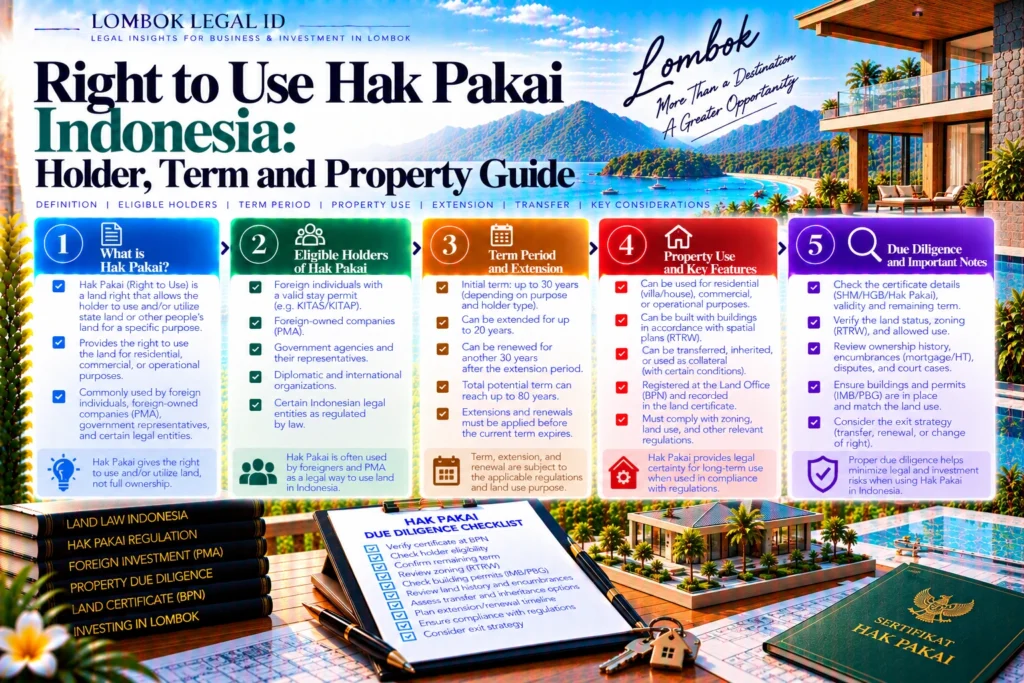
For fixed-term Hak Pakai, Article 49 includes Indonesian citizens, Indonesian legal entities, foreign legal entities with a representative in Indonesia, religious and social bodies, and foreigners among the eligible holders under Government Regulation No. 18 of 2021.
Hak Pakai that lasts while the land is used is instead reserved by Article 49 for Central Government agencies, Regional Governments, village governments, foreign-state representatives and representatives of international bodies under the same regulation.
This means the phrase ‘Hak Pakai holder’ is not enough for due diligence. The legal category of the holder should be checked against the exact type of Hak Pakai recorded or proposed.
Foreign individuals and foreign legal entities are different holder categories
A foreign individual and a foreign company should not be treated as the same applicant. Article 49 separately recognizes foreigners and foreign legal entities that have representation in Indonesia within the fixed-term holder categories.
An Indonesian legal entity, including a company structure that otherwise satisfies Indonesian company and investment law, is another category again. Investors comparing company-held land structures can review Lombok Legal ID’s PT PMA HGB property guide separately, because HGB and Hak Pakai serve different land-right structures.
What Land Can Carry Hak Pakai?
Article 51 permits fixed-term Hak Pakai over State Land, Hak Milik land and Hak Pengelolaan land under the current PP.
By contrast, Hak Pakai that lasts while used can be granted over State Land or Hak Pengelolaan land. The underlying land therefore needs to be identified before a buyer evaluates the term or transaction documents.
For State Land, the right is granted through a ministerial decision. For Hak Pengelolaan land, the ministerial grant is based on approval from the Hak Pengelolaan holder. For Hak Milik land, the structure is created by the Hak Milik holder through a PPAT deed.
Article 54 requires the grant of Hak Pakai to be registered at the Land Office and states that Hak Pakai over State Land, Hak Pengelolaan or Hak Milik arises upon that registration under the current regulation.
Hak Pakai over Hak Milik requires a different transaction file
Where Hak Pakai sits over Hak Milik, the underlying owner remains part of the legal structure. The investor should review the PPAT deed granting the Hak Pakai, its registration and the agreement governing the relationship with the Hak Milik holder.
That is different from purchasing a registered right directly over State Land. Lombok Legal ID’s PPAT services guide provides broader context on land deeds, certificate checking and registration in Lombok.
How Long Does Hak Pakai Last?
The duration depends on the type and underlying land.
Article 52 allows fixed-term Hak Pakai over State Land or Hak Pengelolaan land for up to 30 years initially, an extension of up to 20 years and a renewal of up to 30 years under Government Regulation No. 18 of 2021.
Those are maximum statutory stages, not a guarantee that an existing property has 80 years remaining. A buyer should inspect the original grant date, previous extension history, current expiry date and conditions applying to any future extension or renewal.
For Hak Pakai over Hak Milik land, Article 52 provides a term of up to 30 years and allows renewal through a new deed granting Hak Pakai over the Hak Milik under the same PP.
Hak Pakai that lasts while used follows a different model. It does not use the ordinary fixed-term cycle; it lasts for an unspecified period while the land continues to be used and utilized for the qualifying purpose.
Can Hak Pakai Be Sold, Transferred or Mortgaged?
The answer again depends on the type.
Article 60 allows fixed-term Hak Pakai to be encumbered with Hak Tanggungan and to be transferred, assigned, released or changed, while Hak Pakai that lasts while used cannot be mortgaged, transferred or changed under the official PP text.
For an investor or lender, that difference is material. A certificate described simply as Hak Pakai should therefore be checked for its duration category and transaction restrictions before it is treated as saleable or usable as collateral.
The transaction itself can still require additional consent, deed, registration or contractual steps depending on the underlying land and the parties involved. The existence of a transferable fixed-term right does not remove those requirements.
Hak Pakai for Foreign Residential Property
Hak Pakai is particularly relevant to foreign individuals evaluating residential property, but residential ownership has a separate rule set inside PP No. 18 of 2021.
For residential ownership by a foreign individual, Articles 69 and 71 require the foreigner to have immigration documents and permit a landed home to be held on Hak Pakai, including specified Hak Pakai structures over Hak Milik or Hak Pengelolaan under Government Regulation No. 18 of 2021.
Article 72 also makes foreign residential ownership subject to limits concerning minimum price, land area, number of land plots or apartment units and residential designation under the current regulation.
Those residential restrictions should not be confused with the general Article 49 list of parties who may hold fixed-term Hak Pakai. A foreign buyer should therefore verify both the land-right rules and the separate residential-property conditions applicable to the actual transaction.
Seven Checks Before Relying on Hak Pakai
Before buying, accepting, financing or restructuring a Hak Pakai asset, check these points:
- Identify the type of Hak Pakai. Confirm whether it is fixed-term or granted for as long as the qualifying use continues.
- Confirm holder eligibility. Match the current or proposed holder to the Article 49 category that applies.
- Identify the underlying land. Determine whether the right sits over State Land, Hak Pengelolaan or Hak Milik.
- Check registration. Confirm that the right and any relevant deed have been properly registered at the Land Office.
- Calculate the actual remaining term. Do not use the statutory maximum as a substitute for the certificate’s real dates and history.
- Check transfer and collateral rights. Fixed-term and while-used Hak Pakai have materially different Article 60 rules.
- Check the intended use. For foreign residential property, review immigration-document requirements and the applicable residential restrictions; for business or institutional use, confirm the property fits the holder and project structure.
The English label ‘Right to Use’ is therefore only a starting point. The legally useful analysis comes from the exact Hak Pakai category, its underlying land, holder, registration and remaining duration.
Conclusion
Right to use Hak Pakai Indonesia rules are more structured than the name suggests. A fixed-term Hak Pakai can be available to individuals and legal entities, including specified foreign parties, and may sit over State Land, Hak Milik or Hak Pengelolaan. A separate Hak Pakai category lasts while the land continues to be used and is reserved for specified government and representative institutions.
For investors, the main risk is treating all Hak Pakai certificates as interchangeable. Before relying on the right, verify who can hold it, what land sits underneath it, how long it actually remains valid, whether it can be transferred or mortgaged and whether separate foreign-residential conditions apply.
Check the Hak Pakai Structure Before Signing
If you are reviewing Hak Pakai property or land rights in Lombok, Lombok Legal ID can assist with PPAT-related certificate checking, land-registration review and transaction-document coordination based on the actual holder and underlying land structure.
A pre-transaction review can help identify term, registration, Hak Milik or Hak Pengelolaan relationships and foreign-residential conditions before the parties commit to the transaction.
For help coordinating the documents and next steps discussed above, review our ppat services in Lombok.
Read More: Property and PPAT Guide in Lombok: Due Diligence, Land Deeds and Registration
FAQ Right to Use Hak Pakai Indonesia
What is Hak Pakai in Indonesia?
Hak Pakai is a legally recognized land right allowing its holder to use and/or obtain produce from specified land under the conditions of the grant or agreement. Current rules distinguish fixed-term Hak Pakai from Hak Pakai that lasts while the qualifying use continues.
Can foreigners hold Hak Pakai?
Yes. PP No. 18 of 2021 includes foreigners among the eligible holders of fixed-term Hak Pakai. Foreign residential ownership is subject to additional immigration-document and property restrictions.
How long can Hak Pakai last?
Fixed-term Hak Pakai over State Land or Hak Pengelolaan can be granted for up to 30 years, extended for up to 20 years and renewed for up to 30 years. Hak Pakai over Hak Milik has an initial term of up to 30 years and can be renewed through a new granting deed.
Can Hak Pakai exist over privately owned Hak Milik land?
Yes. PP No. 18 of 2021 recognizes fixed-term Hak Pakai over Hak Milik. The structure is created through the Hak Milik holder and a PPAT deed and must be registered at the Land Office.
Can Hak Pakai be sold or transferred?
Fixed-term Hak Pakai can be transferred, assigned, released or changed subject to the applicable legal requirements. Hak Pakai granted for as long as the land is used cannot be transferred or mortgaged.
Can Hak Pakai be used as collateral?
A fixed-term Hak Pakai can be encumbered with Hak Tanggungan under Article 60 of PP No. 18 of 2021. The while-used category cannot.
Is Hak Pakai the same as HGB?
No. They are different land rights with different legal purposes, holder rules and structures. HGB is centered on the right to construct and own buildings, while Hak Pakai is a broader right to use land under the terms of its grant or agreement.
References & Sources
- Law No. 5 of 1960 on Basic Agrarian Principles — peraturan.bpk.go.id
- Official Text of Law No. 5 of 1960 on Basic Agrarian Principles — peraturan.bpk.go.id
- Government Regulation No. 18 of 2021 on Management Rights, Land Rights, Apartment Units and Land Registration — peraturan.bpk.go.id
- Official Text of Government Regulation No. 18 of 2021 — peraturan.bpk.go.id