

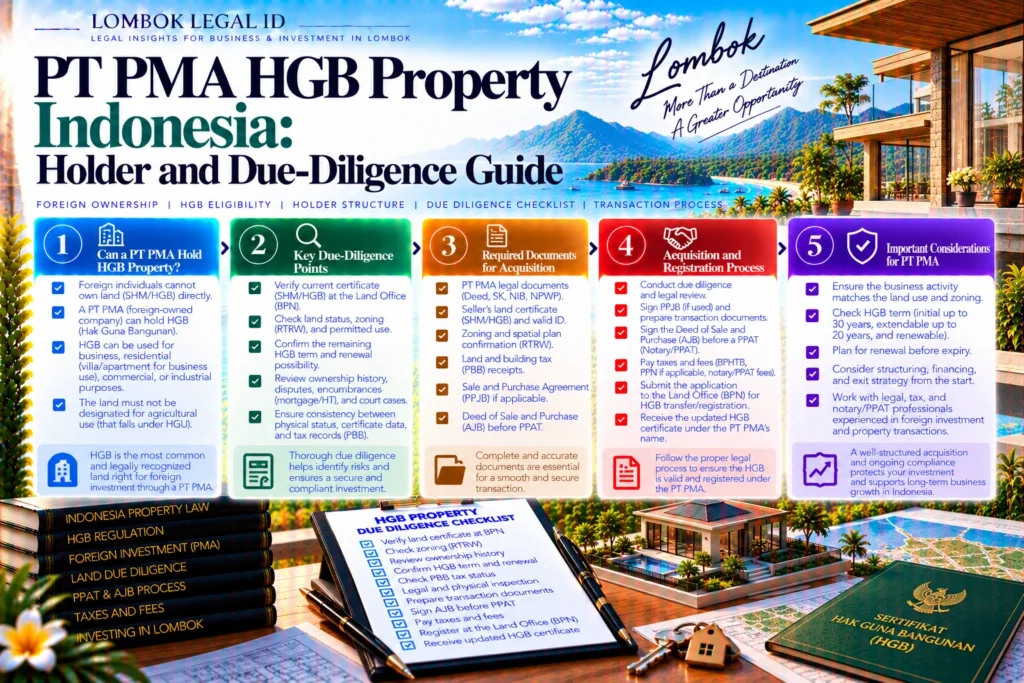
A PT PMA can fall within the category of Indonesian legal entities permitted to hold Hak Guna Bangunan, or HGB. But that answer is only the beginning of a property review. Before a foreign-investment company acquires or relies on an HGB asset, it should verify the registered holder, underlying land, remaining term, extension conditions and whether the intended business use fits the overall legal structure.
Indonesia’s Investment Law, Law No. 25 of 2007, remains in force in amended form according to the official BPK database. Article 5 states that foreign investment must generally be conducted through a limited liability company established under Indonesian law and domiciled in Indonesia unless otherwise provided by law under the official Investment Law text.
Indonesia’s foundational land-right framework remains Law No. 5 of 1960 on Basic Agrarian Principles, which the official BPK database lists as in force.
PT PMA HGB Property Indonesia: Can the Company Hold HGB?
Article 35 defines HGB as the right to construct and own buildings on land that is not the HGB holder’s own under the official UUPA text.
The current detailed HGB framework is Government Regulation No. 18 of 2021, which the official BPK database lists as in force and as revoking Government Regulation No. 40 of 1996.
Article 34 provides that HGB may be granted to Indonesian citizens and legal entities established under Indonesian law and domiciled in Indonesia under the current regulation.
Read together with the Investment Law’s PT requirement, Article 34 means that a properly established PT PMA falls within the class of Indonesian legal entities that can be an HGB holder; it does not mean every parcel, project or intended use is automatically compliant under the current HGB framework.
For comparison, Article 21 generally limits Hak Milik to Indonesian citizens, subject to the provision allowing the Government to designate particular legal entities under specified conditions under the UUPA.
Investors who have not yet established the corporate vehicle can review Lombok Legal ID’s PT PMA setup guide separately. The company-formation question and the HGB property question should then be tested together rather than treated as substitutes for each other.
Step 1 — Confirm the PT PMA Is the Intended Legal Holder
The first document comparison should be simple: which entity will actually be recorded as the HGB holder?
Check the PT PMA’s exact legal name and current corporate records against the seller’s land documents and the proposed transaction structure. Where the property is being acquired for the company’s operations, the land-holding structure should be consistent with the company that will actually use and account for the asset.
A shareholder’s foreign nationality does not mean the shareholder personally becomes the HGB holder. The legal holder is the Indonesian legal entity recorded in the land-registration system.
Step 2 — Identify What Sits Under the HGB
An HGB certificate should not be reviewed without identifying the underlying land.
Article 36 provides that HGB may exist over State Land, Hak Pengelolaan land or Hak Milik land under Government Regulation No. 18 of 2021.
Those structures are not interchangeable. They affect how the HGB was created and what additional relationships or approvals may need to be reviewed.
HGB over Hak Pengelolaan needs a separate consent review
For HGB over Hak Pengelolaan, the explanation to Article 38 states that the Minister grants the HGB to the prospective holder with the approval of the Hak Pengelolaan holder under the official PP text.
The due-diligence file should therefore identify the Hak Pengelolaan holder and review the legal relationship supporting use of that land. The HGB certificate alone may not show every contractual or approval issue relevant to the project.
HGB over Hak Milik depends on the underlying owner and PPAT deed
An HGB can also sit above privately held Hak Milik.
The explanation to Articles 38 and 39 states that HGB over Hak Milik is created through an agreement recorded in a deed made by a PPAT and becomes binding on third parties after registration at the Land Office under Government Regulation No. 18 of 2021.
For a PT PMA evaluating this structure, the review should therefore include the underlying Hak Milik holder, the PPAT deed creating the HGB, registration evidence and the rights and obligations that apply when the HGB ends or is renewed.
Lombok Legal ID’s PPAT services guide provides broader context on certificate checking, land registration and transaction documentation.
Step 3 — Check the Actual Remaining HGB Term
Do not value an HGB property by simply saying it has an ’80-year title.’ The statutory framework contains maximum grant, extension and renewal periods, but an existing certificate may already be years into its current term.
Article 37 allows HGB over State Land or Hak Pengelolaan land for an initial term of up to 30 years, an extension of up to 20 years and a renewal of up to 30 years under the current regulation.
For HGB over Hak Milik, Article 37 provides an initial term of up to 30 years and renewal through a new deed granting HGB over Hak Milik under the same regulation.
The due-diligence question is therefore the actual expiry date and the legal history of the right. Check when the HGB was first granted, whether it has already been extended, what stage it is currently in and what must happen before the company can rely on a later extension or renewal.
Step 4 — Test Extension and Renewal Conditions
Future term should not be treated as automatic.
Article 40 makes extension or renewal conditional on matters including proper use of the land, compliance with the right’s conditions, continued holder eligibility, consistency with spatial planning and the land not being used or planned for a public-interest purpose under the current regulation.
For HGB over Hak Pengelolaan, Article 40 additionally requires the Hak Pengelolaan holder’s approval for an extension or renewal under the PP.
Article 41 provides that an HGB extension application may be filed after the land has been used and utilized according to the purpose of the right and no later than before expiry, while a renewal application may be filed within two years after the right expires under Government Regulation No. 18 of 2021.
For an investor, this means an acquisition model should not automatically capitalize the full theoretical future term as if approval were already secured.
Step 5 — Match the Property to the PT PMA’s Business Use
A valid HGB certificate does not answer every operational question. The company also needs to ask whether the property fits the business that the PT PMA is actually established and licensed to conduct.
Review the company’s business activities, the intended use of the building and land, spatial-planning position and any sector-specific requirements that apply to the project. A hotel, office, warehouse, industrial facility and other commercial use may present different licensing and site questions even where the land right is HGB.
The title analysis should therefore be connected to the business model rather than used as a substitute for business licensing or spatial due diligence.
Step 6 — Audit the Transaction and Registration File
Before signing, create one transaction file that brings the corporate and land documents together.
At minimum, compare the PT PMA’s current corporate identity with the registered HGB holder and seller, review the certificate and Land Office data, identify the underlying land, check the expiry and extension history, review any Hak Pengelolaan or Hak Milik documentation, and reconcile the property with the intended business use.
Property-specific risks such as access, boundaries, encumbrances and physical or legal disputes should also be reviewed independently. Lombok Legal ID’s property access due-diligence guide covers that separate layer of the transaction.
Eight Checks Before a PT PMA Acquires HGB Property
Use this checklist before committing the company to the acquisition:
- Confirm the company. Verify the exact PT PMA that will hold the property and its current corporate records.
- Verify the HGB holder. Match the certificate and current Land Office information with the seller or transferor.
- Identify the underlying land. Determine whether the HGB sits over State Land, Hak Pengelolaan or Hak Milik.
- Check the actual remaining term. Use the certificate history, not a generic 30+20+30 assumption.
- Review extension or renewal conditions. Check land use, holder eligibility, spatial planning and required approvals.
- Review Hak Pengelolaan or Hak Milik documents where relevant. Do not rely on the HGB certificate alone when another legal relationship sits beneath it.
- Match the property to the business. Confirm that the location and intended use fit the PT PMA’s actual project and licensing structure.
- Audit the transaction file before signing. Coordinate corporate, PPAT, land-registration and property due-diligence documents as one transaction.
The practical objective is not merely to prove that the company can legally be an HGB holder. It is to establish that this specific HGB is suitable for this specific PT PMA and project.
Conclusion
PT PMA HGB property Indonesia planning has two separate questions. First, a properly established Indonesian foreign-investment company can fall within the legal-entity category permitted to hold HGB. Second, the company still has to prove that the specific property is suitable for acquisition and continued use.
That second question requires more than reading the certificate title. Investors should identify the underlying land, calculate the real remaining term, examine extension and renewal conditions, check any Hak Pengelolaan or Hak Milik relationship and align the property with the company’s actual business use.
For a material property investment, holder eligibility is the starting point; parcel-specific due diligence is what determines whether the structure is workable.
Review the PT PMA and HGB File Together
If your PT PMA is evaluating HGB property in Lombok, Lombok Legal ID can assist with PPAT-related certificate review, transaction-document coordination and business-structure checks based on the actual company, land right and proposed project.
A pre-acquisition review can help identify remaining-term issues, underlying Hak Pengelolaan or Hak Milik relationships, corporate-holder mismatches and other property records before the company commits to the transaction.
For help coordinating the documents and next steps discussed above, review our ppat services in Lombok.
Read More: Property and PPAT Guide in Lombok: Due Diligence, Land Deeds and Registration
FAQ PT PMA HGB Property Indonesia
Can a PT PMA hold HGB in Indonesia?
A properly established PT PMA can fall within the category of Indonesian legal entities permitted to hold HGB because PP No. 18 of 2021 allows HGB to be held by legal entities established under Indonesian law and domiciled in Indonesia. Parcel suitability and business use still require separate review.
Can a PT PMA hold SHM instead of HGB?
Hak Milik is generally restricted by Article 21 of UUPA to Indonesian citizens, subject to limited Government-designated legal-entity exceptions. A PT PMA should not assume that an SHM certificate can simply be transferred into the company’s name.
Is HGB always valid for 80 years?
No. For HGB over State Land or Hak Pengelolaan, PP No. 18 of 2021 permits up to 30 years initially, a maximum 20-year extension and a maximum 30-year renewal. Those are statutory maximum stages, not an automatic guaranteed 80-year term for every existing certificate.
What should a PT PMA check first on an HGB certificate?
Check the registered holder, actual expiry date and underlying land. Those three points determine much of the later due-diligence work.
Why does Hak Pengelolaan matter to an HGB buyer?
HGB over Hak Pengelolaan involves the Hak Pengelolaan holder in the legal structure. Current rules require its approval for the grant and for an extension or renewal, so that relationship should be reviewed before acquisition.
Can HGB exist over privately owned Hak Milik land?
Yes. PP No. 18 of 2021 recognizes HGB over Hak Milik. The structure is created through the relevant agreement and PPAT deed and must be registered at the Land Office.
Does forming a PT PMA make any property acquisition legally suitable?
No. The company structure establishes the investment vehicle, but the land right, underlying land, spatial position, intended business use and transaction documents must still be reviewed for the specific property.
References & Sources
- Investment Law No. 25 of 2007 — peraturan.bpk.go.id
- Official Text of Investment Law No. 25 of 2007 — peraturan.bpk.go.id
- Law No. 5 of 1960 on Basic Agrarian Principles — peraturan.bpk.go.id
- Official Text of Law No. 5 of 1960 on Basic Agrarian Principles — peraturan.bpk.go.id
- Government Regulation No. 18 of 2021 on Management Rights, Land Rights, Apartment Units and Land Registration — peraturan.bpk.go.id
- Official Text of Government Regulation No. 18 of 2021 — peraturan.bpk.go.id