

A warehouse in Lombok may support retail, distribution, manufacturing, hospitality supply, e-commerce fulfillment or third-party storage. Before signing a lease or beginning operations, the business should determine whether the facility falls within the current Tanda Daftar Gudang (TDG) framework and what other site, building or goods-specific requirements may apply.
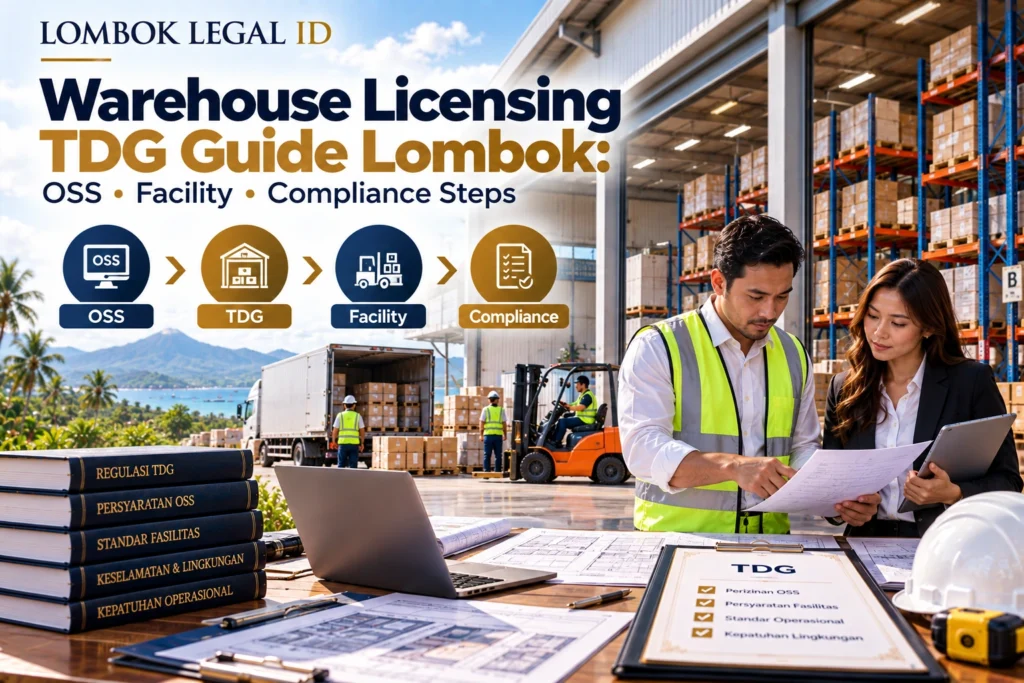
This warehouse licensing TDG guide Lombok explains the practical sequence: identify the warehouse and operator, check whether TDG applies, review exemptions, verify the site and facility, prepare the OSS file, complete the registration process and maintain warehouse records after approval.
The current OSS system lists Tanda Daftar Gudang as a PB-UMKU in the trade sector. The underlying warehouse rules sit within Government Regulation No. 29 of 2021 on the Trade Sector, which remains in force but was amended in 2026 by Government Regulation No. 3 of 2026.
1. What Is a Tanda Daftar Gudang (TDG)?
TDG is the registration evidence for a warehouse. Under Government Regulation No. 29 of 2021, warehouse owners are required to have a TDG and obtain it through warehouse registration.
For a business planning warehouse operations in Lombok, the first question should therefore be whether the proposed premises meet the regulatory definition and classification of a warehouse and whether an exemption applies.
TDG should not be confused with the company’s NIB. The NIB identifies the business within the risk-based licensing system, while TDG addresses registration of the warehouse facility.
2. Check Whether the Facility Falls Within the Current Warehouse Classification
Government Regulation No. 3 of 2026 amended the warehouse provisions of Government Regulation No. 29 of 2021. The amended rules classify warehouses as closed or open warehouses and update the technical thresholds used for warehouse categories.
Under Government Regulation No. 3 of 2026, closed warehouses are divided into several categories based on floor area and/or storage capacity, while open warehouses are classified using a minimum area threshold.
For practical planning, record at least:
- whether the warehouse is closed or open
- total floor or storage area
- storage capacity
- whether the facility is a conventional warehouse, silo or tank
- the goods to be stored
- whether storage is for the company’s own goods or for third parties
Do not select the TDG route from the business name or lease description alone. The physical facility and actual storage activity should be reviewed first.
3. Check Whether a TDG Exemption Applies
Not every storage location should automatically be treated as requiring separate TDG registration.
Government Regulation No. 29 of 2021 contains exemptions from warehouse registration for certain facilities, including warehouses located in bonded storage areas, warehouses under customs supervision and certain warehouses attached to retail or production activities.
Because an exemption depends on the actual use and relationship of the storage space to the business activity, document the reason before relying on it. A small stock room, production-attached storage area and independent commercial warehouse can have different regulatory treatment.
If the facility does not clearly fall within an exemption, verify the TDG position before signing a long-term warehouse lease or investing in fit-out works.
4. Identify the Owner, Operator and Actual Warehouse Activity
A warehouse project can involve several parties:
- property owner
- warehouse owner
- tenant
- warehouse operator
- owner of the stored goods
- logistics or fulfillment provider
These roles should be mapped before an application is prepared.
The business should also describe what happens inside the facility. Ask whether it is used only for storage or whether it also performs activities such as repacking, fulfillment, processing, distribution or production.
The nature of the goods also matters. Food, chemicals, dangerous goods, cold-chain products, customs-controlled goods or regulated commodities may trigger requirements outside the TDG framework.
A TDG should therefore be treated as one component of warehouse compliance, not as permission to store every category of goods.
5. Review the Lombok Site Before Fit-Out
Warehouse licensing should be coordinated with the property and site review.
Before committing to a facility, check:
- exact address and parcel location
- legal basis for using the premises
- intended warehouse activity
- spatial or zoning compatibility
- building documentation relevant to the proposed use
- access for loading and transport
- layout and storage capacity
- fire and emergency arrangements
- ventilation or other facility requirements relevant to the stored goods
A zoning review and a warehouse registration review answer different questions. For land-use compatibility, see the Zoning Check in Lombok guide.
If the warehouse is connected with a manufacturing operation, the licensing analysis should also distinguish warehouse compliance from the industrial-business licensing applicable to the production activity.
6. Prepare the OSS and TDG Readiness File
The OSS system provides a dedicated PB-UMKU TDG application guide. The exact application fields and evidence should be checked in the live OSS system for the applicant and facility at the time of filing.
A practical readiness file can include:
| Review area | Information to prepare |
|---|---|
| Business | Legal entity, NIB and relevant business activities |
| Warehouse | Address, warehouse type, floor area and storage capacity |
| Operator | Owner, tenant and operational responsibility |
| Goods | Type of goods and storage method |
| Premises | Ownership or lease documents and available building records |
| Location | Spatial or zoning information relevant to the intended use |
| Supporting records | Layout, coordinates and other evidence requested through OSS |
This is a preparation framework rather than a universal statutory attachment list. The live OSS requirements should control the final submission.
7. Complete the Registration and Verify the Issued TDG
A practical workflow is:
Step 1: Define the facility
Confirm the warehouse location, type, area, capacity and goods stored.
Step 2: Test the TDG requirement
Determine whether the facility falls within the warehouse-registration framework or a recognized exemption.
Step 3: Check the business and site records
Reconcile the operator’s NIB, business activities, premises documents and warehouse information.
Step 4: Review other applicable requirements
Check whether the intended goods, processing activities, industrial activity or site conditions require a separate permit, certification or technical review.
Step 5: Access the OSS PB-UMKU route
Use the current TDG route through OSS and complete the data required for the actual warehouse.
Step 6: Respond to verification or correction requests
Keep the submitted source documents consistent with the physical warehouse and company records.
Step 7: Review the issued document
Before relying on the TDG operationally, confirm that the warehouse identity, address and other material details correspond to the actual facility.
An OSS submission receipt should not be treated as equivalent to a completed TDG registration. Keep the final issued document and the application evidence together in the compliance file.
Warehouse Record-Keeping Is an Ongoing Obligation
Warehouse compliance does not end when the TDG is issued.
Government Regulation No. 3 of 2026 amended the administrative-record provisions for warehouses. The current rule requires an owner, manager or tenant storing goods intended for trade to maintain warehouse administration records covering at least the quantities stored and goods entering and leaving the warehouse. See the current amendment in Government Regulation No. 3 of 2026.
A practical warehouse register should therefore be capable of supporting information on inventory movement and the underlying goods records.
Management should also review the compliance impact before changing:
- warehouse operator
- warehouse address
- physical capacity
- layout or use
- categories of goods stored
- relationship between production, retail and storage activities
Changes that alter the factual basis of the warehouse registration should be reviewed before implementation rather than only after an inspection or business-license update.
Special Considerations for Leased Warehouses
A tenant should not assume that warehouse compliance is automatically handled by the landlord.
Before signing a lease, request the warehouse and premises documents relevant to the proposed operation and determine which party is responsible for:
- TDG registration or maintenance
- providing property and building records
- correcting facility deficiencies
- responding to authority inspections
- supplying documents needed for OSS submissions
- updating records when the facility changes
A lease can allocate contractual responsibilities and costs between the parties, but it does not rewrite regulatory requirements imposed by the authorities.
For property-related due diligence before committing to a warehouse site, the PPAT Services Lombok guide provides additional context on land, registration and zoning review.
Frequently Asked Questions Warehouse Licensing TDG Guide Lombok
Is TDG the same as an NIB?
No. TDG is the registration document for the warehouse, while the NIB is the business identification number within the OSS licensing system. The two documents serve different functions.
Is TDG still available through OSS in 2026?
Yes. OSS currently lists Tanda Daftar Gudang as an available PB-UMKU in the trade sector and provides a dedicated application guide.
Does every storage room require TDG?
Not necessarily. The warehouse classification and exemptions must be checked against the actual facility and its use. Certain storage areas connected with retail, production, bonded storage or customs-supervised facilities may receive different treatment under the warehouse rules.
Does TDG allow a business to store any product?
No. TDG addresses warehouse registration. Product-specific, safety, customs, environmental or sector requirements may still apply depending on the goods and activities involved.
Should warehouse licensing be checked before signing a lease?
Yes, particularly when the business depends on the site being legally suitable for commercial storage. Reviewing the warehouse classification, zoning, premises records and TDG position before a long-term commitment can identify issues that may otherwise appear after fit-out.
Review the Warehouse Before You Commit to Operations
The central question in warehouse licensing is not simply whether the company has an NIB. The business should determine whether the proposed facility falls within the TDG framework, whether an exemption applies, whether the premises support the intended use and whether additional requirements apply to the goods or activities.
Prepare the warehouse address, dimensions, capacity, goods list, operator structure, NIB and premises records before starting the OSS submission. This allows the TDG route to be reviewed against the actual facility instead of relying on assumptions from a lease or business description.
For warehouse licensing assistance in Lombok, Lombok Legal ID includes Warehouse Licenses within its business-licensing service scope. A project-specific review can separate the TDG question from zoning, building, industrial and goods-specific requirements before the application is submitted.
This guide provides general information. TDG classification, exemptions, OSS requirements and related facility obligations should be checked against the actual warehouse and the regulations in force when the application is filed.