
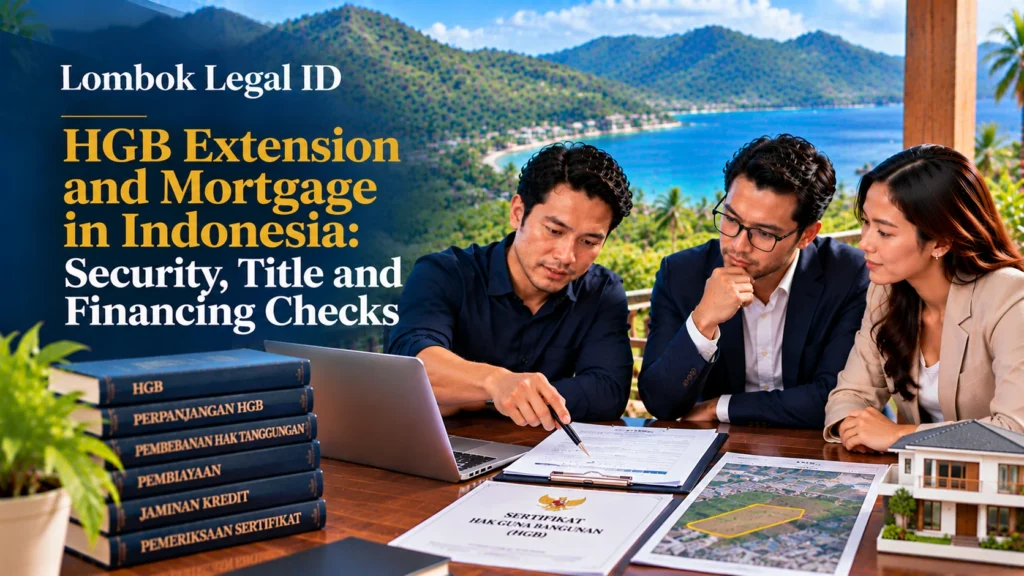
An HGB extension can be important when Indonesian property is used as security for a loan. A lender may hold Hak Tanggungan over a Hak Guna Bangunan right, but the continued existence of the security depends on the legal status of the underlying land right. The borrower must also consider the financing agreement and any requirements imposed by the relevant lender.
Indonesia's Law No. 4 of 1996 on Hak Tanggungan establishes the land mortgage security framework and identifies Hak Guna Bangunan as a land right capable of being encumbered.
The central issue is therefore not simply whether an HGB certificate can be extended. It is whether the land right, mortgage registration, and existing debt remain legally and commercially aligned throughout the extension or renewal process.
HGB Extension Mortgage Indonesia: Why Timing Matters
When HGB is approaching expiry, the timing of the land-right application may affect the security position associated with the property.
A borrower planning refinancing or additional development should distinguish between extending an existing right before its term ends and seeking a new or renewed right after expiry.
This distinction deserves attention before a loan restructuring, property acquisition, or major building investment is finalized.
A certificate showing a remaining HGB term does not independently establish the absence of mortgage security, the terms of the borrowing, or the lender's willingness to provide additional financing.
Understand HGB and Hak Tanggungan
HGB, Hak Tanggungan, and the secured debt are related but legally different.
HGB is the underlying land right. Hak Tanggungan is the security interest associated with the relevant land right. The debt is the borrower's underlying financial obligation.
A property investor should examine all three rather than treating the certificate as a complete description of the financing arrangement.
HGB as the Underlying Land Right
The current HGB framework under Government Regulation No. 18 of 2021 replaced Government Regulation No. 40 of 1996.
The holder should establish the HGB's registered owner, expiry date, underlying land category, and relevant restrictions or conditions.
Hak Tanggungan as Loan Security
A registered Hak Tanggungan is associated with a secured obligation and the relevant land right. Its legal position cannot be assessed solely by asking whether the borrower continues to occupy or operate the property.
The review should identify the secured creditor, the security documentation, the registered status of the encumbrance, and the debt or obligations secured.
The Secured Debt Remains a Separate Question
A borrower should not confuse cancellation or extinguishment of security with repayment of the loan.
Whether the debt remains outstanding must be determined from the applicable financing documents and legal framework, not from the land certificate alone.
What Happens When an Encumbered HGB Expires?
Under Article 18(1) of Law No. 4 of 1996, Hak Tanggungan is extinguished when the land right constituting its security is extinguished.
This creates a significant distinction between the status of the land right and the financial claim secured by that right.
Under Article 18(4) of the Hak Tanggungan Law, extinguishment of the mortgage security because the underlying land right ends does not extinguish the secured debt.
Why This Matters to Borrowers
If the land right ends and the associated security is extinguished, the borrower should not assume that the debt has disappeared.
The lender may still have contractual claims relating to the outstanding obligation. The actual consequences depend on the financing terms and relevant law.
For the borrower, a problem with land tenure may therefore become a financing issue even if business operations continue at the property.
Why This Matters to Lenders
A creditor considering secured financing must assess whether the land right supporting the security will remain available for the intended financing period.
Where the HGB is nearing expiry, the lender may request information about the extension plan, title conditions, and available security arrangements.
These are practical financing considerations, not a claim that every Indonesian lender imposes identical documentary conditions.
Does a Pre-Expiry HGB Extension Preserve the Mortgage?
The legal framework recognizes an important distinction between a qualifying extension of an existing encumbered right and the extinguishment of that right.
The official explanation of Article 18 of the Hak Tanggungan Law states that where an encumbered HGB is extended on an application submitted before the end of its term, the existing Hak Tanggungan remains attached to that land right.
This provision is important when planning the timing of an extension for property already used as loan security.
Extension Is Not the Same as Automatic Approval
The continued attachment principle should not be interpreted as a guarantee that any extension request will be approved.
The underlying HGB application must still satisfy the applicable land-right requirements. The documentation and timing of the actual extension should be examined before relying on continued security in a financing transaction.
Renewal May Require a Different Security Assessment
Where an existing HGB has already ended and a later application concerns renewal or a new grant, the parties should not simply assume that the former mortgage security automatically reappears on the resulting right.
The status of the earlier land right, the security registration, and any necessary new security arrangements should be assessed independently.
This is particularly important where the borrower proposes to refinance immediately after a renewal or property restructuring.
Check the Underlying Land Category
The available HGB process depends on whether the right is established over state land, Hak Pengelolaan (HPL), or Hak Milik.
Under Article 37 of Government Regulation No. 18 of 2021, HGB over state land or Hak Pengelolaan may be granted for up to 30 years, extended for up to 20 years, and renewed for up to 30 years.
Those maximum periods are not automatic entitlements and should not be treated as a guarantee of approval.
The land-right provisions in Government Regulation No. 18 of 2021 distinguish HGB over Hak Milik, where a further period involves a new grant based on agreement with the Hak Milik holder, from the ordinary state-land or HPL extension framework.
HGB Over HPL
Under Article 40 of Government Regulation No. 18 of 2021, extension and renewal are subject to relevant land-use and eligibility conditions, with approval from the Hak Pengelolaan holder required for HGB over HPL.
Where a financed property is built on HPL land, the borrower should investigate the underlying HPL relationship, land-use agreement, and required approvals alongside the lender's documents.
Application Timing
Under Article 41 of Government Regulation No. 18 of 2021, an HGB extension application is addressed before expiry, while the applicable renewal application may be submitted within the specified post-expiry period.
The relevant application history should be documented. A pending application, an approved extension, and a newly registered right should not be treated as identical for financing due diligence.
Mortgage and Land Certificate Due-Diligence Matrix
Before planning a financing transaction, prepare a record-based comparison of the land title, security documents, and borrowing arrangements.
The following table identifies the main items to review and the uncertainty each item helps resolve.
| Item to review | Main question | Why it matters |
|---|---|---|
| HGB certificate | Who holds the right and when does it expire? | Establishes the starting land-tenure position |
| Underlying land status | Is the HGB over state land, HPL, or Hak Milik? | Determines which land-right framework is relevant |
| Extension application records | Was an application submitted and what is its status? | Helps assess timing and continuity of the right |
| Land-right conditions | Are eligibility, land use, and relevant approvals satisfied? | Identifies obstacles to extension or renewal |
| Hak Tanggungan records | What security is registered and in whose favor? | Identifies the existing secured position |
| Security documentation | Which obligations and land rights are described? | Helps reconcile legal security with financing terms |
| Loan agreement | What debt remains and what contractual conditions apply? | Distinguishes debt obligations from land-right status |
| Proposed refinancing documents | What security does the new lender expect? | Identifies matters requiring lender and legal review |
| Existing restrictions or disputes | Are there recorded or unresolved title issues? | Helps identify transaction risks |
The matrix is an internal review tool rather than a prescribed government form. It should be completed using actual records, with unresolved matters referred to the appropriate land, security, or legal professionals.
Coordinate Extension, Refinancing and Lender Review
A borrower should not treat HGB extension as a task entirely separate from its financing arrangements.
The coordination process can begin with a document inventory and proceed to an assessment of which parties need to provide information or take action.
Review the Existing Financing Documents
Check the loan agreement, mortgage documentation, relevant covenants, and provisions concerning title maintenance or changes to secured property.
The existence of Hak Tanggungan does not, by itself, prove that a creditor's separate consent is legally mandatory for every form of HGB extension.
Whether lender consent, notification, additional security, or document delivery is needed should be assessed from the actual transaction, applicable law, relevant administrative procedure, and financing contract.
Verify the Land Office Procedure
The land-right administration framework under Ministerial Regulation No. 18 of 2021 governs procedures for determining Hak Pengelolaan and land rights.
Before submitting documents, confirm the applicable procedure for the particular HGB and whether any issue arising from existing encumbrances requires additional handling.
An official land-office checklist used for one type of land-right change should not automatically be treated as the checklist governing all HGB extension applications.
Verify the Proposed Security Position
If the financing is being renewed, increased, transferred to another lender, or restructured, identify the legal security position expected after the land-right process.
The assessment should distinguish continuation of an existing Hak Tanggungan from circumstances requiring separate creation, amendment, release, or registration of security.
Do not assume that a refinancing agreement alone corrects an unresolved land-right or mortgage registration issue.
Example: A Lombok Accommodation Property
Consider a hypothetical company operating an accommodation business in Lombok. The company holds HGB over a property used for guest facilities and has granted Hak Tanggungan to secure an outstanding loan.
Management plans to renovate the property and obtain additional financing, but the HGB is approaching expiry.
The appropriate preliminary review is not limited to the building's commercial value. The company should establish the remaining HGB term, underlying land status, registered mortgage details, debt balance, financing covenants, and status of any extension application.
If a qualifying extension is pursued before expiry, the statutory treatment of the existing Hak Tanggungan becomes especially relevant. If the right expires before the appropriate process is completed, the potential consequences for security and debt must be evaluated separately.
The proposed lender may also have its own commercial requirements concerning remaining tenure and title certainty.
This example is illustrative and does not describe an actual transaction, lender policy, or client engagement.
Practical Checklist Before a Financing Decision
A borrower or property investor can use the following sequence to organize a preliminary review:
- Obtain the current HGB certificate and relevant title records.
- Confirm the underlying land category and existing HGB term.
- Identify the registered Hak Tanggungan and secured creditor.
- Review the existing loan and security documents.
- Establish the status and timing of any HGB extension or renewal application.
- Identify relevant HPL-holder or Hak Milik-holder arrangements where applicable.
- Confirm the land-right requirements and any unresolved restrictions.
- Compare the proposed financing term with the land-tenure position.
- Determine whether any lender coordination or new security documentation is needed.
- Obtain transaction-specific legal and land-right advice before relying on the title as financing security.
The checklist is designed for initial due diligence. It is not a guarantee that the land office or lender will approve the proposed transaction.
Conclusion
HGB extension and mortgage security in Indonesia must be assessed together, but the land right, Hak Tanggungan, and secured debt remain separate legal matters.
A qualifying pre-expiry extension can preserve the attachment of existing Hak Tanggungan under the statutory explanation. Conversely, extinguishment of the underlying land right can extinguish the security without extinguishing the debt.
For property investors and borrowers, the practical priority is to verify the HGB term, extension status, existing mortgage registration, and financing documents before committing to refinancing, acquisition, or significant development expenditure.
Review Your HGB Title and Mortgage Documentation
If an HGB property is approaching expiry while supporting existing or proposed financing, Lombok Legal ID can be contacted about business setup, notary-related, and PPAT-related documentation review.
Request a consultation to examine the HGB certificate, relevant land records, mortgage documentation, and questions requiring coordination with the lender or competent land office before a financing decision.
Before refinancing, discuss the title and registered encumbrance records through our land certificate checking service.
The financing timetable should be reconciled with the HGB extension and renewal process.
Read Also: Property and PPAT Guide in Lombok: Due Diligence, Land Deeds and Registration
FAQ Hgb Extension Mortgage Indonesia
Can HGB land be used as mortgage security in Indonesia?
Yes. Law No. 4 of 1996 identifies Hak Guna Bangunan as a land right capable of being encumbered by Hak Tanggungan, subject to the applicable requirements and security documentation.
Does Hak Tanggungan automatically disappear when HGB is extended?
Not necessarily. The statutory explanation to Article 18 of the Hak Tanggungan Law recognizes continued attachment of existing security where an encumbered HGB is extended based on an application submitted before expiry. The actual application and extension status still require verification.
What happens to a mortgage if the underlying HGB expires?
Article 18 provides that Hak Tanggungan is extinguished when the underlying land right constituting its security is extinguished. The legal position must be assessed against the actual land-right history, particularly if an extension process was initiated before expiry.
Does the borrower still owe the loan if Hak Tanggungan is extinguished?
Yes, extinguishment of security caused by extinguishment of the underlying land right does not itself extinguish the secured debt under Article 18(4) of Law No. 4 of 1996.
Is lender consent mandatory for every HGB extension?
A universal lender-consent requirement should not be assumed solely because the property is encumbered. The borrower should examine applicable land-office procedures, the actual security arrangement, and the loan agreement to determine whether consent, notification, or additional documents are required in the specific case.
Can an HGB renewal automatically restore an earlier mortgage?
Automatic restoration should not be assumed. If the earlier land right and associated security have been extinguished, the resulting land-right and security position requires separate legal assessment, including any necessary new security documentation or registration.
Why does the remaining HGB term matter when refinancing property?
The remaining land-right term affects the legal and commercial assessment of the security supporting the financing. A lender may consider the expected loan duration, renewal uncertainty, current encumbrances, and the availability of effective security. Specific acceptance requirements vary by transaction and lender.
References & Sources
- Law No. 4 of 1996 on Mortgage Rights over Land and Related Objects — peraturan.bpk.go.id
- Government Regulation No. 18 of 2021 on Management Rights, Land Rights, Apartment Units, and Land Registration — peraturan.bpk.go.id
- Minister of Agrarian Affairs/National Land Agency Regulation No. 18 of 2021 on Determining Management Rights and Land Rights — peraturan.bpk.go.id