
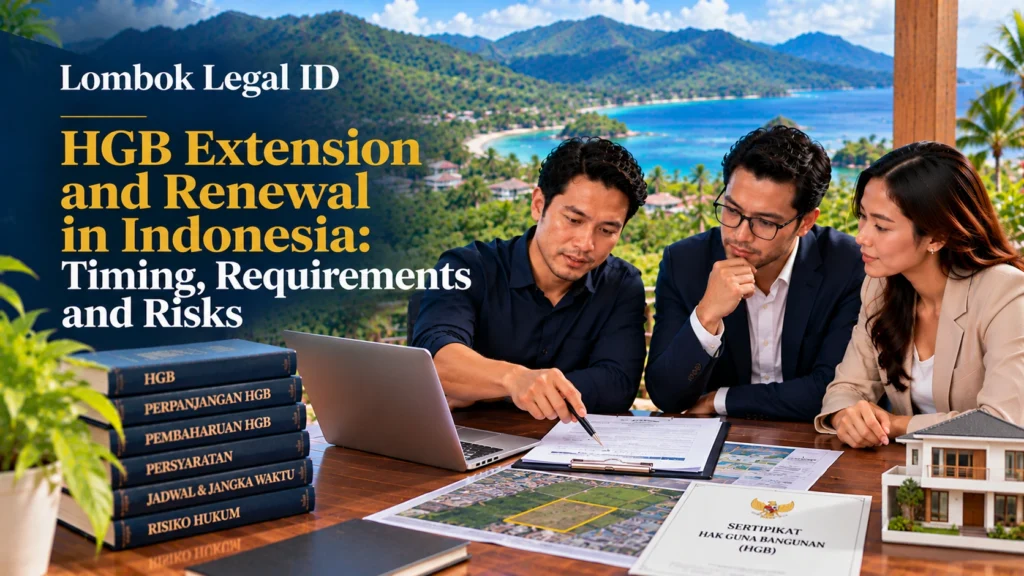
An HGB extension or renewal in Indonesia depends on the existing right, its expiry date, the status of the underlying land, and whether the holder satisfies the applicable requirements. Extension and renewal should not be treated as interchangeable terms: the correct route depends on the circumstances of the particular Hak Guna Bangunan certificate.
The current land-right framework under Government Regulation No. 18 of 2021 governs HGB and replaced Government Regulation No. 40 of 1996.
For a company holding property in Lombok, the sensible first step is to check the certificate and underlying land status before planning an application, refinancing, acquisition, or expansion.
HGB Extension Renewal Indonesia: What Is the Difference?
An extension concerns continuation of an existing HGB term within the applicable legal framework. A renewal involves obtaining a further term through the relevant renewal procedure. Neither should be assumed automatic.
The practical distinction becomes particularly important as the expiry date approaches. A certificate holder should identify whether the existing right remains in force, which category of land supports it, and whether the requested action is legally available.
A decision based only on the expiry date, without examining the land relationship, may lead to incorrect expectations.
Check the Type of Land Under the HGB
Under Article 36 of Government Regulation No. 18 of 2021, HGB may be granted over state land, land subject to Hak Pengelolaan (HPL), and land subject to Hak Milik.
These categories are not interchangeable. Before discussing renewal periods, determine the legal status of the underlying land from the certificate, land records, and relevant supporting documents.
HGB Over State Land
Where the HGB is established over state land, the holder's position is assessed under the applicable land-right rules and the terms of the existing grant.
The review should include whether the land has been used for the purpose for which the right was granted, whether the holder remains eligible, and whether the application is consistent with the applicable spatial plan.
An approaching expiry should prompt early documentary review rather than an assumption that the government will automatically approve another period.
HGB Over Hak Pengelolaan
HGB over HPL involves an additional underlying land-management relationship.
The holder should establish who holds the HPL, the terms governing the use of the land, and the approval arrangements applicable to the proposed extension or renewal.
An applicant should not assume that possession of an HGB certificate eliminates the need to consider the position of the HPL holder.
HGB Over Hak Milik
The same regulation distinguishes HGB over Hak Milik, which is granted for a maximum of 30 years and may be renewed through a new arrangement with the Hak Milik holder rather than through the ordinary state-land extension sequence.
For a property investment, this distinction can materially affect negotiations with the underlying landowner. The holder should examine the relevant agreement and should not assume that the ordinary extension framework applies unchanged.
HGB Duration and Application Timing
Under Article 37 of Government Regulation No. 18 of 2021, HGB over state land or HPL may be granted for up to 30 years, extended for up to 20 years, and renewed for up to 30 years.
These are statutory maximum periods, not a guarantee that every applicant will obtain the maximum term or that all periods will be granted automatically.
The following table summarizes the main distinctions to check before planning a land-right application.
| Issue | HGB over state land or HPL | HGB over Hak Milik |
|---|---|---|
| Initial term | Up to 30 years | Up to 30 years |
| Extension | Potentially up to 20 years, subject to applicable requirements | Ordinary state-land extension sequence does not apply in the same way |
| Renewal | Potentially up to 30 years, subject to applicable requirements | Requires a new arrangement with the Hak Milik holder |
| Main verification | Certificate, eligibility, land use, underlying land conditions | Certificate, landowner agreement, eligibility, and new arrangement |
The important consequence is that the holder must identify which category applies before relying on a maximum period or deciding which application procedure to pursue.
When Can an Extension Be Requested?
Under Article 41(1) of Government Regulation No. 18 of 2021, an extension application may be submitted after the land has been used in accordance with its granted purpose and must be addressed before the HGB term ends.
Early preparation is advisable because the land office may need to examine information about the holder, the certificate, the land, and compliance with the applicable conditions.
The article does not assume a universally applicable commercial processing time. The actual steps and completion date depend on the application and administrative circumstances.
What Is the Renewal Window?
Under Article 41(2) of Government Regulation No. 18 of 2021, the applicable renewal application must be submitted no later than two years after the HGB term expires.
That provision should not be confused with a guarantee that an expired HGB remains legally unchanged during those two years. The holder should promptly verify the legal consequences of expiry, the status of the underlying land, and the availability of the relevant renewal route.
Requirements to Review Before Applying
The requirements under Government Regulation No. 18 of 2021 make the holder's eligibility, actual land use, compliance with the purpose of the right, and applicable spatial planning relevant to extension and renewal decisions.
A practical preliminary checklist includes:
- The existing HGB certificate and its recorded expiry date
- The legal identity and eligibility of the registered holder
- The underlying land category and supporting land records
- The actual use of the land and any relevant buildings
- The purpose and conditions stated in the original grant
- Applicable spatial planning considerations
- The relevant HPL-holder or Hak Milik-holder arrangements, where applicable
- Existing mortgages, restrictions, disputes, or other matters affecting the property
- Documents demonstrating the holder's continued use and legal interest in the land
This is a due-diligence checklist rather than a complete official application-document list. The exact requirements should be confirmed for the particular right and requested procedure.
The land-right administration framework under Ministerial Regulation No. 18 of 2021 governs procedures for determining Hak Pengelolaan and land rights, including administrative matters relevant to HGB applications.
What If the HGB Has Already Expired?
An expired certificate should be reviewed immediately rather than treated as though an ordinary pre-expiry extension remains available.
The correct analysis depends on whether the HGB was granted over state land, HPL, or Hak Milik, as well as the relevant expiry and application dates.
Questions to resolve include whether the application falls within the applicable renewal framework, who currently has rights over the underlying land, and whether additional agreements or approvals are necessary.
The investor should also check whether property financing, a proposed sale, or an ongoing development depends on rights that may no longer be in force.
Do not assume that continued physical occupation of the property automatically establishes continued HGB ownership or guarantees approval of a renewal.
HGB Due Diligence for Property Investors
An HGB certificate approaching expiry can affect the commercial evaluation of a property transaction.
For example, a buyer may value an existing hotel based on anticipated long-term operations. If the supporting HGB expires soon, the buyer should examine the available extension or renewal pathway before treating the expected operating period as secure.
A buyer-side review should consider the remaining term, holder eligibility, underlying land rights, renewal documentation, planning consistency, property encumbrances, and any relevant landowner or HPL-holder consent.
The active website's land certificate checking guide provides related context for investigating certificate information before an acquisition.
The extension or renewal assessment should then address the additional question of how long the relevant right can lawfully continue and what must be established before the land office can act.
Lombok Hospitality Property Example
Consider a hypothetical company operating accommodation facilities in Lombok under an HGB certificate.
Management plans to invest in renovations and extend the property's commercial operations, but the certificate has a limited remaining term.
Before committing to a major project, the company should verify the certificate's expiry date, identify the underlying land category, confirm the actual land use, and examine the applicable extension or renewal conditions.
If the HGB is over HPL, the underlying management-right relationship should be investigated. If it is over Hak Milik, a new arrangement with the underlying owner may be central to the analysis.
A proposed acquisition or loan secured against the property adds further questions about the existing title and any recorded encumbrances.
The example illustrates why an HGB renewal question should be resolved through land-right due diligence rather than a simple calculation based on the maximum statutory periods.
Conclusion
HGB extension and renewal in Indonesia depend on the nature of the existing land right, the expiry date, the holder's eligibility, and the conditions governing the land.
For HGB over state land or HPL, the legal framework distinguishes the original grant, extension, and renewal periods. HGB over Hak Milik follows a different arrangement involving the underlying landowner.
Before applying or investing, review the certificate, identify the underlying land category, verify the applicable procedure, and resolve missing agreements or discrepancies. The statutory possibility of a further period should never be confused with guaranteed approval.
Review Your HGB Expiry, Extension or Renewal Options
If an HGB certificate supporting a property or business investment is approaching expiry, Lombok Legal ID can be contacted about land certificate checking, PPAT-related documentation, and property legal review services.
Request a consultation to discuss the existing certificate, underlying land status, relevant agreements, and documents that should be examined before an extension, renewal, acquisition, or financing decision.
Before relying on an extension or renewal plan, discuss the certificate history and applicable land-right process through our ownership certificate processing service.
A corporate property acquisition should also address PT PMA eligibility and HGB title checks.
Read Also: Property and PPAT Guide in Lombok: Due Diligence, Land Deeds and Registration
FAQ Hgb Extension Renewal Indonesia
What is the difference between an HGB extension and renewal in Indonesia?
An extension concerns continuation of an existing HGB term under the applicable framework, while renewal involves a further land-right period through the relevant renewal procedure. The available route depends on the certificate's status and whether the HGB is over state land, HPL, or Hak Milik.
Can HGB be extended for 20 years and renewed for another 30 years?
Government Regulation No. 18 of 2021 provides this maximum structure for HGB over state land or HPL, following an initial term of up to 30 years. Those periods are not automatic entitlements, and the actual application must satisfy the applicable requirements.
When should an HGB extension application be submitted?
Under Article 41(1) of Government Regulation No. 18 of 2021, an application can be submitted after the land is used in accordance with its granted purpose and before the existing HGB term expires. Early preparation is advisable to allow time to identify documentary or legal issues.
Can an HGB be renewed after it expires?
Article 41(2) provides for the applicable renewal application to be submitted no later than two years after expiry. Whether a particular right can be renewed depends on the underlying land category, relevant conditions, and the holder's legal position. The two-year window should not be interpreted as automatic continuation of the expired right.
Does HGB over privately owned Hak Milik land follow the same extension rules?
No. HGB over Hak Milik is subject to a distinct arrangement. A further term involves a new arrangement with the Hak Milik holder rather than the ordinary state-land extension sequence.
Does an HGB extension or renewal require approval from an HPL holder?
Where the HGB is established over HPL, the underlying land-management relationship and applicable consent requirements must be examined. Approval should not be assumed merely because the applicant holds the existing HGB certificate.
Can a company assume its property investment is secure because HGB is potentially renewable?
No. Renewal is subject to the applicable legal requirements and the circumstances of the particular land right. Investors should examine the certificate, expiry date, land status, restrictions, and supporting documents before relying on future extension or renewal in a transaction.
References & Sources
- Government Regulation No. 18 of 2021 on Management Rights, Land Rights, Apartment Units, and Land Registration — peraturan.bpk.go.id
- Minister of Agrarian Affairs and Spatial Planning/National Land Agency Regulation No. 18 of 2021 on Procedures for Determining Management Rights and Land Rights — peraturan.bpk.go.id
Recommended Next Articles
- land certificate checking before investing in Lombok — lomboklegalid.com
- ownership certificate processing and land-right categories in Lombok — lomboklegalid.com