

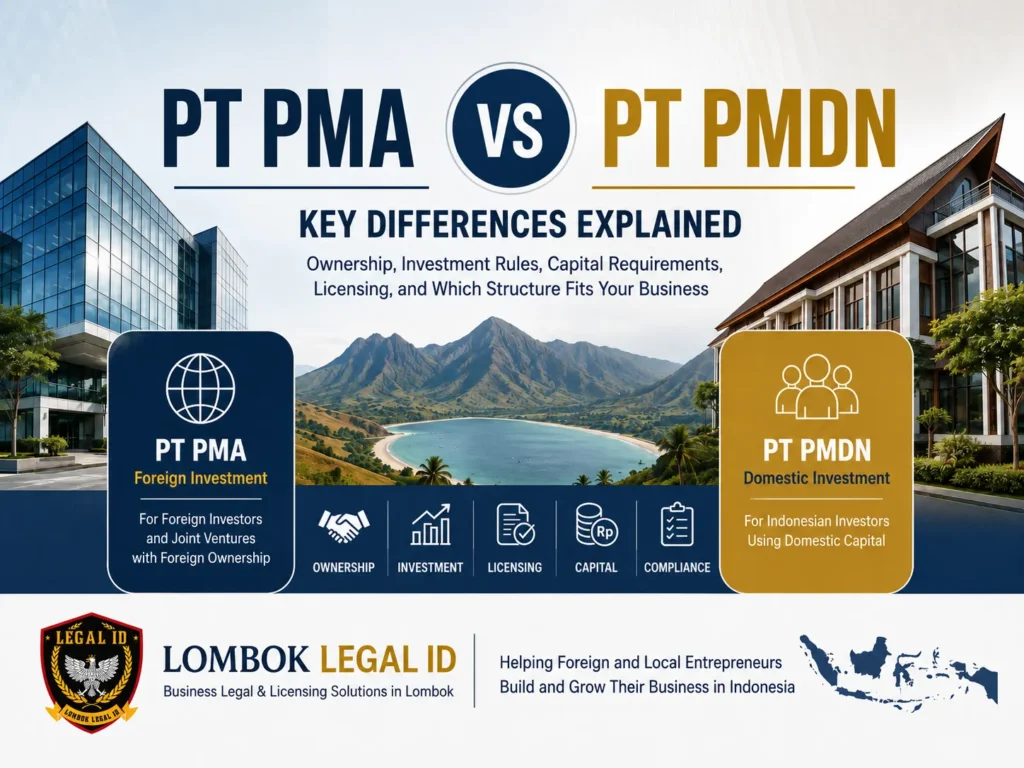
Choosing between a PT PMA and a PT PMDN is not simply a question of which company type is “better.” The correct structure depends primarily on who will own the business, where the investment capital comes from, what business activities the company will conduct, and whether foreign ownership is permitted for the relevant KBLI classification.
Under Indonesia’s investment framework, PMDN means domestic investment, while PMA means foreign investment. The distinction becomes especially important when the investment is carried out through a limited liability company, or Perseroan Terbatas (PT). Indonesia’s consolidated Investment Law defines PMDN as investment carried out by domestic investors using domestic capital, while PMA covers investment by foreign investors using foreign capital either entirely or in a joint venture with domestic investors.
A further legal distinction is critical: domestic investment may be conducted through several forms of business permitted by law, whereas foreign investment must generally be conducted through an Indonesian limited liability company, unless another law provides otherwise. This is why the term PT PMA is central to foreign company establishment, while “PT PMDN” is better understood as a domestic-investment PT rather than a separate corporate form created by the Investment Law.
PT PMA vs PT PMDN at a Glance
| Issue | PT PMA | PT PMDN |
|---|---|---|
| Investment character | Foreign investment, including wholly foreign or joint foreign-domestic investment | Domestic investment using domestic capital |
| Typical shareholders | Foreign individuals, foreign entities, and/or Indonesian investors, subject to applicable rules | Indonesian individuals and/or qualifying Indonesian entities |
| Corporate form | Foreign investment is generally required to use an Indonesian PT | Domestic investment may use a PT, but PMDN itself is not limited to PT form |
| Foreign ownership restrictions | Must be checked against the applicable investment business-field rules | Foreign ownership is not the basis of the structure |
| PMA-specific investment threshold | Subject to specific minimum investment rules and exceptions | Not subject to the PMA-specific threshold merely because it is a PT PMDN |
| Licensing framework | Risk-based business licensing through OSS, plus sector-specific requirements where applicable | Risk-based business licensing through OSS, plus sector-specific requirements where applicable |
| Best suited for | Businesses with foreign equity participation | Businesses funded and owned domestically |
This table is only a high-level comparison. The decisive answer for a real project depends on the shareholder structure, KBLI code, investment value, location, and any sector-specific rules.
What Is a PT PMA?
A PT PMA is an Indonesian limited liability company used for foreign investment. The company is incorporated under Indonesian law, even when all or part of its shares are held by foreign investors.
The Investment Law states that foreign investment must generally be carried out through a limited liability company established under Indonesian law and domiciled in Indonesia, unless otherwise provided by law. Indonesia’s consolidated Investment Law is therefore the starting point for understanding why foreign investors usually need a PT PMA.
Foreign ownership does not automatically mean 100% ownership
A foreign investor should not assume that every business activity can be 100% foreign-owned. Indonesia’s investment business-field framework identifies activities that are open, closed, reserved, or subject to particular conditions. The current official BKPM page for Presidential Regulation No. 49 of 2021 shows the regulation as in force.
This means the practical question is not only, “Can a foreigner establish a PT PMA?” It is also, “Can the proposed KBLI and business activity be owned at the intended foreign ownership percentage?”
Before incorporation, investors should therefore verify the selected KBLI, ownership composition, location, and sector-specific requirements.
What Is a PT PMDN?
PMDN is domestic investment carried out by domestic investors using domestic capital. Where that investment is organized as a limited liability company, the market commonly refers to the entity as a PT PMDN.
The Investment Law is more flexible about domestic investment form than foreign investment. Domestic investment can be conducted through a legal entity, a non-legal-entity business, or an individual business, subject to applicable laws. A PT PMDN is therefore one possible domestic investment structure, not the only form of PMDN.
For entrepreneurs who want a company with a limited-liability structure and domestic ownership, a PT PMDN may be appropriate. Lombok Legal ID already has a more detailed PT PMDN setup guide for Lombok covering the local incorporation context. ([Lombok Legal][4])
The Most Important Difference: Who Owns the Company
The clearest dividing line between PT PMA and PT PMDN is the nature of the investment and ownership.
PT PMA involves foreign investment
A PT PMA is relevant when foreign capital or a foreign investor participates in the investment structure. The Investment Law defines foreign investors broadly to include foreign individuals, foreign business entities, and foreign governments making investments in Indonesia.
This can include a company that is:
- wholly foreign-owned where the business activity permits it;
- a joint venture between foreign and Indonesian shareholders; or
- an Indonesian PT that later becomes foreign-invested through a qualifying share transaction.
The last scenario is particularly important. A company originally established with domestic ownership may need to change its investment status if foreign ownership enters the shareholder structure. The legal and OSS consequences should be reviewed before the transaction is completed.
PT PMDN is based on domestic investment
A PT PMDN is intended for domestic investment. If a structure depends on foreign shareholders while trying to remain classified as domestic investment, the arrangement should be reviewed carefully rather than assuming that the existing PMDN status can simply continue.
This is also one reason nominee-style structures are high risk. The Investment Law prohibits domestic and foreign investors conducting investment through a PT from making agreements or statements that declare shares are held for and on behalf of another person. That prohibition makes transparent, legally accurate shareholding particularly important.
Read More: Business Setup Lombok: Complete Guide to Starting a Company in Indonesia
Investment and Capital Requirements
One of the most practical differences in PT PMA vs PT PMDN planning is the PMA-specific investment framework.
Under Regulation of the Minister of Investment and Downstream Industry/Head of BKPM No. 5 of 2025, a PMA business is categorized as a large-scale business and is generally subject to a minimum total investment value of more than IDR 10 billion, excluding land and buildings, per five-digit KBLI business field per project location. The regulation contains important exceptions and different calculation treatments for certain activities, so the figure should never be applied mechanically without checking the actual sector.
The same regulation provides that a PMA in the form of a limited liability company must generally have at least IDR 2.5 billion in placed/paid-up capital per PT, unless another rule provides otherwise.
Minimum investment value and paid-up capital are not the same thing
These two concepts are often confused.
- Investment value concerns the planned or realized scale of investment in the business activity.
- Placed/paid-up capital concerns capital subscribed and paid into the company.
For PT PMA planning, both need to be reviewed. A business cannot assume that meeting the paid-up capital requirement automatically satisfies the investment-value requirement.
The 2025 regulation also contains detailed rules on how the investment-value threshold is calculated for specific sectors such as wholesale trade, food and beverage services, construction, industry, property, accommodation, agriculture, plantations, livestock, aquaculture, and certain special economic zone activities.
For a PT PMDN, the PMA-specific minimum investment and paid-up-capital rules above do not apply merely because the company is a domestic PT. However, the company remains subject to the general rules governing limited liability companies, its business scale, sector-specific requirements, and licensing conditions.
Business Licensing: Both Structures Must Match the Actual Activity
Indonesia currently operates a risk-based business licensing framework under Government Regulation No. 28 of 2025. The regulation is in force and forms the current overarching framework for risk-based business licensing. ([JDIH BKPM][5])
For both PT PMA and PT PMDN, the company’s business activities need to be mapped accurately to the applicable KBLI and OSS requirements.
Depending on the risk level and sector, licensing may involve:
- a Business Identification Number (NIB);
- standard certification;
- a business license;
- supporting business licenses;
- environmental approvals;
- spatial or location-related approvals; and
- sector-specific technical requirements.
The exact requirements should be checked through the current OSS and sectoral rules rather than copied from another company’s licensing package.
If you need a broader explanation of the current process, the existing NIB OSS RBA registration guide is a useful internal companion article.
Foreign Ownership and the KBLI Check
For PT PMA, the KBLI check has two separate functions.
First, KBLI identifies what the company will actually do. Second, the business activity must be tested against the investment rules to determine whether foreign investment is permitted and whether conditions apply.
A practical pre-incorporation review should therefore answer:
- What is the exact revenue-generating activity?
- Which KBLI code most accurately describes it?
- Is foreign ownership allowed for that business field?
- Is there a maximum foreign ownership percentage or another condition?
- Does the activity require a special license, certification, approval, or professional qualification?
- Will the business operate at more than one project location?
- How will the investment value be calculated for that sector?
This step is often more important than choosing a company name or drafting incorporation documents first. A company can be legally incorporated yet still face a licensing problem if its KBLI, ownership structure, or operational plan is inconsistent with the applicable rules.
PT PMA vs PT PMDN for a Business in Lombok
For businesses planning to operate in Lombok, the national investment and licensing rules remain the core legal framework. Local considerations become relevant when the project involves land, zoning, environmental approvals, construction, tourism facilities, accommodation, restaurants, or other activities with location-specific permits or technical standards.
A domestic entrepreneur with no foreign equity participation may be better aligned with a PT PMDN structure. A foreign entrepreneur, foreign company, or joint venture involving foreign ownership will generally need to evaluate a PT PMA structure and the relevant foreign investment rules.
For incorporation assistance across both pathways, Lombok Legal ID’s verified business setup service covers PT PMDN setup, PT PMA setup, NIB/OSS registration, amendments, and related company setup support.
Foreign investors who need a dedicated incorporation overview can also review the existing PT PMA Setup Lombok guide.
Which One Should You Choose?
The decision can be reduced to a practical sequence.
Choose a PT PMA when foreign equity is part of the plan
A PT PMA is generally the relevant route when a foreign individual or foreign entity will legally hold shares in the Indonesian business, whether alone or together with Indonesian shareholders. Before proceeding, confirm:
- the proposed KBLI;
- foreign ownership eligibility;
- investment value;
- paid-up capital;
- project location;
- licensing risk level; and
- sector-specific conditions.
Choose a PT PMDN when the investment is genuinely domestic
A PT PMDN may be appropriate when the shareholders and investment are domestic and the company will operate as a domestic-investment PT.
Do not choose PT PMDN merely to avoid PT PMA requirements if the commercial reality involves foreign ownership or a foreign investor. Company structure should reflect the actual investment arrangement.
A Practical Pre-Incorporation Checklist
Before deciding between PT PMA and PT PMDN, prepare the following information:
- full identity and nationality of each intended shareholder;
- whether any shareholder is a foreign legal entity;
- intended share percentages;
- main and supporting business activities;
- proposed KBLI codes;
- project location or locations;
- estimated investment value;
- capital plan;
- whether land or buildings are part of the investment;
- required operational permits;
- expected changes in ownership after incorporation; and
- whether the business will employ foreign personnel or require immigration/work authorization planning.
This information allows the structure to be tested against the legal framework before time and money are committed to incorporation.
Final Takeaway
The main difference in PT PMA vs PT PMDN is not the label itself; it is the legal character of the investment. PT PMA is the structure associated with foreign investment through an Indonesian limited liability company, while PT PMDN refers to domestic investment conducted through a PT when the owners and capital are domestic.
For PT PMA, foreign ownership eligibility, KBLI selection, minimum investment value, paid-up capital, and sector-specific restrictions require particular attention. For PT PMDN, the focus is on a genuinely domestic ownership structure, correct company formation, accurate KBLI selection, and the licensing requirements that apply to the activity.
Because ownership rules and licensing requirements can vary by sector, investors should verify the exact KBLI and transaction structure before incorporating or transferring shares. A structure that is correct for one hospitality, construction, consulting, or trading business may not be correct for another.
Confirm the Right Investment Structure Before You Incorporate
Choosing PT PMA or PT PMDN affects ownership, capital planning, KBLI selection, and the licensing path that follows. A structure review before incorporation can help identify foreign-ownership restrictions, investment requirements, and OSS issues before they become costly amendments.
For a practical next step, review the verified business setup services in Lombok and prepare your proposed shareholders, KBLI activities, location, and investment plan for assessment.
FAQ – PT PMA vs PT PMDN
What is the main difference between PT PMA and PT PMDN?
The main difference is the character of the investment and ownership. PT PMA is used for foreign investment through an Indonesian limited liability company, while PT PMDN refers to a PT used for domestic investment with domestic investors and capital.
Can a foreigner be a shareholder in a PT PMDN?
A PT PMDN is a domestic-investment structure. If foreign ownership enters the company, the investment status and licensing implications should be reviewed before the transaction because the company may need to be treated as a PMA company.
Can a PT PMA be 100% foreign-owned?
Sometimes, but not for every business activity. The permitted foreign ownership percentage depends on the relevant business field, KBLI classification, and applicable investment rules.
Is PMDN always a limited liability company?
No. Indonesia’s Investment Law allows domestic investment to be carried out through legal entities, non-legal-entity businesses, or individual businesses, subject to applicable law. PT PMDN describes the domestic-investment arrangement when it uses a PT structure.
What is the minimum investment for a PT PMA?
Under Minister of Investment and Downstream Industry/Head of BKPM Regulation No. 5 of 2025, PMA generally requires total investment of more than IDR 10 billion excluding land and buildings per five-digit KBLI business field per project location, but the regulation contains sector-specific exceptions and different calculation treatments.
What is the minimum paid-up capital for a PT PMA?
Regulation No. 5 of 2025 generally sets minimum placed/paid-up capital of IDR 2.5 billion per PT PMA, unless another applicable regulation provides otherwise.
Do PT PMA and PT PMDN both need OSS registration?
Both structures may be subject to Indonesia’s risk-based business licensing framework through OSS. The exact licenses depend on the company’s KBLI, risk level, location, and sector-specific requirements.
Why is KBLI important when choosing PT PMA or PT PMDN?
KBLI identifies the business activity for licensing purposes. For PT PMA, it is also essential for checking whether foreign ownership is allowed and whether investment, licensing, or sector-specific conditions apply.
Can a PT PMDN later become a PT PMA?
Potentially, yes. If a foreign investor acquires shares or foreign investment otherwise enters the company, the transaction may require changes to the company’s investment status, corporate documents, OSS data, and licenses. The exact steps should be checked before completing the transaction.
Which structure is better for a business in Lombok?
Neither structure is universally better. A domestic-owned business may fit PT PMDN, while a business with foreign equity will generally need to evaluate PT PMA. The correct choice depends on ownership, KBLI, investment value, location, and the applicable licensing rules.