

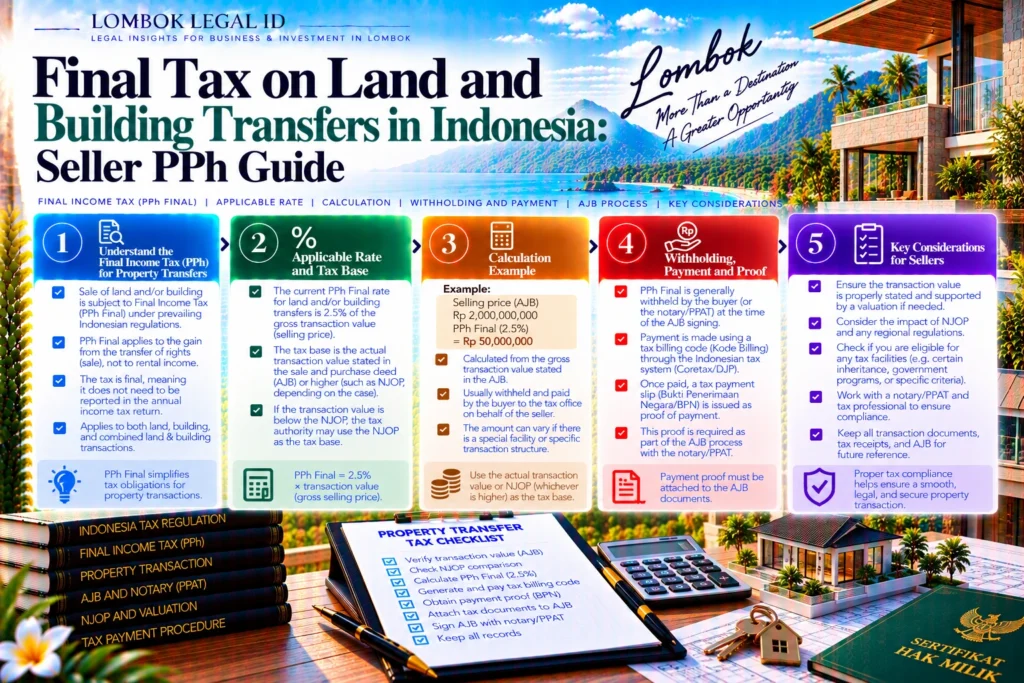
For most ordinary Indonesian land or building sales, the seller-side final income tax is 2.5 percent of the gross transfer value. But 2.5 percent is not a universal rule for every property transfer: the regulation also contains 1 percent and 0 percent categories and several statutory exceptions.
The governing regulation remains Government Regulation No. 34 of 2016, which the official BPK database lists as in force.
Final Tax on Land and Building Transfers: The Short Answer
Article 1 provides that income received or obtained by an individual or entity from the transfer of land and/or building rights, or from a land/building sale-and-purchase binding agreement and its changes, is subject to final income tax under the official regulation.
For the ordinary category, Article 2 sets final PPh at 2.5 percent of the gross transfer value for land or building transfers outside the specified simple-house or simple-apartment category carried out by taxpayers whose principal business is property transfer under Government Regulation No. 34 of 2016.
For a straightforward Rp1 billion ordinary sale within that category, the basic final-PPh calculation is therefore Rp25 million before considering whether a different statutory category or exception applies.
The important word is ordinary. Before using the 2.5 percent figure, classify the transfer, the seller and the transaction value correctly.
Step 1 — Check Whether the Transfer Is Taxable or Exempt
PP No. 34 of 2016 covers more than conventional sale transactions. Its transfer concept includes sale, exchange, release, surrender, auction, gift, inheritance and other agreed methods, but Article 6 separately removes specified transactions from the payment or collection obligation.
Article 6 provides statutory exceptions, including inheritance and a transfer by an individual whose income is below the non-taxable-income threshold where the gross transfer value is below Rp60 million and is not an artificially split amount under Government Regulation No. 34 of 2016.
Inheritance is not treated like an ordinary sale
A certificate name change caused by inheritance should therefore not automatically be calculated as a 2.5 percent ordinary sale. The inheritance exception concerns the final-PPh payment obligation under PP No. 34 of 2016; the heirs can still face separate land-registration, BPHTB and documentary requirements depending on the transaction stage.
Lombok Legal ID’s inherited land sale guide addresses the inheritance-registration stage separately.
Low-income and qualifying gift transfers need separate evidence
The Rp60 million exception is not simply a small-property exemption available to every seller. It is tied to an individual whose income is below the non-taxable-income threshold, and the transfer amount must not be artificially divided.
Article 6 also lists qualifying gifts to specified recipients and certain mergers, consolidations or business divisions approved to use book value among the exceptions under the regulation.
Because exceptions depend on conditions and supporting evidence, the safer sequence is to establish the legal basis for the exception before assuming that no payment or verification document is required.
Step 2 — Choose the Correct 2.5%, 1% or 0% Rate
PP No. 34 of 2016 contains three headline rate categories.
The ordinary rate is 2.5 percent. The same Article 2 applies a 1 percent rate to qualifying transfers of Rumah Sederhana or Rumah Susun Sederhana by taxpayers whose principal business is transferring land or buildings under the regulation.
Article 2 also sets a 0 percent rate for specified transfers to government, specially assigned state-owned enterprises or specially assigned regional-owned enterprises for public-interest land acquisition under the official text.
A normal private seller should not use those special rates merely because the property is inexpensive or because the buyer is a company. The legal category of the transaction controls the rate.
Step 3 — Determine the Gross Transfer Value
The percentage alone is not enough; the tax base must also be correct.
For a normal unrelated-party sale, Article 2 uses the amount actually received or obtained, while a sale influenced by a special relationship uses the amount that should have been received or obtained under Government Regulation No. 34 of 2016.
Other transfer types use different statutory references. Government acquisition uses the amount determined by the authorized official, auction uses the auction record value, and other transfer methods can use the value that should have been received based on market price.
For related companies, shareholders or family-controlled structures, this means the contractual number should not automatically be treated as the final tax base without checking whether the special-relationship rule applies.
Step 4 — Identify When the Final PPh Must Be Paid
Payment timing depends partly on the seller’s business profile.
For an ordinary transferor, Article 3 requires the applicable final PPh to be self-paid before the authorized official signs the deed, decision, agreement or auction minutes for the transfer under the official regulation.
That makes final PPh a pre-signing issue in a normal PPAT sale rather than a tax to calculate only after the land certificate is submitted for name transfer.
The timing changes for a taxpayer whose principal business is transferring property. For taxpayers whose principal business is transferring land or buildings, Article 3 instead makes the tax due when part or all of the payment is received and calculates it on each payment, including down payments, interest, levies and other additional payments connected with the transfer under the regulation.
For that principal-business category, Article 3 requires the tax to be paid no later than the 15th day of the month following the month in which the payment was received under Government Regulation No. 34 of 2016.
Developers and other taxpayers whose principal business is property transfer should therefore model tax payment against the payment schedule rather than only the final AJB date.
Step 5 — Complete Formal Proof-of-Payment Verification
Paying the tax and proving payment are connected but separate transaction tasks.
Article 3 also requires the authorized official to receive evidence that the tax obligation has been fulfilled before signing the relevant transfer instrument under the official PP.
For the current administrative step, DJP’s formal-payment-verification service guide directs payments made with billing codes created in 2025 and later through Coretax.
The DJP guide describes an electronic application for formal verification and issuance of a formal-research certificate after processing. Buyers and sellers should therefore leave enough time between tax calculation and the intended deed execution to complete the required administrative step.
After the transfer deed stage, certificate registration remains a separate land-administration process. Lombok Legal ID’s land certificate registration guide covers that later registration workflow.
Seven Checks Before a Land or Building Transfer
Before the seller calculates or pays final PPh, review these points:
- Classify the transfer. Determine whether it is an ordinary sale, inheritance, gift, auction, restructuring or another transfer type.
- Check for an Article 6 exception. Do not assume every name change creates a 2.5 percent payment obligation.
- Select the correct rate. Confirm whether 2.5 percent, 1 percent, 0 percent or an exception applies.
- Determine the gross transfer value. Review whether the transaction is independent, related-party, auction-based or another statutory category.
- Identify the seller’s business profile. A property business can have payment-by-payment timing that differs from an ordinary seller.
- Complete payment and formal verification before the required deed stage. Coordinate the tax file with the PPAT timetable.
- Keep seller PPh separate from other transaction costs. The final PPh calculation does not by itself determine every buyer-side, registration or local tax obligation.
This sequence prevents two common errors: multiplying every property value by 2.5 percent without classifying the transaction, and waiting until certificate registration to address a tax obligation that should have been handled before the transfer instrument was signed.
Conclusion
Final tax on land and building transfers compliance in Indonesia starts with classification, not multiplication. The ordinary final-PPh rate is 2.5 percent of the relevant gross transfer value, but PP No. 34 of 2016 also contains a 1 percent category, a 0 percent category and several statutory exceptions.
The seller must then determine the correct transfer value and payment timing. For an ordinary seller, tax compliance generally precedes the authorized transfer instrument; for a taxpayer whose principal business is transferring property, the timing can follow each payment received.
The practical objective is to settle the tax analysis and formal proof-of-payment process before it becomes a bottleneck in the deed and certificate-transfer workflow.
Check the Final PPh Before the Transfer Deed
If you are preparing a land or building transfer in Lombok, Lombok Legal ID can assist with PPAT-related transaction documentation, tax-compliance coordination and land-registration preparation based on the actual transfer structure.
A pre-signing review can help identify the applicable final-PPh category, tax base, payment timing and supporting documents before the deed and certificate-transfer process proceeds.
For help coordinating the documents and next steps discussed above, review our financial consultant in Lombok.
Read More: Business Finance, Accounting and Tax Guide for Lombok Companies
FAQ Final Tax on Land and Building Transfers
What is the usual final PPh rate on a land or building sale in Indonesia?
The ordinary category under PP No. 34 of 2016 is 2.5 percent of the gross transfer value, subject to special rates and statutory exceptions.
Does every land certificate name transfer require 2.5 percent final PPh?
No. The underlying legal event must be classified first. Article 6 includes exceptions such as inheritance and certain qualifying gifts, restructurings and low-income transfers.
Who normally pays the final PPh on a property transfer?
The obligation generally falls on the individual or entity receiving or obtaining income from the transfer, subject to the specific statutory category and any exception.
When must an ordinary seller pay the final PPh?
PP No. 34 of 2016 generally requires an ordinary transferor to pay before the authorized official signs the deed, decision, agreement or auction minutes.
Is the 2.5 percent calculated from profit?
No. The ordinary rule is based on the gross transfer value determined under Article 2, not the seller’s accounting profit from the property.
Do property developers use the same payment timing as an ordinary seller?
Not necessarily. Where the taxpayer’s principal business is transferring land or buildings, the final tax becomes due as part or all of the payment is received and is calculated on each qualifying payment.
What happens after the final PPh is paid?
The transferor may still need formal verification of the payment evidence before the relevant deed or transfer process proceeds. DJP currently routes 2025-and-later billing-code verification through Coretax.
References & Sources
- Government Regulation No. 34 of 2016 on Final Income Tax for Transfers of Land and Buildings — peraturan.bpk.go.id
- Official Text of Government Regulation No. 34 of 2016 — peraturan.bpk.go.id
- DJP Formal Verification Service for Land and Building Transfer Income-Tax Payments — pajak.go.id