

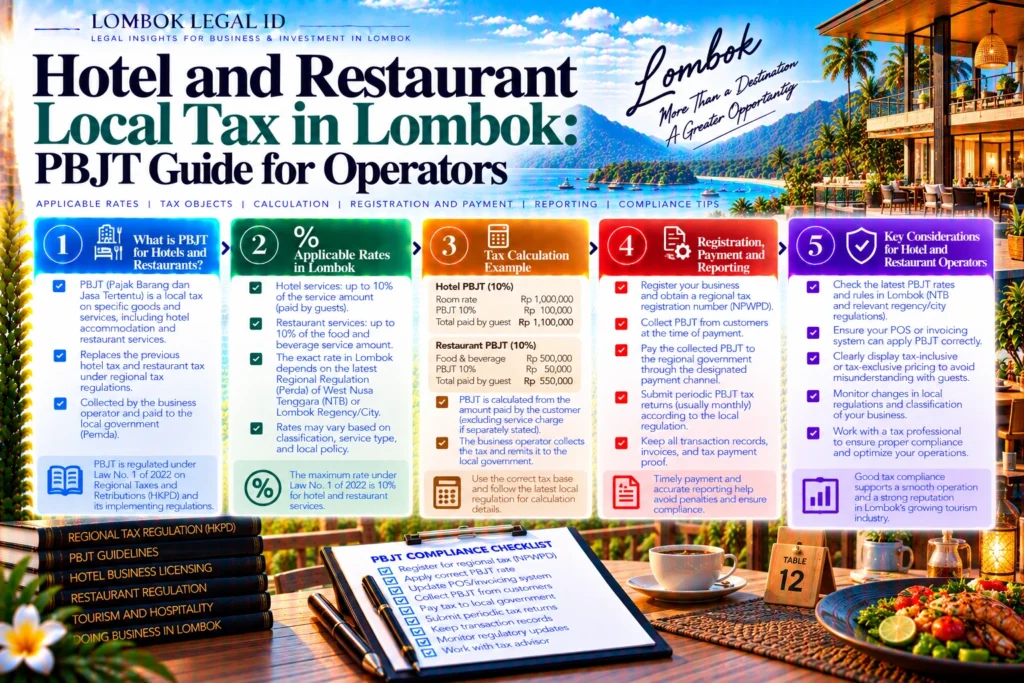
Hotel and restaurant local tax in Lombok now sits within the Pajak Barang dan Jasa Tertentu (PBJT) framework. For operators, the key questions are no longer simply ‘hotel tax or restaurant tax?’ but what service was sold, where the transaction occurred, what the customer paid and what rate the local city or regency has enacted.
The national framework is Law No. 1 of 2022, which the official BPK database lists as in force.
Hotel and Restaurant Local Tax in Lombok: The Short Answer
Article 50 places both food and/or beverages and hotel services within the PBJT object under the official law text.
Article 58 caps the general PBJT rate at 10 percent, while requiring the actual rate to be established by regional regulation under Law No. 1 of 2022.
That second point is essential for Lombok. A hotel in Mataram and a resort in another Lombok regency should not automatically use the same local rule merely because both properties are on Lombok.
For businesses in Kota Mataram, begin the local review with Perda Kota Mataram No. 1 of 2024 and confirm any amendments, applicable rate and implementing procedure with BKD for the relevant revenue stream.
For Kabupaten Lombok Tengah, Peraturan Daerah Nomor 1 Tahun 2024 is in force and its official abstract confirms PBJT on food and/or beverages and hotel services.
The operating rule is therefore: identify the correct local government first, then use that jurisdiction’s current Perda and implementing procedure.
Operators who are also checking whether the accommodation, restaurant and supporting activities are correctly reflected in OSS can review Lombok Legal ID’s hotel business licensing due-diligence guide separately from this local-tax analysis.
What Hotel and Restaurant Revenue Falls Under PBJT?
PBJT is transaction-based. A hospitality business may have several revenue streams, and each should be classified instead of placing the entire hotel invoice into one undifferentiated tax bucket.
Hotel rooms, hostels, villas and related accommodation
Article 18 of the Mataram regulation includes food and/or beverages and hotel services within PBJT under the official local regulation.
Article 21 expressly includes accommodation such as hotels, hostels, villas, tourist lodges, motels, inns, guesthouses, resorts, cottages and glamping within hotel services in Kota Mataram under the local regulation.
For an operator, this means the accommodation model should be checked against the local definition rather than relying only on the commercial label used on Booking.com, an OTA, the company’s KBLI or the property’s marketing name.
Restaurant and hotel food-and-beverage sales
Food and beverage PBJT can apply to restaurant operations and qualifying food service inside a hotel. The national framework covers food and beverage supplies, while the local Perda can specify exclusions and thresholds.
Check local food-and-beverage exclusions and turnover thresholds before enabling PBJT in the billing system. Confirm the period, taxpayer basis and current effective rule with the responsible local authority. A threshold in the Mataram regulation should not automatically be copied into another Lombok regency.
Who Pays and Who Reports PBJT?
The law separates the economic burden from the business’s tax-administration role.
Article 56 identifies the consumer as the PBJT tax subject and the person or entity conducting the relevant sale, supply or consumption as the taxpayer under Law No. 1 of 2022.
In practical terms, the customer is the tax subject, while the hotel, restaurant or other taxable operator is responsible for the PBJT obligation associated with its taxable sales under the applicable local procedure.
This distinction matters for invoices, point-of-sale settings and accounting. PBJT collected from a guest should not be confused with the hotel’s own corporate income tax or with the buyer-side property taxes paid when the business acquires land or a building.
For businesses that need a separate tax and accounting support path after the PBJT classification is established, Lombok Legal ID’s Financial Consultant services cover tax consultation, accounting and financial-report preparation.
How the PBJT Tax Base Is Calculated
The national rule starts from what the customer pays.
Article 57 states that the PBJT tax base is generally the amount paid by the consumer for the relevant goods or services under the national law.
If a taxable hotel stay in a jurisdiction with a 10 percent PBJT rate has a relevant tax base of Rp2,000,000, the simple PBJT calculation would be Rp200,000. The actual invoice classification should still be checked where the bill includes multiple components such as accommodation, restaurant charges, event-space rental or another service with different tax treatment.
Article 59 provides that PBJT is collected in the region where the relevant sale, supply or consumption occurs and that the tax becomes due when the payment, supply or consumption takes place under the official law.
For multi-property hotel groups, this means PBJT accounting should be linked to the operating location rather than only to the company’s registered head office.
Is the Rate Always 10% in Lombok?
No. Ten percent is the national ceiling for the general PBJT rate, not a mandatory nationwide rate. The operative number comes from the applicable local regulation.
Each Lombok jurisdiction must be checked against its own current tax regulation and implementing procedure before the operator configures its billing system.
This is especially important for businesses that manage hotels, restaurants or villas in more than one Lombok jurisdiction. One accounting template can be operationally convenient, but it should not replace jurisdiction-specific tax verification.
The same principle applies to local exemptions and turnover thresholds. A threshold written into the Mataram Perda does not automatically become a Lombok-wide rule.
PBJT Versus VAT for Hotel and Restaurant Sales
PBJT and VAT are different taxes, and a qualifying local-tax transaction should not automatically be charged with both merely because the operator is VAT-registered for other activities.
The VAT boundary is addressed by PMK 70/PMK.03/2022, which remains published in the Ministry of Finance legal database and took effect on 1 April 2022.
The Ministry of Finance summary states that food and beverages served in hotels, restaurants, eateries and qualifying catering businesses that are regional-tax objects are not subject to VAT under PMK 70/PMK.03/2022.
The same Ministry of Finance guidance states that specified hotel-room and event-space services are outside VAT when they fall within the regulated hotel-service category, while services such as certain non-event room rentals, apartment or condominium unit rentals and travel-agency services remain subject to separate VAT treatment under PMK 70/PMK.03/2022.
A hotel should therefore classify each revenue stream before assigning a tax code. The fact that the core room charge is a PBJT object does not automatically decide the VAT position of every additional service sold by the same legal entity.
Seven Tax Checks for a Lombok Hotel or Restaurant
Before configuring invoices or filing local tax returns, review these points:
- Identify the local jurisdiction. Determine whether the establishment is in Kota Mataram, Lombok Barat, Lombok Tengah, Lombok Timur or Lombok Utara.
- Classify each revenue stream. Separate accommodation, food and beverage, meeting rooms, parking, entertainment and other services.
- Check whether the supply is a PBJT object. Use the current national framework and the applicable local Perda.
- Confirm the local rate. Record the applicable rate and its legal basis for the exact operating location.
- Check local thresholds or exclusions. These can be jurisdiction-specific.
- Separate PBJT from VAT analysis. Use PMK 70/PMK.03/2022 for the central-tax boundary and review other services independently.
- Align invoices, POS data and tax reporting. The tax category on the customer bill should match the transaction recorded for local-tax reporting.
Operators should perform the same review when opening a new property, moving into another regency or adding a new revenue stream such as a restaurant, event room or other guest service.
Conclusion
Hotel and restaurant local tax in Lombok compliance is now best understood through PBJT. National law places food and beverage sales and hotel services within PBJT, sets the general rate ceiling at 10 percent and bases the tax primarily on what the customer pays.
The actual rate and important local details come from the relevant city or regency. Confirm those inputs for the establishment and transaction rather than treating the national ceiling as a universal local rate.
For hotel and restaurant operators, the practical workflow is to classify the revenue, identify the jurisdiction, verify the local PBJT rule and then check whether the same supply falls outside VAT under the national VAT-boundary regulation.
Review the Local Tax Setup Before Filing
If you operate a hotel, villa, hostel or restaurant in Lombok, Lombok Legal ID can assist with financial-compliance review and business-document coordination based on the property’s actual city or regency and revenue structure.
A pre-filing review can help identify PBJT classification, local-rate issues, VAT boundaries and invoice-treatment problems before they affect recurring tax reporting.
For help coordinating the documents and next steps discussed above, review our financial consultant in Lombok.
Read More: Business Finance, Accounting and Tax Guide for Lombok Companies
FAQ Hotel and Restaurant Local Tax in Lombok
Is hotel tax in Lombok still a separate tax?
Under the current national framework, qualifying hotel services are included within PBJT rather than treated as a separate national tax category called hotel tax.
Is restaurant tax in Lombok part of PBJT?
Yes. Qualifying food and beverage sales are included in PBJT, subject to the applicable local regulation and any local exclusions or thresholds.
How should an operator confirm the local PBJT rate?
Check the current local Perda and implementing rules with the responsible local tax authority. Record the applicable rate, revenue category and effective date before configuring invoices.
Is the hotel and restaurant tax rate 10 percent everywhere in Lombok?
Not automatically. National law sets a general PBJT ceiling of 10 percent, while the actual rate is established by each local government through its regional regulation.
Who is the PBJT taxpayer for a hotel or restaurant?
The consumer is the tax subject, while the hotel, restaurant or other business conducting the taxable supply is the taxpayer under the PBJT framework.
Do hotel room and restaurant charges also attract VAT?
Qualifying hotel services and food or beverages that are regional-tax objects are excluded from VAT under PMK 70/PMK.03/2022, but other services sold by the business may require separate VAT analysis.
Should a small food business check local exclusions?
Yes. Verify the current local turnover threshold and other exclusions for the actual establishment. Do not copy a Mataram figure into another Lombok jurisdiction.
References & Sources
- Law No. 1 of 2022 on Financial Relations Between the Central Government and Regional Governments — peraturan.bpk.go.id
- Official Text of Law No. 1 of 2022 — peraturan.bpk.go.id
- Mataram City Regulation No. 1 of 2024 on Regional Taxes and Retributions — peraturan.bpk.go.id
- Official Text of Mataram City Regulation No. 1 of 2024 — peraturan.bpk.go.id
- Central Lombok Regulation No. 1 of 2024 on Regional Taxes and Retributions — peraturan.bpk.go.id
- Ministry of Finance Regulation 70/PMK.03/2022 on Food, Hotel, Entertainment, Parking and Catering Supplies Not Subject to VAT — jdih.kemenkeu.go.id