
A shareholders agreement can be one of the most useful governance documents for a PT PMA with two or more investors, but it should not be treated as a substitute for Indonesia’s formal corporate structure. The strongest arrangement is one in which the commercial deal among shareholders, the Articles of Association, share ownership records, RUPS mechanics, board authority, and foreign-investment restrictions do not contradict each other.
Indonesia’s central company-law framework remains Law No. 40 of 2007 on Limited Liability Companies, which the official BPK database lists as in force and amended, including through Law No. 6 of 2023. The Investment Law No. 25 of 2007 also remains in force as amended, so a PT PMA shareholders agreement should be reviewed against the current corporate and investment framework rather than drafted as a standalone commercial document.
Shareholders Agreement PT PMA Lombok: What It Should Accomplish
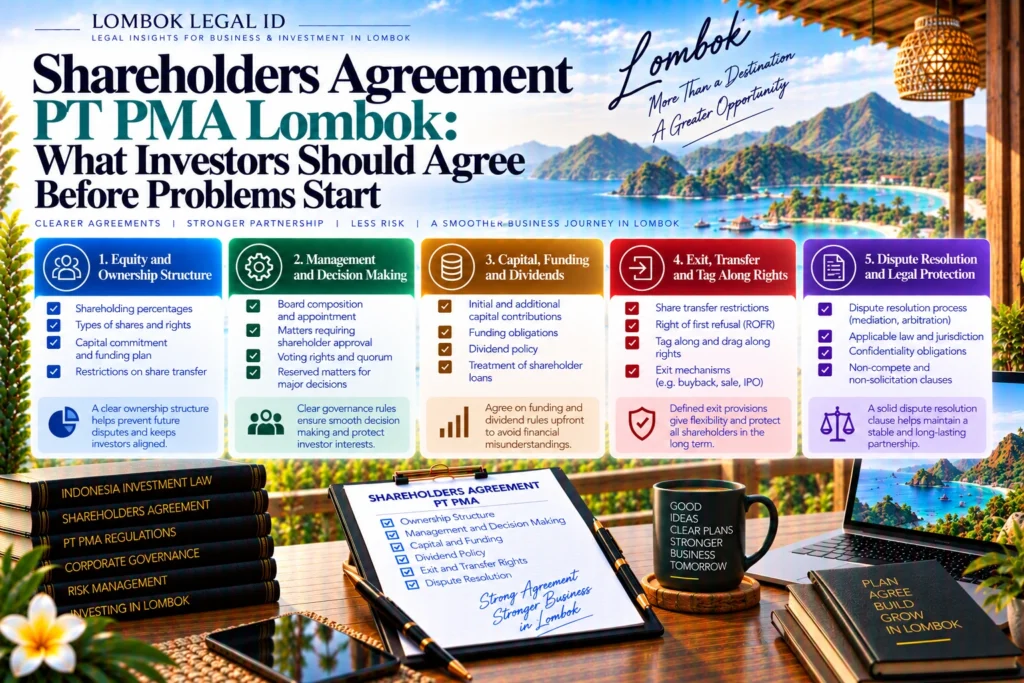
A useful shareholders agreement should answer questions that often become disputes later: who controls major decisions, how new funding will be provided, what happens if a shareholder wants to sell, how a deadlock is handled, what information shareholders receive, and how an exit is managed.
The agreement can therefore be used as a governance roadmap among the parties. The important limitation is that corporate actions still take place through the legal structure of the Indonesian company.
Article 5 of the official text of the Investment Law provides that foreign investment generally must be conducted through a limited liability company established under Indonesian law and domiciled in Indonesia, unless another law provides otherwise. The same Article 5 states that investment through a limited liability company may be carried out by subscribing for shares at establishment, purchasing shares, or using another method permitted by law under the same official text.
This is why the real shareholder structure matters. Commercial control cannot be separated from the legally recorded ownership and corporate governance of the PT PMA.
Start With the Formal PT PMA Structure
Shareholders agreement versus Articles of Association
The Articles of Association perform a formal corporate function that a private shareholders agreement should not be assumed to replace.
Article 15 of the official text of the Company Law requires the Articles of Association to contain core corporate matters including capital, shares and share classes, rights attached to shares, the composition of the Board of Directors and Board of Commissioners, RUPS procedures, appointment and removal procedures, and profit and dividend arrangements.
Article 52 provides shareholders with statutory rights that include attending and voting in RUPS, receiving dividends and liquidation proceeds, and exercising other rights granted by the Company Law once the statutory conditions for those rights are satisfied.
The practical drafting rule is alignment. If shareholders negotiate a control mechanism that depends on voting rights, board composition, share classes, transfer restrictions, or corporate approval procedures, they should examine whether the corresponding formal company documents and approvals also need to reflect that mechanism.
RUPS and board powers cannot be ignored
A shareholders agreement may identify decisions that investors want treated as reserved matters, but the implementation must respect the powers assigned to the company’s legal organs.
Under Article 75, RUPS has authority that is not granted to the Board of Directors or Board of Commissioners within the limits established by the Company Law and the Articles of Association under the official Company Law text.
Article 92 places management of the company with the Board of Directors for the company’s interests and in accordance with its purposes and objectives, subject to the limits of the law and Articles of Association under the official Company Law text.
For investors, this means a clause should not merely say that one shareholder ‘controls’ an operational matter. The agreement should identify which corporate organ actually has authority and what vote, approval, appointment, or Articles of Association mechanism is needed to implement the commercial bargain.
Six Clause Groups to Negotiate Carefully
Reserved matters and voting thresholds
Reserved matters define decisions that shareholders do not want left to an ordinary majority or routine management process. Depending on the company, these may include major borrowing, issuing new shares, acquiring or selling significant assets, changing the business direction, related-party transactions, appointing key management, or entering material contracts.
The useful drafting question is not how long the list can be. It is which decisions could materially change the investor’s economic position or risk exposure and which corporate organ legally takes those decisions.
Board composition and management oversight
Shareholders often negotiate nomination rights, board representation, reporting obligations, and approval processes. These arrangements should be checked against the Articles of Association and the statutory responsibilities of directors and commissioners rather than being drafted as though directors are simply agents who must follow every shareholder instruction.
Funding, dilution and future capital
The agreement should answer what happens when the PT PMA needs additional capital. Investors should decide whether funding is expected through additional equity, shareholder loans where legally and commercially appropriate, third-party finance, or a combination.
The document should also address what happens if one shareholder participates in a funding round and another does not. A clear process is more useful than assuming all shareholders will always contribute in the same proportion.
Share transfers and exit mechanics
Transfer clauses should be coordinated carefully with the Articles of Association. Article 57 permits the Articles of Association to impose specified share-transfer conditions, including an obligation to offer shares first to certain or other shareholders and requirements for prior approval from a corporate organ or competent authority under the official Company Law text.
A shareholders agreement may therefore address matters such as permitted transfers, rights of first offer, tag-along arrangements, negotiated drag mechanics, lock-up periods, valuation procedures, or an agreed exit process, but the parties should verify how each mechanism interacts with mandatory law, the Articles of Association, and any investment approval or ownership restriction applicable to the transferee.
Foreign-ownership planning must also be checked against the current investment-field framework because Presidential Regulation No. 10 of 2021 remains in force as amended by Presidential Regulation No. 49 of 2021.
Deadlock and escalation
A 50/50 commercial structure creates a particular governance risk because major decisions can stop when the parties no longer agree. A shareholders agreement can establish an escalation path before the disagreement becomes destructive.
A practical sequence may include management discussion, shareholder-level negotiation, mediation or another agreed dispute-resolution step, followed by a clearly drafted exit mechanism if the deadlock remains unresolved. The appropriate structure depends on the ownership percentages, funding arrangements, business model, and bargaining position of the parties.
Information, reporting and financial visibility
Investors should define what financial and operational information will be provided, how frequently it will be delivered, and who can inspect relevant company records, subject to applicable law and company governance.
This is particularly important where one shareholder is involved in day-to-day management while another investor is not physically present in Lombok or Indonesia.
Three PT PMA Structures That Need Extra Caution
Scenario 1: The local shareholder is only holding shares for the foreign investor
This is not a problem that should be ‘solved’ by clever wording. Article 33 paragraph (1) of the official Investment Law text prohibits domestic and foreign investors investing through a limited liability company from making an agreement and/or statement affirming that shares in the company are owned for and on behalf of another person. Article 33 paragraph (2) states that an agreement or statement of that kind is null and void by operation of law under the same official text.
Decision implication: structure the actual ownership transparently and check whether the relevant business field permits the intended foreign ownership rather than using a nominee arrangement to simulate another ownership structure.
Scenario 2: Two shareholders each hold 50 percent
Equal economics can create governance paralysis if the agreement does not distinguish routine decisions from genuinely fundamental matters.
Decision implication: define reserved matters, quorum expectations, escalation steps, funding decisions, and a workable deadlock mechanism before the company faces a real disagreement.
Scenario 3: A minority investor expects veto rights that exist only in a private draft
The commercial intent may be clear between the signatories, but implementation can become uncertain if the protection depends on a corporate vote, share-transfer rule, board appointment, or other mechanism that is not coordinated with the Articles of Association and corporate approvals.
Decision implication: identify every material protection and ask whether it operates purely as a contractual promise or also requires formal implementation through the company’s constitutional documents or corporate organs.
Pre-Signing Checklist for Lombok Investors
Before signing a shareholders agreement for a PT PMA, review the following points:
- Confirm the actual shareholders and ownership percentages. They should match the intended and legally permissible investment structure.
- Check the relevant business fields and foreign-ownership position. Do not assume that a percentage used in another PT PMA is automatically suitable for this company.
- Compare the agreement with the Articles of Association. Look specifically at voting, share classes, board composition, RUPS procedures, transfer restrictions, and dividend mechanics.
- Map every reserved matter to the correct corporate organ. Determine whether RUPS, directors, commissioners, or another formal approval process is required.
- Define future funding. State what happens if the company needs more capital and one shareholder does not participate.
- Test the transfer provisions. Review first-offer rights, approvals, permitted transferees, valuation, and exit provisions against the Articles of Association and investment restrictions.
- Design a deadlock process that can actually be used. Avoid a mechanism that simply sends both sides back into the same blocked vote.
- Review reporting and information rights. Particularly where investors are based outside Lombok or outside Indonesia.
- Check dispute-resolution and governing-law provisions with Indonesian counsel. Cross-border investors should understand how the chosen mechanism interacts with Indonesian corporate actions and assets.
- Remove nominee ownership arrangements. Article 33 of the Investment Law prohibits the relevant agreement or statement that shares are owned for and on behalf of another person.
Investors who are still determining the correct foreign-owned company structure can first review Lombok Legal ID’s PT PMA setup guide for Lombok before finalizing shareholder governance terms.
Conclusion
A shareholders agreement PT PMA Lombok should do more than divide voting percentages on paper. Its real value is creating a workable system for decisions, funding, transfers, information, deadlock, and exit while remaining aligned with Indonesian corporate and investment law.
The strongest drafting process starts with the actual ownership structure and then compares every important protection with the Articles of Association, RUPS powers, directors’ authority, share-transfer rules, and foreign-investment restrictions. That alignment reduces the risk that shareholders discover during a dispute that their commercial agreement and the company’s formal legal mechanics do not operate in the same way.
Align the Shareholders Agreement With the PT PMA Structure
If you are establishing or restructuring a foreign-invested company in Lombok, Lombok Legal ID can assist with reviewing the PT PMA structure, shareholder arrangements, corporate documents, and related notarial or business setup requirements.
A focused legal review before signing can help identify inconsistencies between the negotiated commercial terms, Articles of Association, ownership structure, and formal company approvals.
For help coordinating the documents and next steps discussed above, review our notary services in Lombok.
Read More: Notarial Documents Guide in Lombok: Preparing Deeds, Leases and Agreements
FAQ Shareholders Agreement PT PMA Lombok
Does a PT PMA need a shareholders agreement?
Indonesian company law establishes the formal company structure through legislation, the Articles of Association, and corporate organs. A separate shareholders agreement can still be useful for documenting detailed commercial arrangements among investors, but its necessity and scope depend on the ownership and governance structure.
Can a shareholders agreement replace the Articles of Association?
It should not be treated as a replacement. The Articles of Association contain formal corporate matters required or recognized under the Company Law, while a shareholders agreement can document additional arrangements among its parties. Material governance protections should be reviewed for consistency with the Articles of Association and corporate approval mechanics.
What clauses are important in a PT PMA shareholders agreement?
Common priorities include reserved matters, voting arrangements, board composition, funding, dilution, share transfers, information rights, deadlock, exit procedures, dispute resolution, and mechanisms for implementing agreed governance protections.
Can shareholders restrict transfers of PT PMA shares?
The Company Law permits specified transfer restrictions to be included in the Articles of Association, including first-offer requirements and certain prior approvals. Any contractual transfer clause should therefore be checked against the Articles of Association, investment restrictions, and other applicable law.
Can a shareholders agreement use an Indonesian nominee to hold foreign investor shares?
The Investment Law prohibits domestic and foreign investors investing through a limited liability company from making agreements or statements asserting that shares are held for and on behalf of another person. Ownership should be structured transparently and within the applicable foreign-investment rules.
What should 50/50 PT PMA shareholders agree in advance?
They should pay particular attention to reserved matters, quorum, funding obligations, escalation procedures, deadlock resolution, transfer rights, valuation mechanics, and an exit path if cooperation breaks down.
References & Sources
- Limited Liability Company Law No. 40 of 2007 — peraturan.bpk.go.id
- Official Text of the Limited Liability Company Law No. 40 of 2007 — peraturan.bpk.go.id
- Investment Law No. 25 of 2007 — peraturan.bpk.go.id
- Official Text of Investment Law No. 25 of 2007 — peraturan.bpk.go.id
- Job Creation Law No. 6 of 2023 — peraturan.bpk.go.id
- Amendment to the Investment Business Fields Regulation — peraturan.bpk.go.id