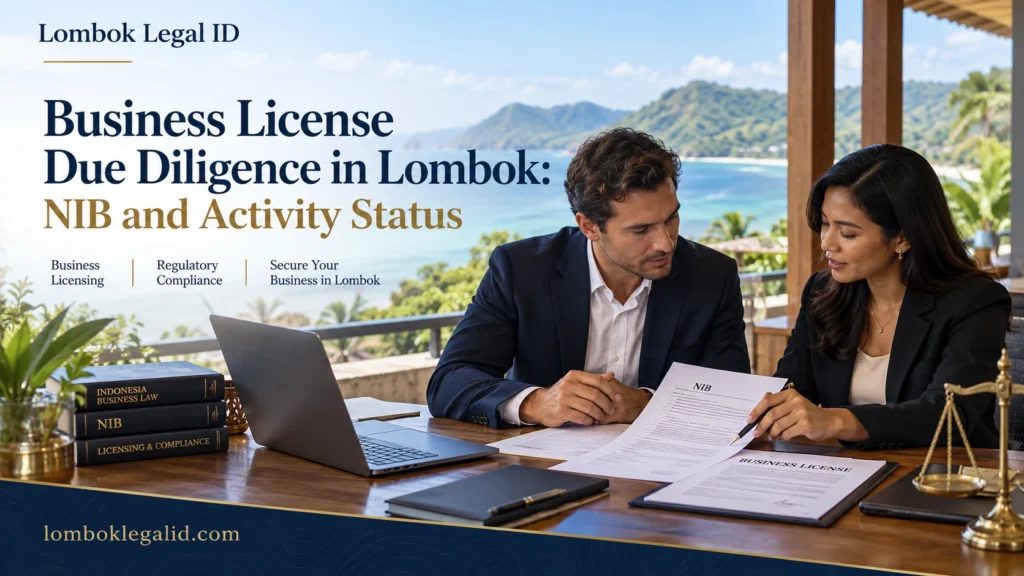
An existing company in Lombok may hold an NIB, operate from established premises, and generate revenue. None of those facts alone confirms that its licensing records match every activity currently being conducted.
For investors, business license due diligence in Lombok means checking the legal entity, registered business activities, current OSS status, relevant certificates or permits, and the relationship between those records and the actual operation.
The objective is not merely to collect licenses. It is to establish what can be verified, what remains uncertain, and what may need correction before an acquisition or investment proceeds.
Indonesia's current overarching framework is Government Regulation No. 28 of 2025, effective from 5 June 2025, which replaced Government Regulation No. 5 of 2021.
Business License Due Diligence Lombok: What Investors Should Verify
A meaningful licensing review starts with three questions:
- Which legal entity is responsible for the business being acquired?
- Which activities does that entity actually conduct, and where?
- What licensing documentation supports each activity at its present stage of operation?
The answers must be consistent across company documents, OSS records, business contracts, and available operational evidence.
Consider a buyer evaluating a company operating a warehouse, delivery service, and retail outlet. A valid NIB in the company's name is useful evidence, but the buyer still needs to establish whether the registered activities correspond to the warehouse, transport-related operations, and retail business actually conducted.
The same principle applies to other sectors. The starting point is always the business being purchased, not an assumed standard licensing package.
Identify the Business Entity and the Actual Operator
Before examining individual permits, identify the legal person conducting the business.
Request corporate establishment and amendment documents, the current company profile, the NIB, and relevant operating agreements. Compare the legal names and identifiers across those records.
Separate Ownership From Operations
The owner of a building or business asset may not be the company conducting the business inside it.
For example, one company might own a commercial property while another entity operates the business and receives customer payments. The licensing review should identify the actual operator rather than assuming that licenses held by a property owner necessarily cover another party's activities.
A useful working file records:
- The entity that owns the shares or business assets
- The entity contracting with customers
- The entity responsible for daily operations
- The entity identified in OSS and relevant licensing records
- Material differences requiring explanation
Where those entities differ, obtain the agreements explaining their responsibilities.
Check Whether the Transaction Changes the Operator
A proposed share purchase, asset acquisition, or operating takeover can involve different legal and administrative consequences.
Do not assume that an existing license automatically follows the assets, survives every restructuring, or authorizes a different operator. Identify the exact transaction structure and obtain a current, activity-specific assessment before making transferability assumptions.
Review the NIB and Registered Activities
The NIB is the starting document, not the conclusion of the investigation.
The risk-based licensing framework covers basic requirements, principal Business Licensing, Business Licensing to Support Business Activities (PB UMKU), OSS services, and supervision.
Request the current OSS-generated documents and, where appropriately authorized, examine the underlying business and project records.
Reconcile KBLI With Commercial Reality
Prepare a list of activities actually generating revenue, then compare each item with the registered business classifications and project details.
Questions worth investigating include:
- Does the registered activity describe what the company actually sells or performs?
- Are additional commercial activities conducted under the same entity?
- Are registered business locations consistent with physical operations?
- Does the business rely on third-party operators or subcontractors?
- Have changes in the operating model been reflected in the available records?
Avoid selecting a KBLI solely from the company's marketing description. The relevant classification and activity scope should be examined using current official classifications and the actual commercial model.
Where legacy classification records appear, verify how they correspond to the classification currently applicable in OSS. A historical document is not sufficient evidence of a completed classification update.
Check Licensing Status Beyond the NIB
Under the current risk-based licensing regulation, the principal licensing documentation depends on the activity's risk classification rather than simply on whether the business possesses an NIB.
The broad framework distinguishes activities of low, medium-low, medium-high, and high risk. Their licensing requirements differ, so an investor should check the classification of the specific activity rather than infer it from the size or popularity of the business.
Standard Certificates and Other Permits
When the relevant activity requires a Standard Certificate, examine its actual status rather than accepting a document label as proof of completed verification.
A review should distinguish between an applicable business declaration, a certificate requiring further verification, and a certificate whose required verification has been completed. The correct interpretation depends on the activity's risk classification and the applicable rules.
For high-risk activities, examine whether the required Permit has been obtained and whether the operation being conducted matches the authorized activity and stage.
The applicable procedural framework also includes Minister of Investment and Downstreaming/BKPM Regulation No. 5 of 2025, which addresses risk-based licensing procedures and related OSS administration.
Beyond principal licensing, identify any applicable supporting business permissions and project-specific basic requirements. These may involve location, environmental matters, buildings, or sector-specific activities, depending on the business.
Do not treat this general checklist as a determination that every listed permission applies to every Lombok business.
Create a Licensing Evidence Matrix
A licensing evidence matrix helps an investor distinguish documents received from matters actually verified.
| Review area | Evidence to examine | Investor's question |
|---|---|---|
| Legal entity | Corporate documents and current profile | Is this the entity operating the business? |
| NIB | Current OSS-issued registration | Does the registered identity match? |
| Business activities | KBLI and OSS activity records | Are actual activities accurately represented? |
| Business location | Project and premises information | Do recorded locations match operations? |
| Standard Certificates | Applicable certificate and status evidence | Has the relevant status been established? |
| Other permits | Activity-specific licensing documents | Are required permits available and applicable? |
| Supporting permissions | Relevant PB UMKU and project records | Are supporting requirements addressed? |
| Changes | Amendments and OSS update records | Are material operational changes reflected? |
Add two internal columns to the working review: evidence status and required follow-up.
Evidence status can be recorded as verified, pending independent verification, inconsistent, or unavailable. A missing document should initially be treated as an evidence gap, not automatically as proof of a legal violation.
This distinction is particularly important when access to the full OSS account has not yet been granted by the seller.
Identify Transaction Risks and Unresolved Discrepancies
Not every discrepancy has the same significance.
Distinguish Missing Evidence From Confirmed Problems
An effective findings register can use four categories:
- Verified: Relevant records have been reviewed and no material discrepancy was identified within the defined review scope.
- Unverified: Evidence has been requested but authenticity, completeness, or current status remains unresolved.
- Discrepant: The available records conflict with the observed operation or with other transaction documents.
- Critical for the transaction: A potential licensing issue could materially affect the proposed activity, operating continuity, or investment structure and requires professional evaluation before proceeding.
These are practical due-diligence categories, not official OSS status labels.
A discrepancy becomes more significant when it relates directly to a revenue-producing activity, an important business location, or an authorization whose absence could prevent the intended operation.
Assign Responsibility for Resolving Findings
The buyer and seller should identify which party must provide evidence or address an identified issue.
For each material finding, record the affected activity, supporting documents, outstanding question, responsible party, and agreed verification milestone.
Depending on the transaction, a material issue may justify further investigation, a condition to completion, a contractual protection, or a decision not to proceed. These are transaction-planning possibilities rather than automatic legal remedies.
Different Transactions Require Different Checks
Licensing due diligence should reflect what the buyer is actually acquiring.
| Transaction | Primary review concern |
|---|---|
| Share acquisition | Continuing entity, corporate changes, registered activities, and existing compliance exposure |
| Asset purchase | Identity of the future operator and whether new or updated licensing is needed |
| Operating-business takeover | Operator agreements, responsibility for licensed activities, and the records of the operating entity |
| Business expansion after acquisition | Whether new activities, locations, or scopes require an updated licensing assessment |
The existence of an NIB at signing does not itself resolve what the post-transaction operator will need.
An investor should therefore connect the licensing findings to the contemplated structure before completing contractual negotiations.
Documents to Request Before Signing
Request a targeted document package rather than a folder of unrelated certificates.
A practical initial request includes:
- Current corporate establishment and amendment documents
- Available current corporate ownership and management information
- Current NIB and relevant OSS activity records
- A list of activities actually conducted and their locations
- Applicable Standard Certificates and supporting status evidence
- Relevant business permits and supporting permissions
- Material operational, lease, or management agreements
- Records of licensing changes and amendments
- Relevant notices, inspections, or unresolved licensing correspondence disclosed by the seller
- Explanations for discrepancies identified during reconciliation
For older businesses, also consider whether the licensing documents were created under an earlier regulatory framework.
The official regulatory status record for Government Regulation No. 5 of 2021 confirms that it was revoked by Government Regulation No. 28 of 2025 and should not be treated as the current overarching licensing authority.
This does not automatically mean every document issued under an earlier framework is invalid. The status of legacy business licensing should be examined against applicable transitional arrangements and the specific records involved.
Conclusion
An existing business should not be considered licensing-ready for investment merely because its seller produces an NIB.
A stronger review follows a clear sequence: identify the actual operator, map commercial activities, reconcile OSS and KBLI records, examine applicable licensing status, identify discrepancies, and evaluate those findings against the proposed transaction.
The most useful result is a documented explanation of what has been verified, what remains uncertain, and what needs resolution before the investor commits to the business.
Review an Existing Business's Licensing Position Before Investing
If you are considering acquiring or investing in an existing business in Lombok, Lombok Legal ID provides business licensing and legal compliance assistance. A consultation can begin with reviewing the available NIB, OSS activity records, corporate documents, and the specific licensing questions raised by the transaction.
Prepare the business's current registration documents, a summary of its actual operations, and the proposed transaction structure for a focused consultation.
Before committing to an acquisition, discuss the entity, operator and outstanding licensing questions through our business setup and licensing consultation.
When verification is unresolved, compare the evidence with the medium-high-risk Standard Certificate framework.
Read Also: Company Setup Guide in Lombok: Entity Choice, OSS and Launch Planning
FAQ Business License Due Diligence Lombok
Is an NIB enough for business license due diligence in Lombok?
No. An NIB is an essential starting record, but the investigation should also consider actual activities, KBLI classification, relevant licensing status, project locations, and supporting permissions where applicable.
Can an investor rely on the seller's printed OSS documents?
Printed records can be useful initial evidence, but material information should be reconciled with available current OSS records and other supporting documentation. Where access is restricted, record the verification limitation instead of assuming that the printout establishes every aspect of current compliance.
Does acquiring company shares automatically require a new NIB?
Not necessarily. The answer depends on the legal entity, transaction structure, resulting corporate changes, and applicable OSS requirements. A share acquisition should not be treated as identical to an asset purchase or a change of business operator.
What if a seller has a Standard Certificate that is not verified?
First establish the applicable risk classification, certificate requirements, and exact status. Do not assume that the mere existence of a document means the activity has completed all necessary steps. Seek activity-specific confirmation before drawing a legal conclusion.
Should a buyer stop an acquisition if licensing documents are missing?
Missing documents should trigger a documented investigation rather than an automatic conclusion. Determine whether the document is legally applicable, whether it exists in current records, and whether the matter is material to the intended investment. Significant unresolved licensing issues may warrant transaction conditions or further legal review.
References & Sources
- Government Regulation No. 28 of 2025 on Risk-Based Business Licensing — peraturan.bpk.go.id
- Ministerial Regulation No. 5 of 2025 on OSS Business Licensing Procedures — peraturan.bpk.go.id
- Government Regulation No. 5 of 2021 — Historical and Revoked Regulatory Status — peraturan.bpk.go.id
Recommended Next Articles
- hotel business licensing due diligence in Lombok — lomboklegalid.com
- basic requirements for business licensing in Indonesia — lomboklegalid.com
- high-risk OSS licensing requirements — lomboklegalid.com