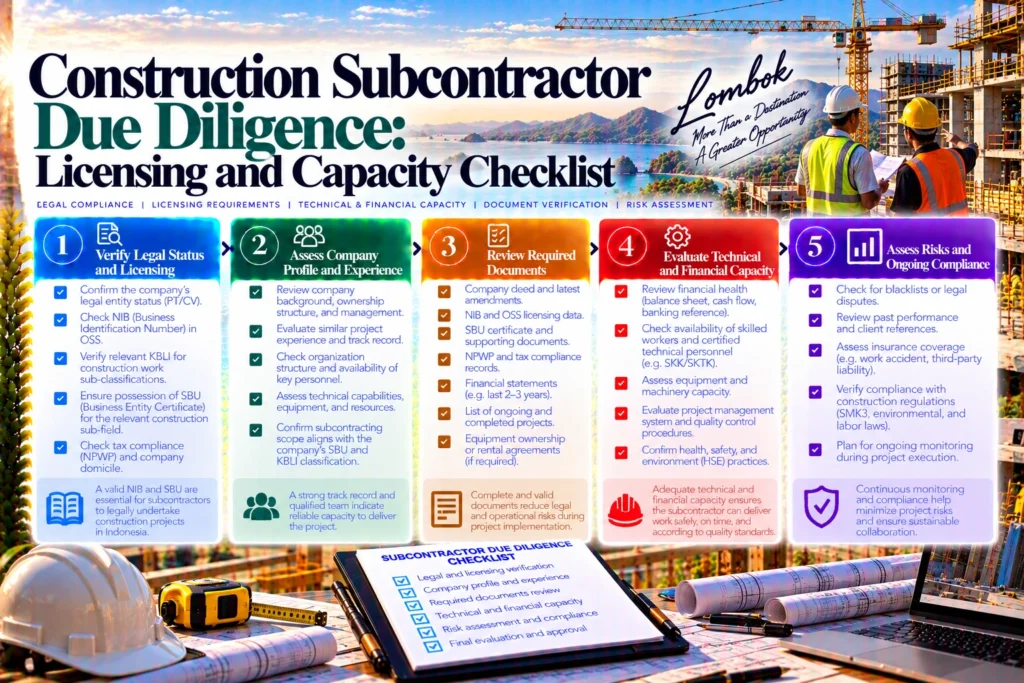
Construction subcontractor due diligence should answer one practical question: is this specific business legally eligible and operationally capable of performing this specific work package? A valid-looking company profile is not enough if the OSS record, SBU scope, personnel or actual capacity do not match the subcontract.
Construction Subcontractor Due Diligence: The Short Answer
Indonesia’s current national risk-based licensing framework is Government Regulation No. 28 of 2025, which is in force and revoked Government Regulation No. 5 of 2021.
The regulation covers basic requirements, Business Licensing, PB UMKU and OSS services and states that a business actor must hold the applicable Business Licensing to conduct its activity under PP No. 28 of 2025.
For construction businesses, the current Ministry of Public Works service page states that a construction business entity should hold NIB, a verified Standard Certificate and SBU Konstruksi within the construction licensing process.
OSS currently lists Sertifikat Badan Usaha (SBU) konstruksi as an available PB UMKU in the public works sector.
Due diligence should therefore start with legal and certification eligibility, then move into capacity, project history and contract risk.
Check 1 — Verify the Legal Entity and Current OSS Record
Confirm that the company named in the proposal, subcontract and invoice structure is the same entity shown in the current NIB and OSS record.
Check the registered construction activity, business address, legal operator and licensing status against the scope being offered. A trading name, group-company name or marketing brand should not substitute for identifying the entity that will actually sign and perform the subcontract.
Where there is uncertainty over the business activity shown in OSS, Lombok Legal ID’s NIB activity attachment guide provides a separate framework for reviewing KBLI, scope and status.
Check 2 — Match the SBU to the Subcontract Package
The next question is not simply whether the subcontractor has an SBU. Ask whether the SBU classification and subclassification fit the actual work package.
The official BPK database continues to list Government Regulation No. 14 of 2021, which amended the implementing regulation for the Construction Services Law, as in force.
The current sector-specific framework is Peraturan Menteri Pekerjaan Umum Nomor 6 Tahun 2025, which addresses business standards, supervision and sanctions under risk-based licensing in the public works sector.
Specialist work needs a specialist eligibility check
Article 22 of the official PP No. 14 of 2021 text states that specialist construction work must be performed by a specialist construction business and, for specified classifications where the provider lacks the specialist subclassification, the work must be carried out by a specialist subprovider.
This makes classification matching especially important for packages such as specialist installations or other work that falls within a specialist construction classification. Do not assume the main contractor’s broad SBU automatically establishes the subcontractor’s eligibility for every specialist package.
Do not rely on a certificate title alone
Review the actual certificate data against the tender scope, drawings, bill of quantities and method of work. If the subcontract package materially differs from the business scope supported by the subcontractor’s certification, resolve that mismatch before appointment.
This is also where a current validity check matters. A copy saved in a tender folder should be compared with the current business and licensing record rather than accepted solely because the PDF looks authentic.
Check 3 — Verify Workforce and Competency Capacity
Certification should be connected to real people who can support delivery.
The same Ministry guidance identifies PJBU, PJTBU and PJSKBU among the construction-workforce roles that are assessed against the qualification and subclassification being applied for in the SBU process.
For subcontractor due diligence, compare the personnel supporting the company’s certification with the personnel proposed for the project. Request the project organization chart, responsible technical personnel and relevant competency evidence where those items are material to the package.
For construction-company technical roles, review our PJTBU and PJSKBU requirements guide. Electrical SKTTK and construction SKK belong to different certification systems.
Check 4 — Test Equipment, Financial and Delivery Capacity
A subcontractor can be legally eligible but still lack delivery capacity for the proposed package.
For SBU applications, the Ministry’s current service guidance lists annual sales, financial capability or asset value, construction workforce, equipment, anti-bribery management and registered construction-association membership among the information to be prepared for certification.
Use those categories as starting evidence, then perform a project-specific capacity review. Confirm whether critical equipment is owned, leased or still to be sourced; whether the workforce can be mobilized on the required dates; and whether the subcontractor has enough financial capacity to fund labour, materials and early-stage project costs before payment cycles stabilize.
These are due-diligence questions, not automatic statutory pass/fail thresholds. Their importance depends on the package size, programme, payment terms and technical complexity.
Check 5 — Review Experience and Current Commitments
Past experience is useful only when it is genuinely comparable.
Request a short list of completed and current projects that resemble the proposed package in technical scope, scale and execution environment. Verify selected references directly with the relevant project counterparty where practical.
Also ask about current commitments. A subcontractor with credible past projects can still become a delivery risk if the same project team, specialist personnel or key equipment is already committed elsewhere during your critical programme period.
A useful commercial review can also include disclosed claims, material disputes, insolvency concerns, insurance arrangements and unresolved performance issues. These checks should be proportionate to the value and risk of the package rather than treated as a fixed government checklist.
Check 6 — Lock the Contract Scope and Risk Allocation
The due-diligence file should influence the subcontract, not disappear after vendor approval.
Translate important findings into contract conditions. Clearly identify the scope, exclusions, interfaces, technical standards, programme milestones, approved personnel, equipment commitments, inspection requirements, reporting, safety responsibilities, payment milestones, variation procedure and rules for further subcontracting.
Where approval depends on a missing or expiring licensing item, make the appointment conditional on satisfactory evidence before mobilization rather than relying on a verbal commitment to fix the issue later.
For an OSS licensing gap, Lombok Legal ID’s Standard Certificate verification guide provides adjacent context on why an incomplete licensing status should be investigated before operation.
Ten Checks Before Appointing a Subcontractor
A practical pre-appointment file should answer these ten questions:
- Who is the contracting entity? Match the proposal, corporate documents, NIB and subcontract party.
- Is the current OSS record consistent with the work? Check the registered construction activity and licensing status.
- Is the SBU current and relevant? Match its classification and subclassification to the package.
- Is specialist eligibility required? Test specialist work against the construction-services rules before award.
- Are responsible personnel credible and available? Compare certification roles with the proposed project team.
- Is equipment available for the programme? Verify ownership, leasing or committed access to critical equipment.
- Can the subcontractor finance delivery? Review financial evidence against package size and payment timing.
- Does comparable experience check out? Verify selected references and actual scope delivered.
- Are current commitments manageable? Test whether people, equipment and management capacity are already overstretched.
- Does the subcontract capture the risks found during due diligence? Convert conditions, interfaces and unresolved items into written contractual controls.
The final decision does not need a fictional universal score. A more useful result is a documented approve, approve with conditions, or do not appoint decision supported by the risks and evidence found during review.
Conclusion
Construction subcontractor due diligence should combine regulatory eligibility and delivery capability. NIB, current Business Licensing and SBU are the starting gate; SBU package fit, specialist eligibility, workforce, equipment, finances, experience and current commitments determine whether the subcontractor is suitable for the actual project.
The practical sequence is entity identity → OSS status → SBU scope → specialist eligibility → personnel → equipment → financial capacity → experience → current workload → contract controls.
Review Construction Licensing Gaps Before Appointment
If a proposed subcontractor has unresolved SBU, OSS or business-certification issues, Lombok Legal ID can assist with Business Certification and Business Setup review based on the actual construction activity and company record.
The strongest time to identify a licensing mismatch is before appointment or mobilization, when the contracting structure and work package can still be corrected without disrupting active construction.
For help coordinating the documents and next steps discussed above, review our business certification in Lombok.
Read More: Business Certification Guide Lombok: Construction SBU, SKK and Electrical SBU
FAQ Construction Subcontractor Due Diligence
What should be checked first in construction subcontractor due diligence?
Start with the exact legal entity, current NIB and OSS record, verified Standard Certificate and SBU. Then test whether the SBU classification and subclassification match the proposed package.
Is having an SBU enough to approve a subcontractor?
No. The SBU should be checked for scope and current relevance, while personnel, equipment, financial capacity, experience, current commitments and contract risks still need separate review.
Why does specialist classification matter for a subcontractor?
PP No. 14 of 2021 contains specific provisions for specialist construction work and specialist subproviders. Where the package falls within specialist work, the business classification should be checked before award.
What construction workforce evidence should be reviewed?
Ministry guidance identifies roles including PJBU, PJTBU and PJSKBU within SBU workforce requirements. For a project appointment, also check the actual proposed site and technical personnel relevant to the package.
Should financial statements be part of subcontractor due diligence?
Financial capability is relevant because Ministry SBU guidance already uses financial-capacity or asset information as a certification input. Project-specific due diligence can then test whether available resources are proportionate to the subcontract value and payment cycle.
Should subcontractor references be independently checked?
For material packages, direct reference checks are a useful practical control. Focus on projects comparable in technical scope, scale and programme rather than relying only on a marketing project list.
What should happen when due diligence finds a correctable gap?
Where the issue can be resolved without creating unacceptable project risk, approval can be made conditional on satisfactory evidence before mobilization. Material eligibility or capacity failures may justify not appointing the subcontractor.
References & Sources
- Government Regulation No. 28 of 2025 on Risk-Based Business Licensing — peraturan.bpk.go.id
- Government Regulation No. 14 of 2021 on Construction Services Implementation — peraturan.bpk.go.id
- Official Text of Government Regulation No. 14 of 2021 — peraturan.bpk.go.id
- Minister of Public Works Regulation No. 6 of 2025 on Public Works Risk-Based Licensing Standards — jdih.pu.go.id
- Ministry of Public Works Construction Risk-Based Business Licensing Guidance — sahabat.pu.go.id
- OSS Construction Business Entity Certificate — oss.go.id