

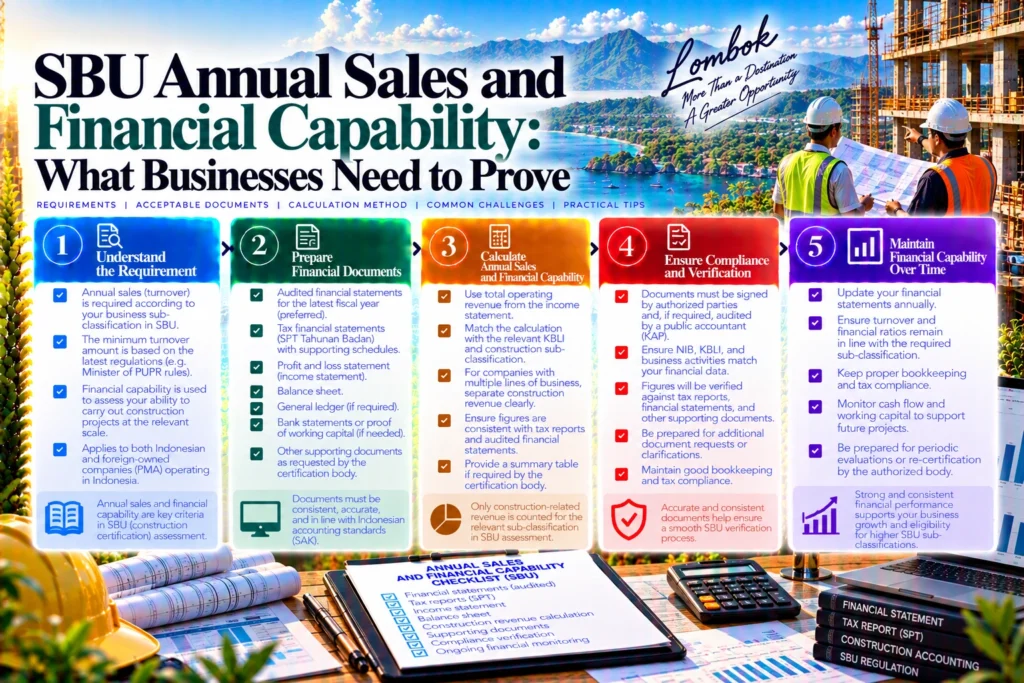
SBU Annual Sales and Financial Capability: Two Different Tests
For construction SBU purposes, annual sales and financial capability answer different questions. Annual sales shows relevant construction-business experience reflected through qualifying work, while financial capability examines the company’s financial position using the evidence required for its qualification level.
For general construction business entities, the eligibility assessment considers annual sales, financial capability, construction personnel availability, and equipment capability under Minister of Public Works and Housing Regulation No. 8 of 2022.
That distinction matters when preparing a new SBU application, renewal, or qualification upgrade. A company can have significant contract experience but still need separate financial evidence, and a company with a strong balance sheet still needs to demonstrate the relevant experience required by the certification framework.
The official BPK regulatory database lists Minister of Public Works and Housing Regulation No. 8 of 2022 as in force, with an effective date of 1 August 2022. As of the current review, OSS lists the construction SBU as an available PB-UMKU in the public works sector on the official OSS construction SBU page.
How Annual Sales Is Assessed
Annual sales in SBU assessment is not simply a figure copied from a general income statement. The certification framework connects annual sales to construction experience that can be substantiated through project records.
Under Minister of Public Works and Housing Regulation No. 8 of 2022, annual sales are evidenced by construction-work contract records validated by the project owner and recorded as the BUJK’s experience.
This makes document consistency important. Contract identity, project scope, business entity name, work value, relevant subclassification, and the experience recorded in the integrated construction information system should be reviewed together rather than as separate files.
The same regulation also allows annual-sales assessment to consider accumulated sales within SBU validity periods for up to three consecutive previous renewal periods, subject to the applicable certification conditions described in Regulation No. 8 of 2022.
For a business planning an upgrade, the practical question is therefore not only how much revenue the company has generated, but whether the relevant construction experience is properly documented, recorded, and aligned with the subclassification being proposed.
How Financial Capability Is Assessed
Financial capability is a separate test based on the company’s financial position. For general BUJK, the regulation distinguishes the evidence expected according to qualification.
For small BUJK, financial capability is derived from total equity in the company’s balance sheet, while medium and large BUJK use total equity in a balance sheet audited by a registered public accounting firm under Regulation No. 8 of 2022.
For this assessment, total equity is calculated as the difference between assets and total liabilities under Regulation No. 8 of 2022.
Under Article 4(3) of Regulation No. 8 of 2022, a new SBU application is made through OSS using Single Sign On on the PB-UMKU menu connected to integrated SIJK, and the applicant submits SBU requirement data and documents through integrated SIJK, including annual-sales and financial-capability or asset data.
For specialist BUJK, the eligibility assessment uses annual sales, asset value, construction personnel availability, and equipment capability rather than the general-BUJK financial-capability criterion under Regulation No. 8 of 2022.
Why a High Contract Value Does Not Automatically Prove Financial Capability
A large completed contract can support annual-sales or experience evidence, but it does not by itself establish the company’s current equity position. Contract value and balance-sheet equity measure different things.
For example, a company may have delivered substantial projects while also carrying significant liabilities. The SBU review therefore should not be prepared on the assumption that project turnover automatically satisfies the financial-capability component.
Why Strong Equity Does Not Replace Construction Experience
The reverse is also important. Strong equity can support the financial-capability assessment, but it does not replace the need for properly recorded construction experience where annual-sales evidence is required.
An investor or company owner should therefore avoid preparing only audited accounts while leaving contract history, project validation, or SIJK experience records unresolved.
Evidence Checklist Before SBU Submission or Renewal
Before filing, the following table helps reconcile the main evidence categories as one package rather than reviewing financial and experience records in isolation.
| Check | What to confirm |
|---|---|
| Proposed SBU scope | Confirm the classification, subclassification, and intended qualification before testing the evidence |
| Construction contracts | Confirm the contracting entity, project owner, work scope, value, and supporting completion or experience records |
| SIJK experience | Check that relevant construction experience is recorded consistently with the supporting contracts |
| Annual-sales evidence | Confirm that the experience being relied on is relevant to the proposed certification scope |
| Balance sheet | Confirm assets, liabilities, and resulting equity are internally consistent |
| Audit requirement | For medium and large general BUJK, confirm that the financial statements relied on for equity assessment meet the audit requirement described in Regulation No. 8 of 2022 |
| Specialist status | Check whether specialist-BUJK asset criteria apply instead of assuming the general financial-capability test |
| Application data | Reconcile information submitted through integrated SIJK with the underlying contracts and financial statements |
This reconciliation is particularly useful before an upgrade request because it lets the business compare the proposed qualification with both its construction experience and its financial evidence before submission.
Common Review Problems
One common issue is treating annual sales as ordinary company turnover without checking whether the amount is supported by relevant construction experience. Another is relying on a balance-sheet figure without confirming whether the required audit status applies to the company’s qualification.
A third problem is evidence mismatch. The contract may describe one scope, the proposed SBU application may use another subclassification, and the recorded project experience may not clearly reconcile the two. That is primarily an evidence-mapping problem rather than something solved by adding more documents.
Businesses should also distinguish a general construction BUJK from a specialist BUJK before applying financial criteria because Regulation No. 8 of 2022 assesses financial capability for general BUJK and asset value for specialist BUJK.
For a broader overview of certification services and related preparation, readers can also review the business certification page.
Conclusion
The key rule for SBU preparation is simple: annual sales and financial capability are separate evidence tracks. Annual sales is tied to relevant construction experience and supporting contract records, while financial capability is tied to the company’s financial position and the evidence required for its qualification.
Before submitting, renewing, or upgrading an SBU, reconcile the proposed subclassification, contract experience, SIJK records, balance-sheet equity, audit status, and any specialist-BUJK asset requirement. That approach provides a more reliable basis for identifying evidence gaps before the certification assessment begins.
Prepare Your SBU Evidence Before Filing
If your business needs help reviewing construction experience, financial evidence, qualification, and supporting certification documents before an SBU application or renewal, Lombok Legal ID can assist with business certification preparation.
A document review can help identify inconsistencies between contracts, SIJK records, financial statements, and the proposed certification scope before submission.
For help coordinating the documents and next steps discussed above, review our business certification in Lombok.
Read More: Business Certification Guide Lombok: Construction SBU, SKK and Electrical SBU
FAQ SBU Annual Sales
Is annual sales the same as company revenue for SBU purposes?
Not necessarily. For SBU assessment, annual-sales evidence is linked to construction-work experience and supporting contract records. Businesses should verify that the experience relied on is recorded and relevant to the proposed certification scope rather than assuming that general accounting revenue alone is sufficient.
Do medium and large BUJK need audited financial statements for financial-capability assessment?
For general BUJK, Regulation No. 8 of 2022 states that medium and large qualification financial capability is derived from total equity in financial statements audited by a registered public accounting firm.
Can strong financial capability replace missing construction experience?
No. The two criteria serve different purposes. Financial capability addresses the company’s financial position, while annual-sales evidence addresses relevant construction-business experience where that criterion applies.
References & Sources
- Minister of Public Works and Housing Regulation No. 8 of 2022 on Procedures for Fulfilling Construction Services Standard Certificates — jdih.pu.go.id
- Official Regulatory Status: Minister of Public Works and Housing Regulation No. 8 of 2022 — peraturan.bpk.go.id
- Construction Business Entity Certificate (SBU) — oss.go.id