

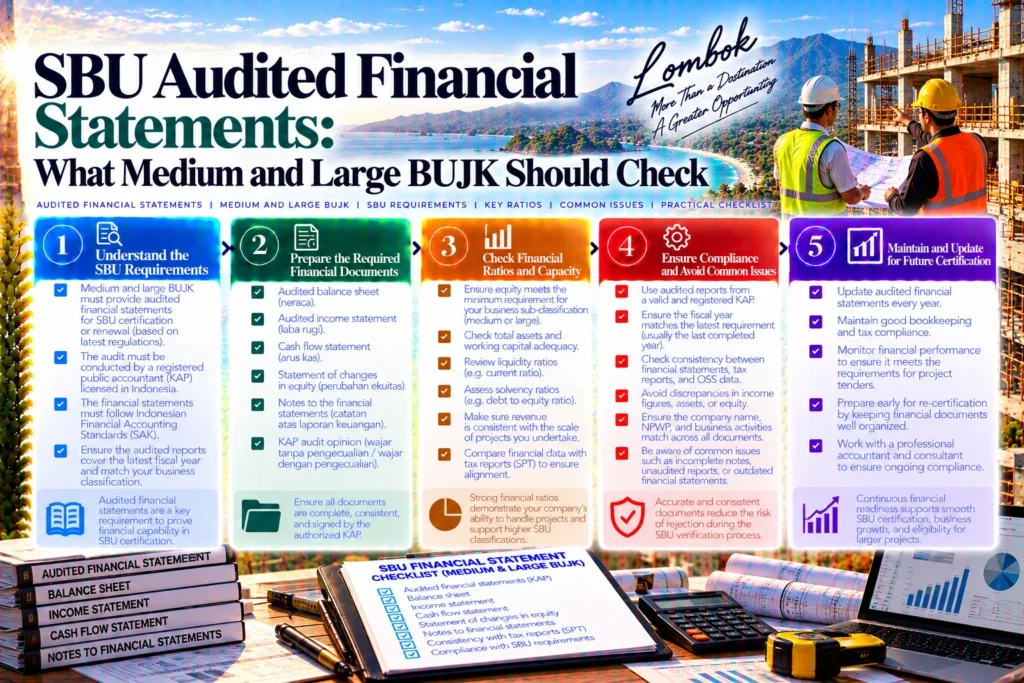
SBU Audited Financial Statements: The Core Requirement
For medium and large general BUJK, audited financial statements are directly relevant to the SBU financial-capability assessment. The regulation does not simply ask whether the company has an audit report; it ties financial capability to total equity shown in the BUJK’s audited balance sheet.
Under Minister of Public Works and Housing Regulation No. 8 of 2022, qualification assessment for a general BUJK examines annual sales, financial capability, construction personnel availability, and equipment capability. The official BPK regulatory database currently lists Minister of Public Works and Housing Regulation No. 8 of 2022 as in force, with an effective date of 1 August 2022.
The official OSS construction SBU page currently lists the construction SBU as an available PB-UMKU in the public works and housing sector.
What the Regulation Actually Measures
Article 11 of Regulation No. 8 of 2022 states that fulfillment of the financial-capability requirement is determined according to the BUJK’s business qualification.
For medium and large general BUJK, the same Regulation No. 8 of 2022 provides that financial capability is obtained from total equity in the BUJK’s balance sheet resulting from an audit by a registered public accounting firm in accordance with applicable laws and regulations.
For this SBU assessment, total equity is calculated as the difference between assets and total liabilities under Article 11 of Regulation No. 8 of 2022.
That formula is important for document preparation. Revenue, project value, bank balance, paid-up capital, total assets, and equity describe different financial concepts. A company should therefore avoid using one of those figures as a substitute for the regulatory equity figure merely because it appears larger or is easier to document.
Audit Requirement for Medium and Large General BUJK
The audit requirement should be read together with the company’s qualification. By comparison, Article 11 states that financial capability for a small BUJK is obtained from total equity in its balance sheet, while the registered-public-accountant audit requirement is expressly stated for medium and large BUJK in Regulation No. 8 of 2022.
For a business moving from a small qualification toward a medium qualification, this distinction affects document readiness. The financial records used for the new qualification should be reviewed before filing so the company does not assume that the documentation used at a lower qualification automatically satisfies the evidence basis for the higher one.
General BUJK and Specialist BUJK Are Not the Same
The audited-equity rule discussed above applies to the financial-capability assessment for general BUJK. The distinction is important because specialist BUJK are assessed using annual sales, asset value, construction personnel availability, and equipment capability rather than the general-BUJK financial-capability criterion under Regulation No. 8 of 2022.
A company should therefore establish whether the proposed SBU scope is treated as general or specialist before using this article as its financial-document checklist. Applying the right financial concept to the wrong business category can create an avoidable evidence mismatch.
Specialist status does not mean audit evidence can be ignored: Article 12 separately bases the specialist asset assessment on the assets shown in a balance sheet audited by a registered public accounting firm. Confirm the applicable measurement before choosing the financial package.
What to Check Before Using the Financial Statements
The regulatory rule is relatively concise, but the supporting documents still need to tell a consistent story. Before relying on audited financial statements for an SBU application, renewal, change, or qualification upgrade, review the financial package against the exact company and certification scope being submitted.
Check the Entity and Reporting Documents
Start with company identity. The audited financial statements, balance sheet, corporate records, and SBU application should refer to the same legal entity. Review the company name and other identifying information for discrepancies that may have resulted from amendments or outdated documentation.
Next, locate the balance sheet used in the audited financial statements and identify the asset, liability, and equity figures. The SBU financial-capability rule focuses on total equity, so the relevant amount should be traceable to the audited financial statements rather than reconstructed from unrelated management figures.
Also confirm that the audit documentation being relied on is actually associated with the balance sheet submitted for the certification review. The purpose of this check is not to predict whether an LSBU will approve the application; it is to prevent the applicant from presenting financial figures drawn from different reporting documents as though they were one evidence set.
Check Equity, Not Just Revenue or Cash
A profitable company can still have a different equity position from what its revenue suggests. Likewise, a substantial bank balance does not by itself establish the total equity used by the SBU financial-capability provision because liabilities form part of the calculation.
For contract and experience evidence, use the separate SBU annual sales and financial capability guide. This distinction also separates financial capability from annual sales. Annual sales is another component of general-BUJK qualification assessment, but audited financial statements do not replace the construction-experience evidence relevant to that separate criterion.
For investors reviewing a contractor before a qualification change, it is useful to ask two different questions: does the company have the construction experience relevant to the proposed SBU scope, and does its financial evidence support the applicable financial-capability assessment? Combining those questions into a single revenue or capital figure can conceal gaps in the supporting documents.
How Audited Financial Statements Fit With Other SBU Evidence
Audited financial statements are only one part of the overall eligibility assessment for a general BUJK. Under Regulation No. 8 of 2022, general-BUJK qualification assessment also covers annual sales, construction personnel availability, and equipment capability.
That means a compliant audit does not by itself establish every SBU criterion. Financial preparation should be coordinated with the company’s proposed classification, subclassification, qualification, recorded experience, personnel evidence, and equipment evidence rather than completed as an isolated accounting exercise.
For a broader view of the certification services connected with Construction SBU, readers can review Lombok Legal ID’s business certification services, which includes Construction SBU within its verified service scope.
Before submission, a practical review should therefore confirm the proposed BUJK category and qualification, identify the audited balance sheet being relied on, trace the reported total equity to that document, and compare the financial evidence with the other records prepared for the same certification application.
Conclusion
For medium and large general BUJK, the key SBU financial-statement issue is not merely whether an audit exists. The regulatory test uses total equity in the BUJK balance sheet resulting from an audit by a registered public accounting firm, and Article 11 defines that equity as assets minus total liabilities.
Businesses preparing an SBU application or qualification change should first confirm that the general-BUJK rule applies, then reconcile the audited balance sheet, equity figure, company identity, qualification, and other SBU evidence. This keeps the financial package aligned with the actual certification criterion instead of relying on revenue, cash, capital, or project value as substitutes for audited equity.
Review Your SBU Financial Evidence Before Submission
If your company is preparing an SBU application, renewal, or qualification change, Lombok Legal ID can assist with business certification preparation and document review.
A pre-filing review can focus on whether the financial statements, qualification, company records, and other certification evidence are consistent before the application is submitted.
For help coordinating the documents and next steps discussed above, review our business certification in Lombok.
Read More: Business Certification Guide Lombok: Construction SBU, SKK and Electrical SBU
FAQ SBU Audited Financial Statements
Do medium and large BUJK need audited financial statements for SBU financial capability?
For general BUJK, Regulation No. 8 of 2022 states that financial capability for medium and large qualifications is obtained from total equity in the BUJK balance sheet resulting from an audit by a registered public accounting firm in accordance with applicable laws and regulations.
What financial figure is used for the SBU financial-capability assessment?
Article 11 uses total equity. For this provision, total equity is calculated as the difference between assets and total liabilities.
Is revenue the same as financial capability for SBU purposes?
No. Annual sales and financial capability are separate components of general-BUJK qualification assessment. The financial-capability provision for medium and large BUJK focuses on total equity in an audited balance sheet.
Does the same audited-equity rule apply to specialist BUJK?
The regulation distinguishes specialist BUJK from general BUJK. Specialist BUJK eligibility assessment uses asset value rather than the general-BUJK financial-capability criterion, so the business category should be confirmed before applying the audited-equity guidance.
References & Sources
- Minister of Public Works and Housing Regulation No. 8 of 2022 on Procedures for Fulfilling Construction Services Standard Certificates — peraturan.bpk.go.id
- Official Regulatory Status for Minister of Public Works and Housing Regulation No. 8 of 2022 — peraturan.bpk.go.id
- Construction Business Entity Certificate (SBU) — oss.go.id