SKK Validity and Role Mapping: Three Checks, Not One
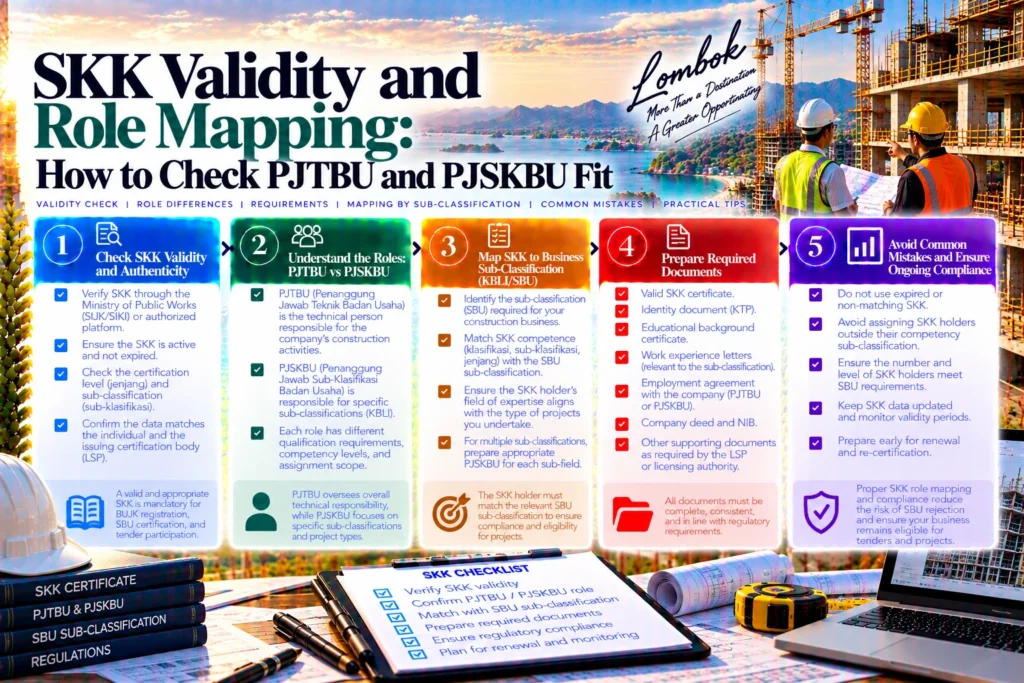
An SKK should not be treated as usable for a company role merely because the holder has a certificate. A reliable SKK validity and role mapping review separates three questions: is the certificate valid for the relevant situation, does its job position and qualification match the competence being relied on, and does that competence fit the intended role inside the BUJK’s certification structure?
Under Minister of Public Works and Housing Regulation No. 8 of 2022, SKK Konstruksi is evidence recognizing the competence of a construction worker, while construction-worker knowledge, skills, and experience are evidenced through that certification. The official BPK regulatory database currently lists Minister of Public Works and Housing Regulation No. 8 of 2022 as in force, effective from 1 August 2022.
That means certificate ownership is the starting point, not the full mapping exercise. For a company preparing or reviewing its SBU personnel evidence, the SKK should be read together with the job position, qualification level, classification or subclassification context, and the BUJK role the person is expected to support.
Start With the Job Position and Qualification on the SKK
For role mapping, the same Regulation No. 8 of 2022 requires applicants to submit SKK data and documents according to the certification scheme for the selected job position and application type.
The regulation further states that an SKK application refers to the established job positions and the conversion of classification, subclassification, and qualification for construction job positions under Article 22 of Regulation No. 8 of 2022.
For a BUJK owner, this creates an important practical distinction. Two workers may both hold SKK certificates, but their certified job positions or qualification levels may address different technical functions. The safer review is therefore to compare the certificate’s exact job-position information with the role and subclassification the company is trying to support rather than using the label “has SKK” as the only criterion.
Education and Experience Still Matter
During verification, the LSP checks the completeness and conformity of SKK application documents with the certification scheme, including the applicant’s education and experience, under Article 26 of Regulation No. 8 of 2022.
This matters when reviewing an existing certificate for a new company role. A higher-sounding job title should not be assumed to cover every lower, adjacent, or differently classified technical function. The correct question is whether the certification scheme and qualification represented by that SKK correspond to the role being relied on.
For readers who need broader assistance with obtaining or assessing an SKK, Lombok Legal ID has a dedicated Building Construction SKK service page explaining its certification support scope.
Use the Role Map as a Separate Check
After checking certificate status and the certified job position, compare the proposed assignment with the company’s current SBU scope. For the role rules, use our PJTBU and PJSKBU requirements guide; for the number of subclassifications and personnel coverage, use the PJSKBU subclassification mapping guide. This article focuses on the validity and certificate checks before that assignment is relied on.
Check SKK Validity and Renewal Separately
Validity should be checked independently from technical role suitability. A certificate can match a relevant job position but still require a validity or renewal review before it is relied on for a current certification process.
One explicit validity rule in the verified regulation concerns the special fresh-graduate route: an SKK for expert qualification level 7 issued under Article 28(1) has a validity period of one year under Article 28(6) of Regulation No. 8 of 2022.
That special rule should not automatically be generalized to every SKK category. For other certificates, a practical review should use the validity information recorded on the actual certificate and the applicable current certification scheme instead of assuming that every SKK has the same term merely from a secondary summary.
For expert qualifications, Regulation No. 8 of 2022 requires evidence of sufficient continuing professional development credits for renewal, and Article 23 states that an expert applying after the SKK has expired still follows the renewal procedure and must satisfy the applicable credit requirement.
This distinction is useful for compliance planning: an expired expert certificate is not treated as a reason to disguise the case as an entirely unrelated new certification request for the same job position. The renewal pathway and its professional-development evidence should be reviewed first. Use our separate SKK expert renewal guide for the continuing-professional-development checklist.
Practical SKK Mapping Checklist Before SBU Review
Before relying on a person’s SKK for a BUJK certification review, work through the evidence in a fixed sequence. First, identify the exact certificate holder and confirm the certificate being reviewed. Next, record the certified job position, qualification level, classification and subclassification information available in the certificate or certification record.
Then identify the intended BUJK function: PJTBU, PJSKBU, or another personnel requirement. Compare that function with the company’s actual or proposed SBU classification and subclassification. For PJSKBU, also check how many subclassifications the person is intended to cover and whether they remain within the same classification.
After technical mapping, check the employment position and whether the person is being relied on by another BUJK. Finally, review the certificate’s validity or expiry information and, where an expert-level renewal is involved, determine whether the required continuing professional development evidence is ready.
This sequence prevents two common reasoning errors: treating an active certificate as automatically suitable for every company role, or treating a technically relevant SKK as usable without first checking its current certification status and company assignment.
Conclusion
SKK role mapping is more than checking whether a construction professional owns a certificate. A defensible review connects the certificate’s current status with its certified job position and qualification, then maps that competence to the specific PJTBU or PJSKBU requirement and the BUJK’s classification and subclassification structure.
For owners and investors reviewing construction-company certification, the practical order is therefore validity first, competency and job-position alignment second, and BUJK role and subclassification mapping third. Keeping those checks separate makes it easier to identify whether the issue is an expired certificate, an unsuitable qualification, or simply the wrong personnel mapping before an SBU application or change is submitted.
Review SKK and BUJK Role Alignment Before Filing
If your company is preparing an SBU application, personnel change, or certification review, Lombok Legal ID can assist with business certification preparation and SKK document review.
The review can focus on certificate status, job-position and qualification alignment, subclassification coverage, and the intended PJTBU or PJSKBU role before submission.
For help coordinating the documents and next steps discussed above, review our business certification in Lombok.
Read More: Business Certification Guide Lombok: Construction SBU, SKK and Electrical SBU
FAQ SKK Validity
Does an active SKK automatically qualify someone to become PJTBU or PJSKBU?
No automatic conclusion should be made from validity alone. The SKK’s job position and qualification must be compared with the applicable BUJK personnel role and the company’s classification and subclassification requirements.
Can one PJSKBU cover several subclassifications?
Regulation No. 8 of 2022 states that one PJSKBU may cover a maximum of five subclassifications within one classification at one BUJK, subject to the applicable qualification and field-of-study requirements.
What happens if an expert SKK has already expired?
Article 23 of Regulation No. 8 of 2022 states that renewal after expiry still follows the SKK renewal procedure for expert qualifications and requires fulfillment of the applicable continuing professional development credit requirements.
Are all SKK certificates valid for one year?
No. The one-year period verified in Regulation No. 8 of 2022 specifically applies to the special fresh-graduate expert-level-7 SKK route under Article 28. Other SKK validity periods should be checked from the actual certificate and the applicable current certification scheme rather than generalized from that exception.