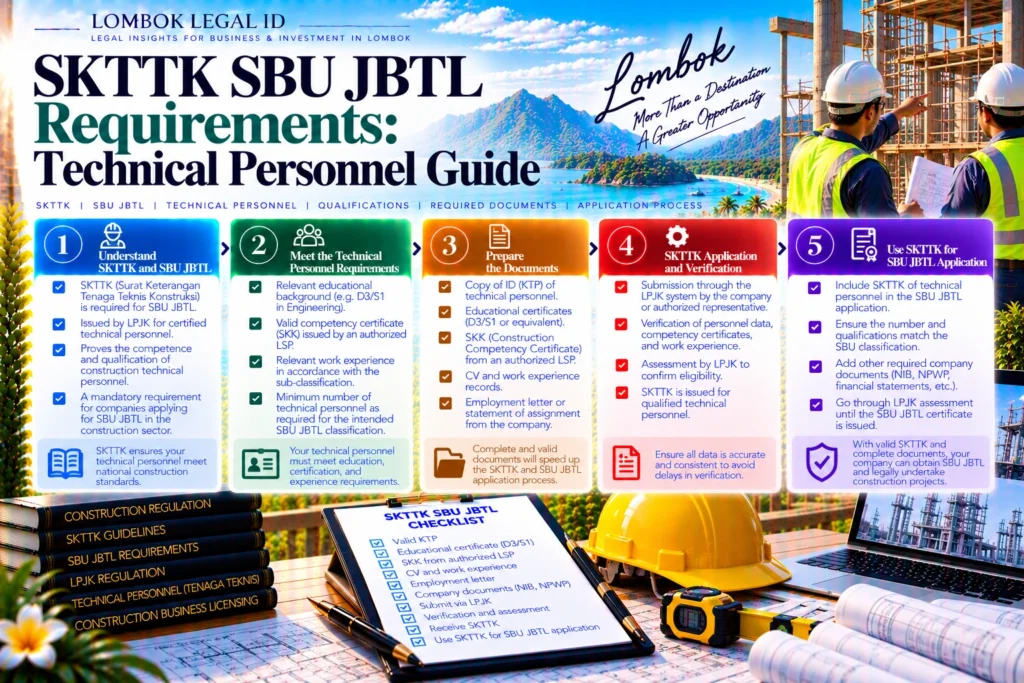
Technical personnel can determine whether an Electrical SBU JBTL application is properly qualified, but the terminology is often misunderstood. Under the current regulation, SKTTK is the competency standard, while the individual technical worker holds a Sertifikat Kompetensi showing formal recognition of that person’s competency classification and qualification.
The current individual competency framework is Minister of Energy and Mineral Resources Regulation No. 6 of 2021, which the official BPK database lists as in force.
For the wider company-certification context, Lombok Legal ID’s business certification services cover Electrical SBU (JBTL) alongside other certification categories. This article focuses specifically on the technical-personnel competency side of an SBU JBTL application.
SKTTK SBU JBTL Requirements: First Clarify the Terminology
Article 1 defines SKTTK as Standar Kompetensi Tenaga Teknik Ketenagalistrikan, while the individual proof of recognized classification and qualification is called a Sertifikat Kompetensi under the official regulation.
This distinction matters when preparing an SBU file. Asking whether a person ‘has SKTTK’ is common industry shorthand, but the document being checked for an individual is the competency certificate and its registered competency scope.
The company-level framework remains Government Regulation No. 25 of 2021, which the official BPK database lists as in force.
Who Needs a Competency Certificate?
Article 28 requires every Tenaga Teknik and assessor working in an electricity business to hold a Sertifikat Kompetensi under Permen ESDM No. 6 of 2021.
That requirement should be read together with the company’s actual work. A technical person supporting an installation business should have competency relevant to that technical work rather than a certificate selected only because it is generally related to electricity.
Permen ESDM No. 6 of 2021 defines competency certification as the assessment process used to obtain formal recognition of the technical worker’s competency classification and qualification under the official text.
The practical question is therefore not only whether a certificate exists. The business should check what field, subfield and competency level that certificate actually recognizes.
Match the Certificate to the SBU Field and Subfield
Article 11 states that competency classification is arranged according to the field and subfield of work in the electricity business under the current competency regulation.
This makes scope matching central to an SBU application. A company requesting several JBTL classifications should map its technical personnel against each requested scope instead of building one generic personnel list for the entire company.
Field and subfield come before personnel selection
Start with the company’s intended SBU scope. Identify the service type, field and subfield, then determine which technical competencies support that scope.
For example, competency related to an installation-utilization area should not automatically be treated as interchangeable with competency for another installation field merely because both concern electricity. The certificate’s recorded classification should be reviewed against the SBU classification actually requested.
The detailed SBU certification framework remains Minister of Energy and Mineral Resources Regulation No. 12 of 2021, which is in force and revoked the former Regulation No. 38 of 2018.
Readers who need the company-level certification process rather than only the personnel rules can continue to Lombok Legal ID’s JBTL company-certification requirements guide, which covers the company-level certification checklist.
One person should not be assumed to cover every scope
A multi-scope application needs a scope-by-scope personnel review. The fact that one technical worker is competent in one classification does not by itself establish competency in every other requested field or subfield.
This is why personnel planning should be completed before the company expands the SBU application. Adding another technical scope can create a new competency requirement even when the corporate entity and other administrative documents remain unchanged.
Individual Competency Level Is Not the Same as Company Qualification
Two different qualification systems are involved.
At individual level, Article 24 states that the electricity competency qualification level is determined from criteria including work scope, skills and knowledge, information-processing ability, responsibility and work attitude under the regulation.
The regulation’s qualification framework contains nine electricity competency levels, from level 1 through level 9 in the SKTTK qualification framework.
At company level, the JBTL business may instead be classified into the applicable small, medium or large qualification. Those company labels should not be confused with the worker’s numbered electricity competency level.
A practical application review should therefore show two separate columns: company qualification requested and technical personnel competency supporting that qualification.
How Technical Personnel Affect SBU JBTL Qualification
Technical personnel are not merely supporting attachments to an SBU application.
Article 43 states that JBTL business qualification is determined from the business’s capability level and the competence of its technical personnel, with technical competence evidenced by competency certificates under the official regulation.
This creates a direct connection between the people named in the certification file and the qualification requested by the company. A technically strong company file therefore needs personnel whose recognized competencies correspond with the intended scope and qualification.
Article 32 requires a JBTL business to obtain the applicable Business Licensing and the Sertifikat Badan Usaha jasa penunjang tenaga listrik under Government Regulation No. 25 of 2021.
The personnel review should consequently be performed as part of the wider SBU and licensing strategy rather than after the certificate has already been submitted.
What to Check on a Technical Person’s Certificate
Before relying on a technical person’s certificate for an SBU application, check at least these elements:
- Identity. Confirm the certificate belongs to the person being proposed in the company file.
- Competency classification. Review the recorded field and subfield.
- Competency qualification. Confirm the level is appropriate for the role and requested business scope.
- Registration details. Check the certificate and registration data used in the electricity-sector system.
- Validity. Confirm the certificate remains valid at the time of filing and during the relevant certification process.
- Role in the company. Identify how the person supports the requested SBU qualification and technical responsibility structure.
- Scope overlap. Where one person is proposed for more than one scope, verify that each scope is actually covered by the person’s recognized competency.
Do not solve a personnel shortage by simply attaching another electricity-related certificate. The competency scope itself must support the work the company seeks to certify.
Seven Personnel Checks Before an SBU JBTL Application
Use this sequence before filing:
- Freeze the intended SBU scope. List every service, field and subfield the company plans to request.
- Create a personnel matrix. Put each requested scope in one column and the proposed competent person in another.
- Check individual competency classification. Make sure the field and subfield align with the requested SBU scope.
- Check competency level. Confirm the person’s qualification level is appropriate to the role being used in the certification file.
- Check certificate validity and registration. Do this before the application is uploaded, not after a deficiency notice appears.
- Check company qualification alignment. Compare the personnel profile with the small, medium or large qualification being requested.
- Recheck the matrix when adding a new scope. A new field or subfield may require different or additional competency coverage.
This personnel matrix is especially useful for companies applying for multiple JBTL scopes because it makes gaps visible before the certification process starts.
Conclusion
SKTTK SBU JBTL requirements are best understood by separating the standard, the individual and the company. SKTTK is the underlying technical competency standard; the worker holds a Sertifikat Kompetensi showing recognized competency classification and qualification; and the company uses competent technical personnel as part of supporting its requested SBU JBTL qualification.
The most important pre-application test is therefore alignment. The technical person’s field, subfield and competency level should match the SBU scope and company qualification being requested.
For owners and investors, reviewing that alignment before filing can prevent a technically valid certificate from being used for the wrong business scope.
Audit the Technical Personnel Before Filing the SBU
If your company in Lombok is preparing an Electrical SBU JBTL application, Lombok Legal ID can assist with business certification review, scope planning and technical-personnel document preparation based on the actual JBTL classification being requested.
A pre-filing personnel audit can help identify mismatches between competency certificates, field and subfield scope, company qualification and the intended SBU application.
For help coordinating the documents and next steps discussed above, review our business certification in Lombok.
Read More: Business Certification Guide Lombok: Construction SBU, SKK and Electrical SBU
FAQ SKTTK SBU JBTL Requirements
What does SKTTK mean?
Under Permen ESDM No. 6 of 2021, SKTTK means Standar Kompetensi Tenaga Teknik Ketenagalistrikan. It is the competency standard, not the name of the individual certificate.
What document does an individual technical worker hold?
The regulation calls the individual document a Sertifikat Kompetensi, which is formal recognition of the worker’s competency classification and qualification.
Does every technical worker in an electricity business need competency certification?
Yes. Article 28 of Permen ESDM No. 6 of 2021 requires every Tenaga Teknik and assessor working in an electricity business to hold a competency certificate.
Can any electrical competency certificate support an SBU JBTL?
Not automatically. The competency classification is organized by field and subfield, so the certificate should align with the SBU scope being requested.
Is an individual competency level the same as a small, medium or large SBU qualification?
No. Individual electricity competency uses its own qualification-level framework, while the company has a separate business qualification. The two are connected but are not the same classification.
Why do technical personnel matter for SBU qualification?
Article 43 of PP No. 25 of 2021 states that JBTL business qualification is determined from business capability and the competence of technical personnel, with competence evidenced by competency certificates.
Can one technical person be used for several SBU scopes?
That should be checked scope by scope. A person’s certificate should be reviewed to confirm that its field, subfield and competency qualification actually support each requested SBU classification.
References & Sources
- Minister of Energy and Mineral Resources Regulation No. 6 of 2021 on Standardization of Electricity Technical Personnel Competency — peraturan.bpk.go.id
- Official Text of Minister of Energy and Mineral Resources Regulation No. 6 of 2021 — peraturan.bpk.go.id
- Government Regulation No. 25 of 2021 on Administration of the Energy and Mineral Resources Sector — peraturan.bpk.go.id
- Official Text of Government Regulation No. 25 of 2021 — peraturan.bpk.go.id
- Minister of Energy and Mineral Resources Regulation No. 12 of 2021 on Classification, Qualification, Accreditation and Certification of Supporting Electricity-Service Businesses — peraturan.bpk.go.id