

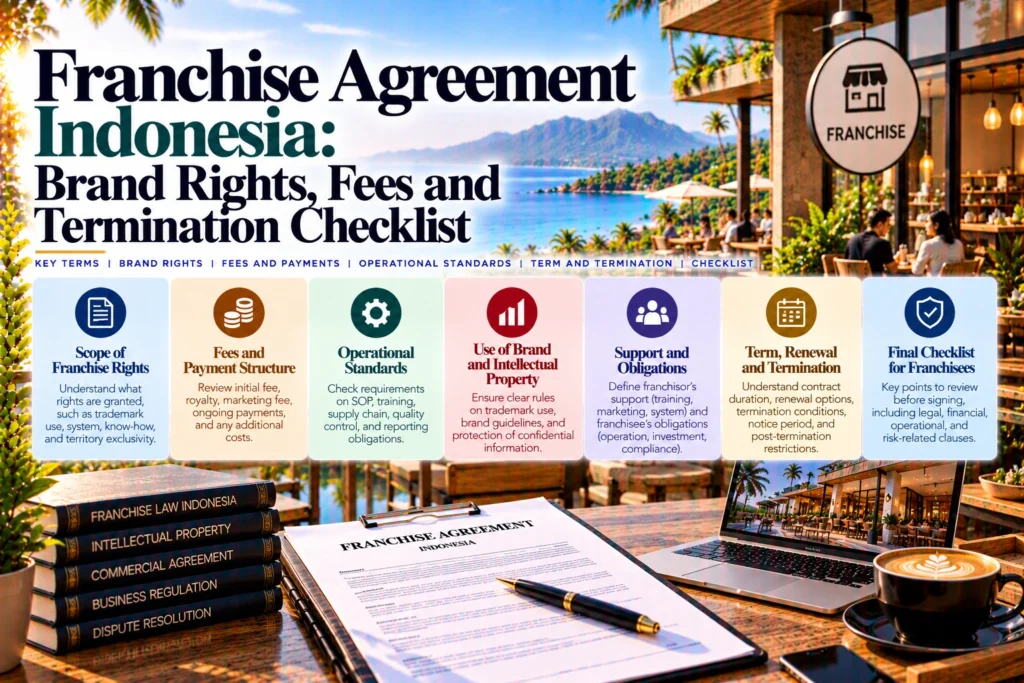
Franchise Agreement Indonesia: A franchise agreement in Indonesia does more than grant permission to use a brand. It should define the business system being licensed, the intellectual property the franchisee may use, the franchisor’s continuing support, the franchisee’s payment obligations, the territory, operating standards, renewal and termination rights, and the registration steps that follow.
For an owner or investor, the safest review is therefore not limited to the royalty percentage. The agreement should be checked against the pre-contract disclosure, the current Indonesian franchise regulation, and the commercial reality of operating the business after signing.
What a Franchise Agreement Must Accomplish
Indonesia’s current central franchise regulation is Government Regulation No. 35 of 2024, which has been in force since 2 September 2024 and revoked Government Regulation No. 42 of 2007.
The regulation treats franchising as a structured business relationship rather than a simple trademark licence. That distinction matters because a true franchise involves a business system, protected intellectual property, operating support, contractual rights and obligations, and registration requirements.
Before signing, an investor should therefore ask three separate questions: what was disclosed before the contract, what rights and duties appear in the final agreement, and what registrations are required before operations begin.
Franchise Agreement Indonesia: Regulatory Minimums to Check
The same Government Regulation No. 35 of 2024 requires the franchise relationship to be based on a written franchise agreement between parties with equal legal standing under Indonesian law and requires minimum clauses covering matters including protected intellectual property, the business activity and system, rights and obligations, operational and marketing support, territory, term, payment procedure, ownership transfer, dispute resolution, renewal and termination, and the number of outlets to be managed.
That list is a regulatory minimum, not a substitute for commercial drafting. A contract can contain every required heading and still leave an investor exposed if fee definitions, performance expectations, approval rights, supplier arrangements, audit access, digital assets, or exit mechanics remain vague.
Review the Offering Prospectus Before Negotiating the Final Contract
Under the official text of Government Regulation No. 35 of 2024, the franchisor or sub-franchisor must provide the Franchise Offering Prospectus to the prospective franchisee or sub-franchisee no later than 14 calendar days before the franchise agreement is signed.
The prospectus is therefore part of the pre-signing due-diligence process. Compare its description of the business system, business history, franchise network, rights and obligations, financial information, and intellectual property with the final contract.
Material differences should be resolved before signature. If the prospectus describes ongoing support, a particular business format, or specific rights but the final agreement narrows those commitments, the investor should understand which document controls and whether the commercial offer has changed.
Confirm Brand and Intellectual Property Rights
A franchisee should know exactly what it is buying the right to use. The agreement should identify the relevant trademarks, logos, operating systems, manuals, designs, recipes, software, copyrighted materials, trade secrets, or other protected elements that form part of the franchise system.
The regulatory minimum expressly addresses intellectual property that remains within its protection period. From a commercial perspective, the agreement should go further by explaining the permitted use, location, duration, quality controls, digital use, modifications, infringement reporting, and what happens if an important brand right expires or is challenged.
Check whether local marketing materials, social-media accounts, domain names, customer-facing apps, photographs, and translated brand content require prior approval. These assets can become significant during both operation and termination.
Make Fees and Financial Obligations Measurable
The regulation requires the agreement to address the procedure for paying compensation, but the parties still need to define the economics precisely.
The contract should separate initial fees, recurring royalties, marketing contributions, technology or system charges, training costs, renewal fees, supplier rebates, required refurbishment expenditure, and any other mandatory payment. If a royalty is percentage-based, define whether it applies to gross sales, net sales, revenue after refunds, or another base.
Also review currency, taxes where allocated by the contract, payment dates, late-payment consequences, audit rights, reporting obligations, and the records used to verify the calculation. A short phrase such as “royalty of X%” is incomplete if the agreement never defines the amount to which that percentage applies.
Define Territory, Outlet Rights, and Expansion
Territory is one of the required subjects under PP No. 35 of 2024, but investors should not assume that naming a city or island automatically creates exclusivity.
The agreement should state whether the franchisee receives exclusive, protected, or non-exclusive rights; whether the franchisor may open another outlet nearby; whether online sales or delivery channels are carved out; and whether another group company may compete using a different brand.
If expansion is expected, define whether additional outlets require separate agreements, new fees, performance conditions, or franchisor approval. Any right to appoint a sub-franchisee should also be written expressly rather than inferred from a general territorial grant.
Operating Support and Brand Standards
A franchise model depends on both standardization and continuing support. The agreement should specify what training, operational guidance, marketing assistance, manuals, technology access, inspections, and business-system updates the franchisor will provide.
Brand standards also need change-control rules. A franchisor may need to update menus, store layouts, software, uniforms, equipment, marketing systems, or service procedures, but the contract should explain who pays for material changes and how much implementation time the franchisee receives.
Procurement clauses deserve separate attention. If the franchisee must buy products, ingredients, furniture, software, or services from the franchisor or designated suppliers, check pricing mechanisms, alternatives when supply fails, quality requirements, and whether affiliate relationships or rebates are disclosed in the contract.
STPW and the Contract-to-Operation Sequence
Signing is not the end of the regulatory process. The 2024 franchise regulation also requires franchisors, sub-franchisors, franchisees, and sub-franchisees to hold a Surat Tanda Pendaftaran Waralaba, or STPW; the franchisor’s STPW is required before making the franchise agreement, while the franchisee’s STPW is required before starting the business.
This creates a practical sequence: review the franchise offering, confirm the franchisor’s regulatory position, negotiate and sign the contract, and complete the franchisee-side registration before operations begin.
The agreement should allocate responsibility for supplying registration documents, updating information when the arrangement changes, and cooperating if an authority requests additional material. Avoid assuming that execution of the contract itself authorizes the outlet to operate.
Termination, Renewal, and Post-Termination Brand Use
Termination provisions should answer both legal and operational questions. Review termination for material breach, non-payment, repeated brand-standard failures, insolvency, IP problems, loss of required registration, prolonged closure, or other agreed events.
Cure periods should be realistic and linked to the type of breach. A late report, unpaid fee, serious food-safety issue, misuse of a trademark, and abandonment of the outlet may justify different remedies.
Post-termination obligations deserve equal attention. The agreement should address removal of branding, return or destruction of manuals, deactivation of software, social-media and domain-name control, customer data, confidential information, remaining branded stock, supplier accounts, deposits, equipment, signage, and any continuing non-use or confidentiality obligations that are legally and contractually applicable.
Renewal should not be described merely as “subject to mutual agreement.” Investors should know whether renewal requires refurbishment, payment of a renewal fee, signing the franchisor’s then-current form, settlement of outstanding amounts, or compliance with new brand standards.
Language Rules for Foreign Franchisors and Franchisees
Separately, Law No. 24 of 2009 requires Bahasa Indonesia in agreements involving an Indonesian state institution, government institution, Indonesian private institution, or Indonesian citizen, while an agreement involving a foreign party is also written in that party’s national language and/or English.
Presidential Regulation No. 63 of 2019 further provides that the foreign-language or English text functions as the counterpart or translation of the Indonesian text and allows the parties to agree which language will be used if interpretations differ.
For an international franchise, prepare the language structure early. The Indonesian and foreign-language versions should match on fees, territory, intellectual property, operating standards, termination triggers, dispute resolution, guarantees, schedules, and defined terms rather than leaving translation until after commercial negotiation is complete.
Pre-Signing Checklist
Before signing, confirm that:
- the franchisor and franchisee legal entities are correctly identified
- the offering prospectus was received and reviewed before signature
- the franchisor’s STPW position has been checked
- protected intellectual property and permitted brand use are clearly identified
- the business system and operating standards are described consistently
- initial, recurring, marketing, technology, training, and renewal fees are defined
- the royalty calculation base can be independently verified
- territory and exclusivity rules are explicit
- opening additional outlets or sub-franchising requires clear authority
- ongoing training, marketing, operational, and technology support is specified
- mandatory suppliers and related-party procurement rules are understood
- reporting and audit rights are workable
- renewal conditions are measurable
- termination and cure provisions match the seriousness of different breaches
- de-branding, data, digital accounts, stock, manuals, and confidential information are covered at exit
- the required Indonesian and foreign-language or English texts are aligned where applicable
- franchisee-side STPW requirements are addressed before operations begin
For investors who need broader agreement-documentation context, Lombok Legal ID also maintains a verified guide to notary services and commercial documentation in Lombok.
Conclusion
A franchise agreement should be reviewed as both a regulated document and a long-term operating framework. PP No. 35 of 2024 establishes important minimum requirements, but an investor still needs to understand how the brand rights, territory, fees, support, procurement, reporting, renewal, and exit provisions will work in practice.
The strongest pre-signing process connects the prospectus, franchise agreement, intellectual-property rights, STPW sequence, and bilingual documents into one consistent transaction. If those pieces contradict one another, the discrepancy should be resolved before the franchisee commits capital or begins operations.
Review the Franchise Structure Before You Commit
If you are preparing, negotiating, or reviewing a franchise arrangement in Lombok, Lombok Legal ID can assist within its stated notary, business setup, agreement-documentation, and business licensing scope.
A tailored review is particularly useful where the franchisor is overseas, several fees or brand documents interact, the territory is commercially important, or the agreement leaves registration, intellectual property, renewal, or termination responsibilities unclear.
FAQ – Franchise Agreement Indonesia
What is the main regulation for franchise agreement Indonesia?
Government Regulation No. 35 of 2024 is the current central franchise regulation. It took effect on 2 September 2024 and revoked Government Regulation No. 42 of 2007.
How long before signing should a franchise prospectus be provided?
PP No. 35 of 2024 requires the franchisor or sub-franchisor to provide the Franchise Offering Prospectus no later than 14 calendar days before the franchise agreement is signed.
What clauses must an Indonesian franchise agreement contain?
PP No. 35 of 2024 requires minimum subjects including party details, protected intellectual property, the business activity and system, rights and obligations, support, territory, compensation arrangements, agreement term, ownership transfer, dispute resolution, renewal and termination, and outlet numbers. Commercial deals usually need additional detail beyond these minimum headings.
Does a franchisee need an STPW?
Yes. Under PP No. 35 of 2024, the franchisee or sub-franchisee must hold an STPW before starting the business, while the franchisor or sub-franchisor must hold its STPW before making the franchise agreement.
Does a foreign franchise agreement need Bahasa Indonesia?
Where an Indonesian institution or citizen is a party, Law No. 24 of 2009 requires Bahasa Indonesia. If a foreign party is involved, the agreement is also written in that party’s national language and/or English, with the parties able to address which language governs differences in interpretation under Presidential Regulation No. 63 of 2019.
References & Sources
- Government Regulation No. 35 of 2024 on Franchising — peraturan.go.id
- Official Text of Government Regulation No. 35 of 2024 on Franchising — peraturan.go.id
- Law No. 24 of 2009 on the National Flag, Language, State Emblem, and National Anthem — peraturan.bpk.go.id
- Presidential Regulation No. 63 of 2019 on the Use of Indonesian Language — peraturan.bpk.go.id
Recommended Next Articles
- notary services and commercial documentation in Lombok — lomboklegalid.com